
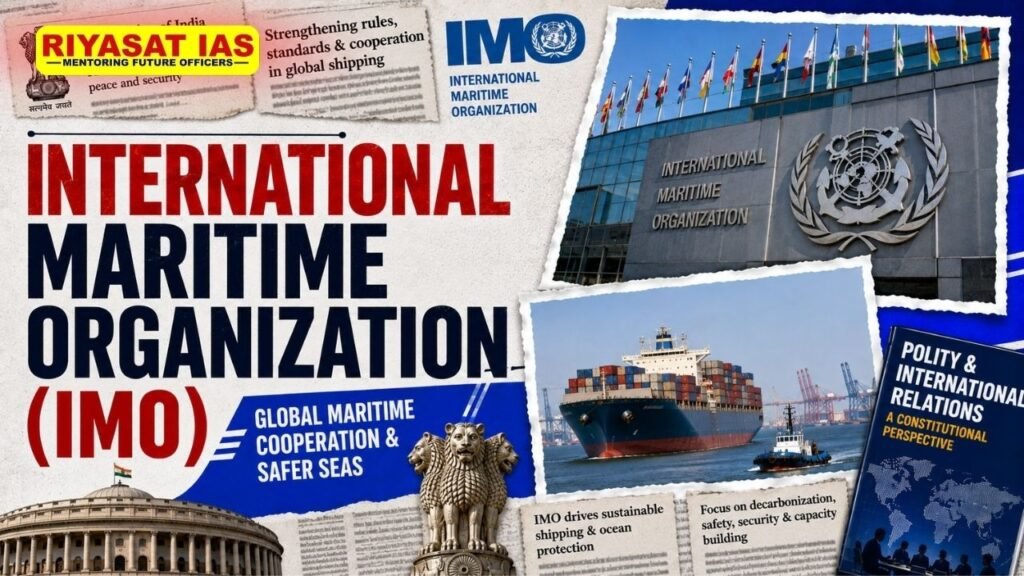
About IMO
The International Maritime Organization is a specialised agency of the United Nations that provides the global regulatory framework for international shipping. Its work primarily focuses on maritime safety, maritime security, prevention of marine pollution, facilitation of international shipping and sustainable maritime transport.
The Convention was adopted on 6 March 1948, and the organisation held its first meeting in January 1959. Its headquarters are located in London, United Kingdom. The IMO currently has 176 Member States and 3 Associate Members. India became a member in 1959.
The IMO operates through the Assembly, Council and specialised committees, with the Assembly serving as the highest governing body. The Council is the executive organ and consists of 40 Member States for the 2026–27 biennium.
Objectives of IMO
· The IMO aims to promote safe, secure and efficient international shipping by developing common international rules and standards for ships and maritime activities.
· It seeks to prevent marine pollution caused by ships and promote environmentally sustainable practices in the maritime sector.
· The organisation also works to facilitate international maritime traffic by harmonising procedures and reducing unnecessary administrative barriers.
· The IMO supports developing countries through technical cooperation, capacity building and implementation assistance so that international maritime standards can be effectively applied across countries.
Major Functions of IMO
· Maritime Safety: The IMO develops international standards concerning the construction, equipment and operation of ships to protect human life and improve safety at sea.
· Maritime Security: It develops international measures against piracy, armed robbery, terrorism and other unlawful acts threatening maritime navigation and port facilities.
· Prevention of Marine Pollution: The organisation establishes international rules to prevent pollution of the marine environment by oil, chemicals, sewage, garbage and harmful substances discharged from ships.
· Standards for Seafarers: The IMO establishes minimum international standards for the training, certification and watchkeeping of seafarers, particularly through the STCW Convention.



· Navigation and Collision Prevention: The IMO develops common rules for safe navigation and prevention of collisions between vessels, including internationally recognised traffic separation schemes under COLREGs.
· Search and Rescue: It develops international frameworks for coordinating maritime search-and-rescue operations and improving the safety of people at sea.
· Facilitation of Maritime Traffic: The IMO works to simplify and harmonise procedures relating to international maritime traffic, port formalities, documentation and clearance procedures.
· Climate Action and Decarbonisation: The IMO is developing measures to reduce greenhouse-gas emissions from international shipping and promote cleaner fuels, energy-efficient ships and a transition towards sustainable maritime transport.
Major IMO Conventions
· SOLAS, 1974: The International Convention for the Safety of Life at Sea (SOLAS), 1974 establishes minimum standards for the construction, equipment and operation of ships compatible with their safety. It is regarded as one of the most important international treaties concerning merchant-ship safety.
· MARPOL, 1973/78: The International Convention for the Prevention of Pollution from Ships (MARPOL) is the principal international treaty dealing with the prevention of marine pollution caused by ships. It covers pollution from oil, chemicals, sewage, garbage and air emissions.
· STCW, 1978: The International Convention on Standards of Training, Certification and Watchkeeping for Seafarers (STCW), 1978 establishes minimum international requirements for the training, certification and watchkeeping of seafarers.
· COLREG, 1972: The Convention on the International Regulations for Preventing Collisions at Sea (COLREG), 1972 establishes international rules governing the conduct of vessels to prevent collisions at sea.
· SAR Convention, 1979: The International Convention on Maritime Search and Rescue (SAR), 1979 establishes an international framework for cooperation and coordination in search-and-rescue operations at sea.
· SUA Convention, 1988: The Convention for the Suppression of Unlawful Acts Against the Safety of Maritime Navigation (SUA), 1988 provides an international legal framework for addressing unlawful acts that threaten the safety of maritime navigation.
· FAL Convention, 1965: The Convention on Facilitation of International Maritime Traffic (FAL), 1965 seeks to simplify and reduce unnecessary formalities, documentation and procedures associated with international maritime traffic.
· Polar Code: The International Code for Ships Operating in Polar Waters, commonly known as the Polar Code, establishes mandatory requirements relating to ship design, equipment, operations, training, search and rescue and environmental protection in polar waters. It became mandatory through amendments to SOLAS and MARPOL from 1 January 2017.
India and IMO
· India has been an IMO Member since 1959 and is currently a member of the IMO Council for the 2026–27 biennium under Category B, which consists of States having a significant interest in international seaborne trade.
· India’s participation in the IMO is important because of its long coastline, large maritime trade, major ports, extensive merchant shipping interests and strategic location in the Indian Ocean.
· India works with the IMO on issues concerning maritime safety, maritime security, seafarer standards, prevention of marine pollution, sustainable shipping and maritime connectivity.
· India’s position on the IMO Council also enables it to participate in shaping international maritime regulations and standards that directly affect its trade, ports, shipping industry and maritime security interests.
· India’s maritime interests are particularly connected with the security of major sea lanes in the Indian Ocean Region, as disruptions in maritime routes can affect India’s trade, energy supplies and wider economic security.
FAQs
1. When was IMO established?
The IMO Convention was adopted in 1948, and the organisation began functioning with its first meeting in 1959.
2. How many members does IMO have?
The IMO currently has 176 Member States and 3 Associate Members.
3. Where is IMO headquartered?
The IMO headquarters are located in London, United Kingdom.
4. Which IMO convention deals with marine pollution?
The MARPOL Convention is the principal international treaty dealing with pollution caused by ships.
5. What is India’s current position in IMO?
India is a Category B member of the IMO Council for 2026–27, representing States with a significant interest in international seaborne trade.


 Ravi Raaz
 Hassan Khan
 Shadab Ali