
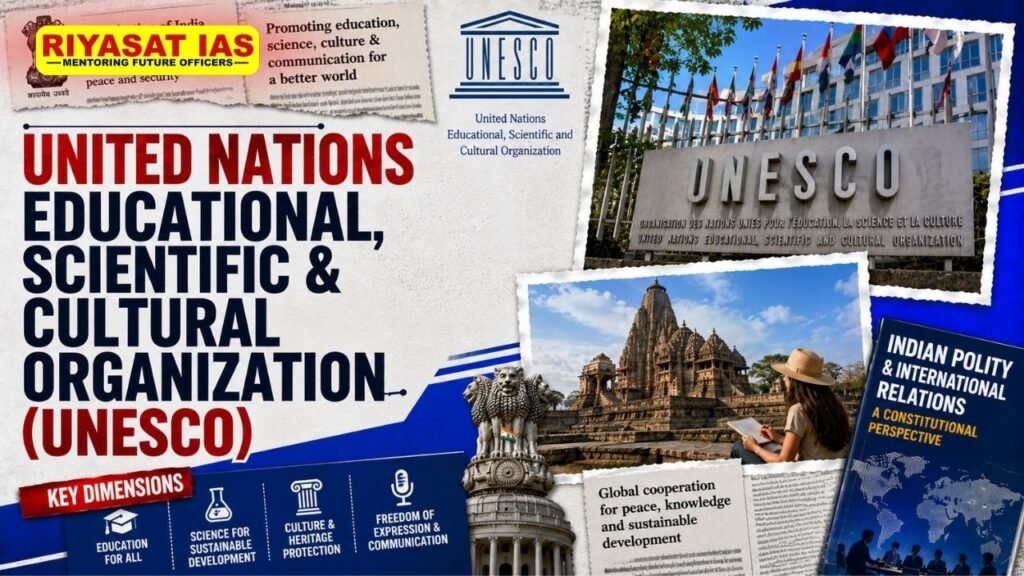
What is UNESCO?
· The United Nations Educational, Scientific and Cultural Organization (UNESCO) is a specialised agency of the United Nations that promotes international cooperation in education, science, culture, communication and information with the broader objective of building peace and sustainable development. UNESCO also develops international standards, generates knowledge and supports countries in addressing global challenges such as climate change, technological disruption, misinformation and threats to cultural heritage.
It has currently 194 Member States and 12 Associate Members, and its headquarters are located in Paris, France.
Establishment and Historical Background
It is emerged from the experience of the Second World War, when countries recognised that lasting peace could not be secured only through political and economic arrangements and required greater intellectual and cultural cooperation.
· A conference was convened in London in November 1945 to establish an educational, scientific and cultural organisation. The UNESCO Constitution was signed on 16 November 1945 and entered into force on 4 November 1946 after ratification by 20 signatories.
· The organisation’s constitutional philosophy is captured in the famous idea that “since wars begin in the minds of men, it is in the minds of men that the defences of peace must be constructed.”
· India was among the 20 founding Member States that first ratified the UNESCO Constitution in 1946.
Objectives of UNESCO
· Promoting Peace through Education and Culture: It seeks to strengthen peace by promoting international cooperation in education, science, culture, communication and information.
· Ensuring Inclusive and Quality Education: It works towards equitable, inclusive and quality education and lifelong learning opportunities, particularly in the context of SDG 4.
· Promoting Scientific Cooperation: It facilitates international scientific cooperation and promotes the use of science, technology and innovation for sustainable development and environmental protection.
· Protecting Cultural and Natural Heritage: It works to identify, protect and preserve cultural, natural, documentary and intangible heritage considered important to humanity.
· Promoting Freedom of Expression and Access to Information: UNESCO supports freedom of expression, media development, access to information and information literacy, while addressing challenges such as misinformation and digital-platform governance.
· Building Inclusive and Sustainable Societies: UNESCO promotes intercultural dialogue, tolerance, cultural diversity, gender equality and respect for human rights as foundations for peaceful and sustainable societies.
Major UNESCO Initiatives and Programmes



· World Heritage Convention
o The 1972 Convention concerning the Protection of the World Cultural and Natural Heritage created the framework for identifying and protecting sites having Outstanding Universal Value.
o The World Heritage List covers both cultural and natural heritage, while the World Heritage Convention also provides mechanisms for international cooperation and assistance.
o As of July 2026, the UNESCO World Heritage List contains 1,273 properties worldwide, while India has 45 World Heritage properties, comprising 37 cultural and 8 natural properties.
· Man and the Biosphere Programme
o The Man and the Biosphere (MAB) Programme, launched in the 1970s, promotes a balanced relationship between people and nature through the World Network of Biosphere Reserves.
o The programme combines natural and social sciences to promote biodiversity conservation while supporting sustainable economic and social development.
o As of July 2026, UNESCO’s World Network of Biosphere Reserves (WNBR) comprises 785 biosphere reserves across 142 countries.
o For India, the current UNESCO-recognised number is 13 biosphere reserves. The Cold Desert Biosphere Reserve in Himachal Pradesh became India’s 13th UNESCO Biosphere Reserve in September 2025.
· Memory of the World Programme
o Launched in 1992, the Memory of the World Programme seeks to preserve and provide wider access to the world’s documentary heritage, including valuable archival and library collections.
· UNESCO Creative Cities Network
o Established in 2004, the UNESCO Creative Cities Network (UCCN) connects cities that use areas such as music, literature, crafts, design, gastronomy, film and media arts as tools for sustainable development.
· UNESCO Global Geoparks
o UNESCO Global Geoparks recognise areas of significant geological heritage where conservation is combined with sustainable development and community participation.
· Global Education Coalition
o The Global Education Coalition was established in March 2020 during the COVID-19 pandemic to support continuity of learning and address education disruptions, with major areas of work including connectivity, teachers and gender.
· Intergovernmental Oceanographic Commission
o The Intergovernmental Oceanographic Commission (IOC) promotes international scientific cooperation relating to the oceans, including ocean observations, marine science and sustainable ocean management.
Major Reports Published by UNESCO
· Global Education Monitoring Report
o The Global Education Monitoring (GEM) Report is UNESCO’s flagship report on education and monitors progress towards SDG 4.
o The 2026 GEM Report, “Access and equity: Countdown to 2030,” examines global progress in expanding education access and reducing inequalities. It reports that 273 million children and youth remained out of school in 2024, highlighting the challenge of achieving SDG 4 by 2030.
· UN World Water Development Report
o The United Nations World Water Development Report (UN WWDR) is the UN-Water flagship publication on water and sanitation and is published by UNESCO on behalf of UN-Water.
o The 2026 edition, “Water for all people: Equal rights and opportunities,” focuses on equality and access to water resources.
· UNESCO Science Report
o The UNESCO Science Report analyses global trends in science, technology, research and innovation and examines how scientific capacity is changing across regions.
· Global Ocean Science Report
o The Global Ocean Science Report assesses global capacities in ocean science, including research infrastructure, human resources and international cooperation.
· World Trends in Freedom of Expression and Media Development
o This report examines global developments concerning freedom of expression, journalism, media pluralism and access to information.
UNESCO and India
· India has been a UNESCO Member State since 1946 and was among the organisation’s founding members. UNESCO’s engagement with India covers education, culture, science, biodiversity, heritage preservation, journalism and sustainable development.
· World Heritage: As of July 2026, India has 45 properties inscribed on the UNESCO World Heritage List, comprising 37 cultural properties and 8 natural properties. The latest addition is the Ancient Buddhist Site of Sarnath, inscribed in 2026.
· Intangible Cultural Heritage: India has several elements on UNESCO’s Representative List of the Intangible Cultural Heritage of Humanity. Recent additions include Garba of Gujarat in 2023 and Deepavali in 2025.
· Biosphere Reserves: India participates in UNESCO’s Man and the Biosphere Programme, and UNESCO currently recognises 13 Indian biosphere reserves.
· Memory of the World: Indian documentary heritage has also been recognised through UNESCO’s Memory of the World International Register, highlighting the importance of India’s archival and documentary traditions.
· Education and Scientific Cooperation: India works with UNESCO on SDG 4, education policy, teacher development, science and technology, water management, cultural preservation and sustainable development. The UNESCO New Delhi Regional Office also serves as an important regional centre for cooperation in South Asia.
FAQs
1. When was UNESCO established?
UNESCO was established in 1945, and its Constitution entered into force on 4 November 1946.
2. How many members does UNESCO have?
UNESCO currently has 194 Member States and 12 Associate Members.
3. Where is UNESCO headquartered?
UNESCO is headquartered in Paris, France.
4. How many UNESCO World Heritage Sites does India have?
India has 45 World Heritage properties as of July 2026, including 37 cultural and 8 natural properties.
5. What is the main purpose of UNESCO?
UNESCO seeks to build peace and sustainable development through international cooperation in education, science, culture, communication and information.



 Ravi Raaz
 Hassan Khan
 Shadab Ali