
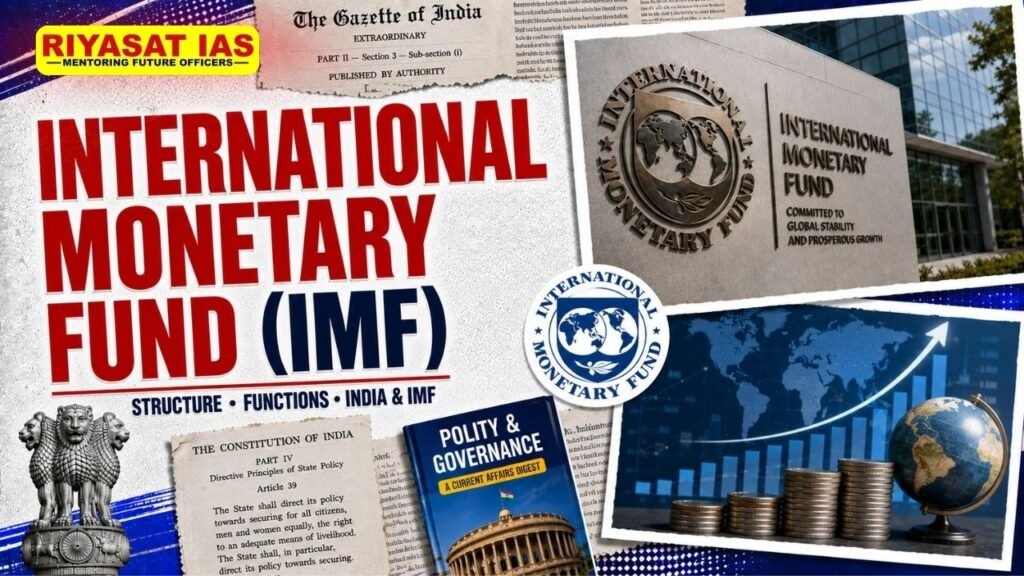
About IMF
· The International Monetary Fund (IMF) is an international financial institution that promotes international monetary cooperation, financial stability, sustainable economic growth and balance-of-payments stability. It provides policy advice, technical assistance and financial support to member countries facing external financing or macroeconomic difficulties.
· The IMF was created at the Bretton Woods Conference in 1944 and formally began operations in March 1947. Its headquarters are located in Washington, D.C., United States. The IMF currently has 191 member countries, with Liechtenstein becoming the 191st member in October 2024.
· The IMF’s resources and governance are largely based on the quota system, under which each member has a quota reflecting its position in the global economy.
Why was the IMF Established?
· The IMF emerged from the economic instability of the inter-war period, particularly the Great Depression, competitive currency devaluations, trade restrictions and unstable international monetary arrangements.
· The Bretton Woods Conference of 1944 sought to establish a stable international economic order after World War II. The IMF was therefore created to promote exchange-rate stability, international monetary cooperation and a multilateral system of payments, while helping countries facing temporary balance-of-payments difficulties.
· The original Bretton Woods system was based on relatively stable exchange rates, with the US dollar linked to gold and other currencies linked to the dollar. Although this fixed-exchange-rate system ended in the 1970s, the IMF continued to evolve towards surveillance, crisis management, lending and macroeconomic policy support.
Objectives of IMF
· The IMF’s objectives are derived from Article I of its Articles of Agreement.
· The IMF seeks to promote international monetary cooperation by providing a permanent institutional framework for consultation and collaboration on monetary issues.
· It seeks to facilitate the expansion and balanced growth of international trade, thereby contributing to higher employment and real income.
· It promotes exchange-rate stability and discourages competitive currency depreciation.
· It seeks to establish a multilateral system of payments for current international transactions and reduce restrictions on international trade and payments.
· It provides temporary financial resources to member countries facing balance-of-payments difficulties, enabling them to correct external imbalances without resorting to measures that could damage national or international prosperity.
Major Functions of IMF
· Economic Surveillance: The IMF monitors the economic and financial policies of member countries and assesses risks to domestic and global economic stability. The Article IV Consultation is the IMF’s principal bilateral surveillance mechanism through which it regularly assesses a member country’s economic situation and policies.
· Financial Assistance: The IMF provides financial assistance to countries experiencing balance-of-payments or external financing problems. Its lending programmes are generally accompanied by policy commitments intended to restore macroeconomic stability and the country’s capacity to repay.
· Technical Assistance and Capacity Development: The IMF provides technical assistance and training in areas such as tax administration, public financial management, monetary policy, financial regulation, statistics and central banking.
· Global Economic Monitoring: The IMF monitors global economic developments and identifies potential risks arising from inflation, debt, financial instability, capital flows, exchange rates and geopolitical shocks.
· Special Drawing Rights: The IMF manages the Special Drawing Rights (SDR) system, which supplements member countries’ official reserve assets.
· Policy Advice: The IMF provides policy advice on fiscal policy, monetary policy, exchange-rate policy, financial-sector stability and structural reforms, depending on the circumstances of individual countries.
Governance Structure
· Board of Governors
o The Board of Governors is the highest decision-making body of the IMF. Each of the 191 member countries appoints one Governor and one Alternate Governor, generally the finance minister or central bank governor.
o The Board of Governors normally meets once a year and retains important powers such as approving quota increases, SDR allocations and amendments to the IMF’s Articles of Agreement.
· International Monetary and Financial Committee



o The International Monetary and Financial Committee (IMFC) advises the Board of Governors on the functioning of the international monetary and financial system and provides strategic direction on major global economic issues.
o Executive Board: The Executive Board is responsible for conducting the IMF’s day-to-day business. It is chaired by the Managing Director and represents the interests of member countries through elected or appointed Executive Directors.
o Managing Director: The Managing Director heads the IMF staff and serves as chair of the Executive Board. The Managing Director is responsible for the day-to-day administration and implementation of IMF policies.
o IMF Staff and Departments: The IMF’s professional staff conduct economic surveillance, prepare lending programmes, undertake research and provide technical assistance and capacity development to member countries.
· Executive Board : It manages the IMF’s day-to-day operations and decision-making, working closely with the Managing Director to implement the Fund’s policies and programmes.
IMF Quota System
· The quota system is the foundation of the IMF’s financial and governance structure.
· A member’s quota broadly reflects its relative position in the world economy and is determined using a formula incorporating variables such as GDP, openness, economic variability and international reserves. A member’s quota has four major implications:
o Financial contribution: It determines the maximum financial resources that a member is normally obliged to provide to the IMF.
o Voting power: Quota shares are a major determinant of a country’s voting power in IMF decision-making.
o Access to IMF financing: Quotas influence the amount of financing a member can normally access from the IMF.
o SDR allocation: A member’s share in general SDR allocations is proportional to its quota.
· The quota system therefore connects IMF financing, voting rights, borrowing access and SDR allocations.
Recent Quota Reform
o The IMF’s 16th General Review of Quotas, approved in December 2023, provided for a 50% increase in IMF quotas, while maintaining the existing quota shares. Implementation requires consent from members representing at least 85% of total quotas. As of April 29, 2026, members representing 76.66% of total quotas had provided consent, so the required threshold had not yet been reached.
o The ongoing discussion on the 17th General Review of Quotas is particularly important for developing countries seeking greater representation in IMF governance.
Special Drawing Rights (SDR)
· The Special Drawing Right (SDR) is an international reserve asset created by the IMF in 1969 to supplement the official reserves of member countries. It is not a currency and cannot be directly used by individuals or businesses for transactions.
· The value of the SDR is based on a basket of five major currencies: US dollar, euro, Chinese renminbi, Japanese yen and British pound sterling.
· SDRs are allocated to IMF members in proportion to their quota shares and can be exchanged between members for freely usable currencies when needed.
· The largest-ever general SDR allocation of approximately $650 billion was made in August 2021 to strengthen global reserve buffers during the COVID-19 crisis.
· As of April 30, 2026, India’s SDR allocation stood at approximately SDR 16.55 billion, while its SDR holdings were approximately SDR 13.71 billion.
IMF and India
· India was one of the founding members of the IMF and joined the Fund in December 1945.
· India’s IMF quota currently stands at approximately SDR 13.11 billion, with the latest quota increase becoming effective in February 2016.
· India’s relationship with the IMF has evolved significantly from being primarily a borrower to becoming an important contributor to global economic discussions.
· 1991 Balance-of-Payments Crisis
o The IMF played an important role during India’s 1991 balance-of-payments crisis, when India faced severe external-sector pressures and sought external financial assistance.
o The crisis became an important catalyst for India’s broader economic liberalisation and structural reforms, including trade liberalisation, industrial deregulation and financial-sector reforms.
· IMF Surveillance: The IMF conducts regular Article IV consultations with India, assessing developments in areas such as growth, inflation, fiscal policy, monetary policy, external balances and financial stability.
· India’s Role in IMF Governance: India participates actively in IMF decision-making and represents a wider constituency of countries through its Executive Director’s office.
o India has also advocated greater representation of emerging markets and developing countries, arguing that IMF governance should better reflect changes in the global economic structure.
Major IMF Reports
· World Economic Outlook (WEO): (projected global growth at 3.1% in 2026 and 3.2% in 2027)
· Global Financial Stability Report (GFSR)
· Fiscal Monitor
· External Sector Report
· Regional Economic Outlook
Criticism of IMF
· The IMF has been criticised for attaching policy conditionalities to its lending programmes, which can require fiscal consolidation, subsidy reforms or structural reforms that may have significant short-term social costs.
· Developing countries have criticised the distribution of voting power because it remains closely linked to quotas, giving larger economies greater influence over IMF decisions.
· IMF programmes have sometimes been criticised for applying relatively standardised policy prescriptions without sufficiently accounting for the specific social and institutional conditions of borrowing countries.
· The Fund has faced criticism over the perceived dominance of advanced economies in its governance and leadership arrangements.
· The quota system has not fully kept pace with changes in the relative economic weight of emerging and developing economies, creating representation gaps.
· IMF surveillance can identify economic vulnerabilities, but its effectiveness depends on the willingness and capacity of member governments to implement recommended reforms.
IMF vs World Bank
| Basis | IMF | World Bank |
| Primary purpose | Promotes international monetary and financial stability. | Promotes long-term development and poverty reduction. |
| Main focus | Macroeconomic stability and balance-of-payments problems. | Development, infrastructure, human capital and poverty reduction. |
| Nature of assistance | Primarily macroeconomic and balance-of-payments financing. | Primarily development financing through loans, credits and grants. |
| Major institutions | A single international monetary institution. | World Bank consists of IBRD and IDA; broader World Bank Group has five institutions. |
| Lending horizon | Generally linked to short- and medium-term macroeconomic adjustment. | Generally supports longer-term development projects and programmes. |
| Major instruments | IMF lending facilities, surveillance and SDRs. | Development loans, concessional finance, grants, guarantees and private-sector financing. |
| Governance | Board of Governors, Executive Board and Managing Director. | Board of Governors, Executive Directors and President. |
| Key reports | WEO, GFSR, Fiscal Monitor and External Sector Report. | World Development Report, Poverty, Prosperity and Planet Report and Global Economic Prospects. |
| India’s relevance | Macroeconomic surveillance, external-sector assessment and global financial stability. | Infrastructure, social development, climate resilience and institutional reforms. |
Way Forward
· IMF quota and governance reforms should better reflect the changing distribution of global economic power while increasing the voice and representation of emerging and developing economies.
· The Fund should make its lending framework more responsive to the diverse circumstances of borrowing countries while maintaining macroeconomic sustainability.
· Greater attention should be given to climate-related financial risks, pandemics, debt vulnerabilities, food insecurity and geopolitical shocks because these increasingly affect macroeconomic stability.
· The IMF should strengthen the global financial safety net by ensuring adequate quota resources and complementary borrowing arrangements.
· Greater transparency and stronger social-impact assessment of conditionality can improve public confidence in IMF-supported programmes.
· The SDR system can be used more effectively to strengthen global reserve buffers, particularly for vulnerable developing economies, while maintaining the SDR’s role as an international reserve asset.
Conclusion
The legitimacy of the IMF in the 21st century will depend not only on its financial strength but also on how effectively its governance reflects the contemporary global economy. A more representative quota structure, responsive lending framework and stronger global financial safety net can make the IMF more effective for both advanced and developing economies.
FAQs
1. When was the IMF established?
The IMF was created at the Bretton Woods Conference in 1944 and began operations in March 1947.
2. How many members does the IMF have?
The IMF currently has 191 Member States, with Liechtenstein becoming the 191st member in October 2024.
3. What is the IMF quota?
A country’s IMF quota determines its financial contribution, voting power, normal access to IMF financing and share in general SDR allocations.
4. Is SDR a currency?
No. SDR is an international reserve asset created by the IMF, and its value is based on a basket of five major currencies.
5. What are the major IMF reports?
The major IMF reports include the World Economic Outlook, Global Financial Stability Report, Fiscal Monitor, External Sector Report and Regional Economic Outlook.




 Ravi Raaz
 Hassan Khan
 Shadab Ali