
GS-II: International Relations | India’s Neighbourhood | Regional Security | Foreign Policy | Strategic Autonomy
Context
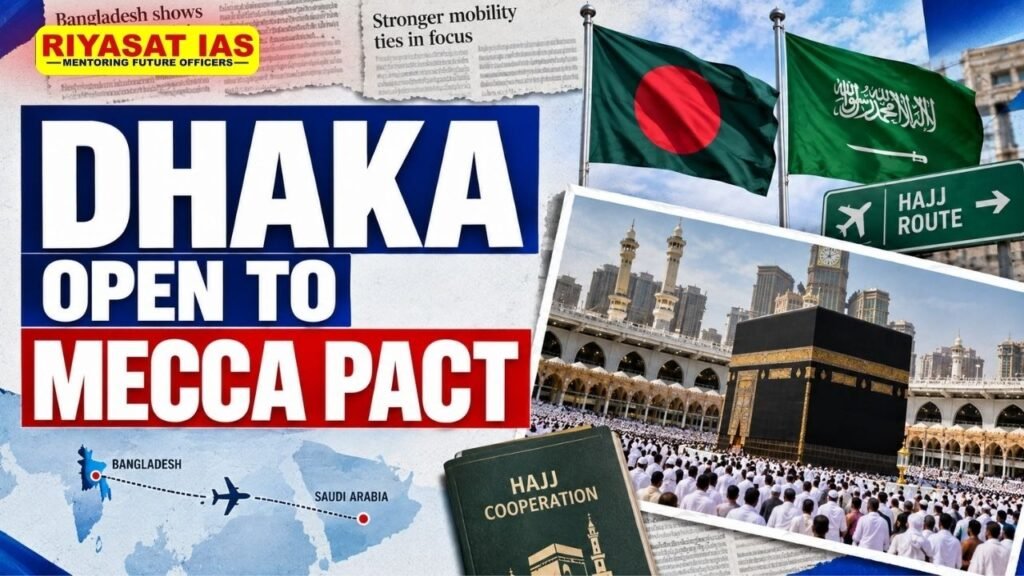
- Bangladesh’s Opening: Bangladesh has indicated that it would positively consider joining the Mecca Joint Defence Agreement (MJDA) if the existing members formally invite it.
- Existing Members: The pact was signed on 7 August 2026 by Saudi Arabia, Türkiye and Pakistan.
- Opposition Support: Bangladesh Jamaat-e-Islami chief and Leader of the Opposition Shafiqur Rahman backed Dhaka’s right to independently decide whether to join, calling it a matter of Bangladesh’s sovereignty and national interest.
- No Formal Membership Yet: Bangladesh has not received a formal invitation and has not taken a final decision to join.
What is the Mecca Joint Defence Agreement?
- Nature: A mutual defence and security agreement among Saudi Arabia, Türkiye and Pakistan.
- Collective Defence Principle: An armed attack against one member is to be treated as an attack against all members, broadly resembling the collective-defence principle of NATO’s Article 5.
- Strategic Capabilities:
- Saudi Arabia: Financial resources and strategic position in the Gulf.
- Türkiye: Significant conventional military and defence-industrial capabilities.
- Pakistan: Large military, combat experience and nuclear capability.
- Broader Objective: Greater defence cooperation, deterrence and strategic coordination among participating Muslim-majority states
Why is Bangladesh Interested?
- Defence Cooperation: Could provide Dhaka with another channel for military and security cooperation.
- West Asian Linkages: Bangladesh has substantial economic and labour linkages with Saudi Arabia and other Gulf countries.
- Economic Interests: Closer relations with Saudi Arabia and Türkiye could potentially support investment, trade, energy cooperation and employment opportunities.
- Strategic Diversification: Membership could allow Bangladesh to diversify its external partnerships rather than relying heavily on any single strategic partner.
- Islamic Multilateralism: Dhaka has indicated that participation in a security arrangement among Muslim-majority countries would not necessarily be unusual.



Why Does It Matter for India?
- Geographical Proximity: Bangladesh’s possible entry would bring a Saudi-Türkiye-Pakistan-backed security framework closer to India’s eastern neighbourhood and the Bay of Bengal.
- Pakistan Factor: India is particularly sensitive to Pakistan’s involvement because of the longstanding India-Pakistan strategic rivalry.
- Regional Security: Expansion of the pact could alter the existing South Asian security architecture.
- India-Bangladesh Relations: The development comes amid strains in bilateral relations and could complicate efforts to stabilise ties.
- Strategic Balancing: Dhaka may seek greater strategic space under its “Bangladesh First” approach, while India would seek to prevent the emergence of an adverse security alignment on its eastern flank.
Concerns for Bangladesh
- Non-Alignment: Joining a formal defence bloc could constrain Bangladesh’s traditional preference for strategic autonomy and balanced diplomacy.
- Entrapment Risk: A collective-defence commitment could potentially draw Bangladesh into conflicts in which it has no direct national interest.
- India Relations: Membership could complicate relations with its major regional neighbour, India.
- China Factor: Dhaka would also need to balance its relations with China, another major economic and strategic partner.
- Iran & West Asia: Participation in a security grouping could make it harder for Bangladesh to maintain equally balanced relations with different West Asian powers. Analysts have warned that membership could test Dhaka’s longstanding non-aligned approach.
Implications for India
Challenges
- Strategic Encirclement Concerns: Greater Pakistan-linked security cooperation near India’s eastern frontier could create strategic complications.
- Bay of Bengal Security: India may need to closely monitor any expansion of defence cooperation into the Indian Ocean region.
- Neighbourhood First: It could complicate India’s efforts to maintain Bangladesh as a stable and cooperative neighbour.
- Security Cooperation: Intelligence, military and defence-industrial cooperation among pact members could acquire wider regional dimensions.
Opportunities
- Diplomatic Engagement: India can reinforce engagement with Dhaka rather than viewing the development only through a security lens.
- Economic Interdependence: Greater connectivity, trade and energy cooperation can strengthen bilateral resilience.
- Sub-regional Cooperation: Platforms such as BIMSTEC can provide Bangladesh with an alternative framework based on economic and functional cooperation rather than military alignment.
- Strategic Autonomy: India can continue advocating an open, inclusive and non-exclusive Indo-Pacific.
Way Forward
- Respect Sovereign Choice: India should recognise Bangladesh’s sovereign right to determine its external-security partnerships.
- Deepen Bilateral Engagement: Strengthen cooperation in trade, connectivity, energy, water, border management and security.
- Avoid Zero-Sum Diplomacy: Bangladesh should be encouraged to maintain diversified partnerships rather than entering rigid geopolitical blocs.
- Strengthen BIMSTEC: Promote Bay of Bengal-centred economic and security cooperation.
- Maintain Strategic Autonomy: Bangladesh should carefully assess whether collective-defence obligations could restrict its independent foreign-policy choices.
- India’s Approach: New Delhi should focus on building durable interdependence with Dhaka, rather than attempting to dictate its strategic choices.
Conclusion
Bangladesh’s openness to the Mecca Pact reflects the changing security architecture of South and West Asia. For Dhaka, the attraction lies in diversified defence partnerships and stronger ties with influential Muslim-majority states; for India, the concern arises primarily from the Pakistan dimension and the pact’s possible expansion towards the Bay of Bengal.
The larger lesson is that regional stability cannot be secured through competing military blocs alone. India should respond through deeper neighbourhood engagement, economic interdependence and inclusive regional institutions while respecting Bangladesh’s strategic autonomy.
UPSC Mains Practice Question
Q. “Bangladesh’s possible entry into the Mecca Joint Defence Agreement could reshape the strategic environment of India’s eastern neighbourhood.” Discuss its implications for India-Bangladesh relations and regional security. (250 words, 15 marks)





 Ravi Raaz
 Hassan Khan
 Shadab Ali