
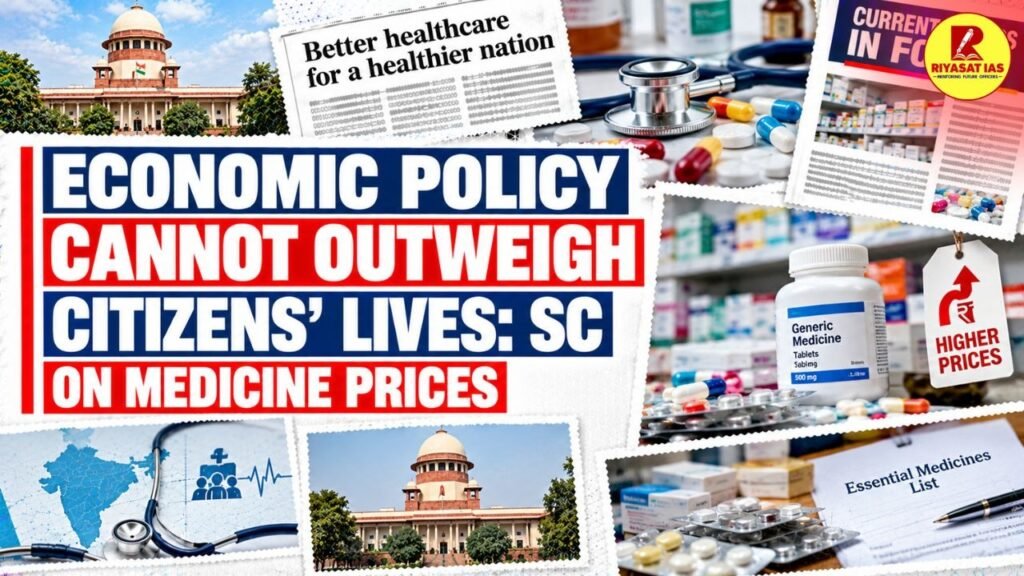
GS-II | Health | Governance | Right to Health | Judicial Intervention
Introduction
- Supreme Court’s Observation: The Supreme Court referred to the enormous markup from what a retailer pays for a drug to the MRP as “carnage,” and described the situation as “broad daylight dacoity” with patients.
- Illustrative Example: An example of a drug that is used by retail pharmacies at a cost of approximately INR 2,700, has been reported as having a Maximum Retail Price (MRP) of almost INR 27,000.
- Court’s Question: The Court raised a question regarding why the 16 percent retail margin that is allowed by the Drugs (Prices Control) Order (DPCO), 2013, cannot be applied to each and every essential medicine.
Legal Framework for Medicine Price Regulation
- Essential Commodities Act, 1955: The Essential Commodities Act of 1955 gives power to the federal government to regulate what is considered “essential” commodities (goods), which includes medications.
- Section 3(1): The regulatory control over production, supply, and distribution is allowed under section 3(1). This regulatory control will be used to make sure that goods are produced and distributed fairly, and that consumers can buy them at reasonable prices.
- Section 3(2)(c): Gives the Government authority to establish regulations for price controls on commodities.
- Drugs (Prices Control) Order, 2013: The Drugs (Prices Control) Order, 2013 was issued by the government of India under the Essential Commodities Act. It is the main regulatory body for setting the prices of medicines in India.
- National Pharmaceutical Pricing Authority (NPPA): The National Pharmaceutical Pricing Authority (NPPA), which was created in 1997 by the Department of Pharmaceuticals, has the responsibility of:
- Fixing and revising ceiling prices of scheduled formulations.
- Setting retail prices for new drugs.
- Monitoring overcharging and enforcing the DPCO.
- Ordering recovery of overcharged amounts from companies.
- The government will establish price caps on some drugs and medical devices that are not subject to standard price control, when applicable.
Scheduled vs Non-Scheduled Medicines
- Scheduled Formulations: Formulations that have been included in schedule I of the DPCO on the basis of the National List of Essential Medicines (NLEM), which has been developed by the Ministry of Health and Family Welfare. The prices of these medicines can be regulated by the government.
- Non-Scheduled Formulations: Medicines that are not on the list and, typically, are not covered under price caps.
- Limited Scope: The NLEM includes 384 medications and represents approximately 20% of the total drug-market value. Therefore, roughly 80% of the market functions primarily without direct price control.



How Ceiling Prices Are Calculated
- Ceiling Price: The highest price that a scheduled formulation can be sold for, prior to taking into account tax.
- Identification of Formulations: The NPPA identifies both brand-name and generic products that contain the same active ingredient.
- Market Share Cut-Off Point: All versions that make up less than 1% of the overall market sales are removed from consideration. The cutoff is determined by the MAT (Moving Annual Turnover), which calculates sales from the last 12 months using market research data.
- PTR (Price to Retailer): This is the cost that a manufacturer or distributor charges to a retailer, like a pharmacist or hospital pharmacy.
- Calculation Method: The NPPA uses the average of the PTR for each version that qualifies, then adds a 16% markup for retailers.
- Example: For three version examples that would be considered eligible for the program with PTRs of ₹8, ₹10 and ₹12, the average value would be ₹10. After the 16 percent margin is applied to the average price of ₹10, the maximum price can then be established at ₹11.60.
- Annual Adjustment: On an annual basis, on April 1, ceiling prices are adjusted using the Wholesale Price Index (WPI). Manufacturers may adjust their prices upward to match the previous years WPI change without obtaining prior approval. However, if the WPI decreases, then the manufacturer must decrease its prices within 45 days.
The Loophole: Non-Scheduled Medicines
- Initial Launch Price: In most cases, manufacturers are free to determine the initial launch price for non-scheduled medicines as long as they do so within their own pricing policies and without being subject to government intervention regarding a maximum allowable price.
- Annual Price Increase Limit: The MRP can’t be raised more than 10 percent in each year after that.
- Petitioners’ Argument: Because the DPCO has no control over the first-time introduced prices of non-scheduled drugs, there is nothing stopping manufacturers from having high initial MRPs.
- Limitation of the Current Ceiling: A limitation of the current ceiling is that while it will restrict subsequent increases, it cannot help to lower a previously set price that was too high.
Constitutional Argument
- Right to Life and Health: The petitions cite the right to life (including the right to health) as a constitutional justification for regulating medicine prices.
- Uncontrolled Initial Pricing: The petitioners also argue that when manufacturers are able to establish the initial retail price (MRP) at their discretion, they have the ability to arbitrarily set prices based upon factors other than their actual production costs.
- Hospital Pharmacy Impact: The petition states that pharmaceutical companies use the input of corporate hospitals to establish retail prices (MRPs). In addition, it claims that pharmacy costs make up 30-40 percent of a patient’s total hospital bill in corporate hospitals when they are critically ill.
- Generic versus Brand Name Drugs: Based on comments made by members of the Lok Sabha, the petitioners note that most generic drugs cost anywhere from 50 to 90 percent less than their brand-name equivalents.
- Reducing Healthcare Costs: Greater utilization of generic medications has been identified as a potential way to lower patient healthcare costs.
Key Issues and Challenges
- Limited Price-Control Coverage: Most of the pharmaceutical industry is unregulated by direct price controls.
- Unregulated Initial Prices: The current regulatory structure allows for future increases to be made within limits, however, it does not allow for a limit to be set on the first price of a non-scheduled medicine.
- Disproportionate Trade Margins: Trade margins which are significantly different from one another create questions regarding whether or not the product is affordable, and also if there is a level of transparency in pricing.
- Enforcement Gaps: The gaps in enforcement as well as the allegations of excessive markups demonstrate that there needs to be greater monitoring and enforcement of the price controls that currently exist.
- Healthcare Affordability: High prices for medications can place an enormous financial strain on individuals who require long term care and/or are in need of critical treatment.
Way Forward
- Review the Initial Price Setting Process: Consider ways to prevent initial pricing of un-scheduled essential drugs from being too high without justification.
- Strengthen Price Regulation: Evaluate the possibility of applying the 16% retail margin structure to more types of essential medicines.
- Strengthen Enforcement of the DPCO: Improve the National Pharmaceutical Pricing Authority’s (NPPA) monitoring and response to instances of overcharging and non-compliance with the DPCO.
- Promote Generic Prescribing: Ensure that generic drugs are prescribed appropriately so that patients can save money on their prescriptions.
- Transparency Enhancement: Enhance the transparency of pricing for medicines and margins of all stakeholders (manufacturers, distributors, retailers and hospital pharmacies).
- Balanced Regulation: Design regulations that protect affordability and take into account the accessibility and long-term sustainability of the drug supply.
Conclusion
The Supreme Court’s statements illustrate the difference between how medicine prices should be formally regulated and how they actually are. Although the DPCO has established a process for regulating the prices of medicines, non-scheduled medicines may typically be introduced into the market without a price limit. To address the problem, strengthen the enforcement of the regulations, and promote the use of affordable generic medicines as alternatives to expensive brand-name medicines to ensure that individuals have access to the most basic forms of healthcare, and to prevent high-priced medicines from undermining their ability to access those forms of healthcare.
UPSC Mains Practice Question
Q. “The right to health includes the right to affordable access to essential medicines” as per Article 21. Discuss the problems associated with India’s medicine pricing system and provide suggestions for improving both affordability and regulation.
Prepare for UPSC 2027 with Expert Mentorship!
Strengthen your current affairs, analytical thinking, and answer-writing skills with a structured UPSC mentorship program.




 Ravi Raaz
 Hassan Khan
 Shadab Ali