
GS-III: Indian Economy | Industrial Growth | Manufacturing | Infrastructure | Economic Indicators | Investment
Context
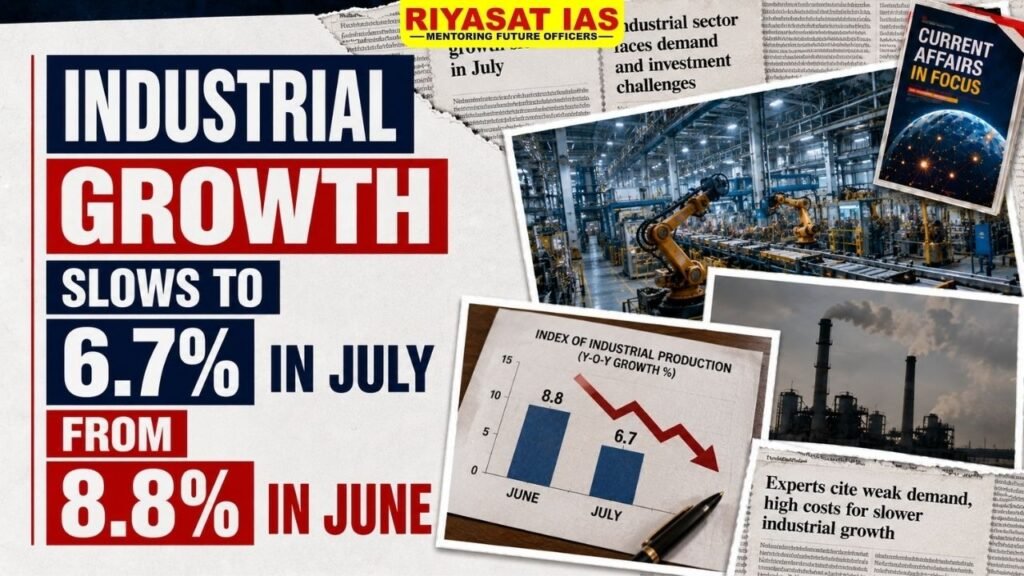
- Industrial Moderation: India’s Index of Industrial Production (IIP) grew 6.7% year-on-year in July 2026, compared with the revised 8.8% growth in June.
- Still Robust: July growth was higher than the 5.4% recorded in July 2025.
- FY27 Trend: IIP growth during April–July 2026 stood at 6.3%, compared with 4% in the corresponding period a year earlier.
- Key Drag: The moderation was primarily due to a 0.9% contraction in mining, while manufacturing and electricity also recorded slower growth.
What is the Index of Industrial Production (IIP)?
- IIP: Measures changes in the volume of industrial production in the economy.
- Compiled by: National Statistical Office (NSO) under the Ministry of Statistics and Programme Implementation.
- Current Base Year: 2022-23 = 100 under the new IIP series.
- Broad Sectors Covered:
- Mining & Quarrying
- Manufacturing
- Electricity & Gas Supply
- Water Supply, Sewerage & Waste Management
- Significance: IIP is an important high-frequency indicator of industrial activity and helps assess the momentum of the secondary sector.
Why Did Industrial Growth Slow?
- Mining Contraction: Mining fell by 0.9%, exerting downward pressure on IIP.
- Manufacturing Deceleration: Manufacturing growth moderated from 9.5% to 7.3%.
- Electricity Moderation: Electricity growth declined from 11.3% to 8.7%.
- Weak Non-Durable Consumption: Consumer non-durables contracted by 1%, indicating uneven consumption demand.
- High Base/Sequential Effect: The comparison is also affected by the strong performance recorded in June.



Important: The slowdown should be viewed as a moderation rather than a collapse, since July’s 6.7% growth remained above the year-earlier level.
Concerns
- Mining Weakness: Persistent mining contraction can constrain industrial raw-material supply.
- Uneven Consumption: Negative growth in consumer non-durables indicates that recovery is not broad-based.
- Manufacturing Slowdown: Manufacturing remains strong but has lost some momentum.
- External Shocks: Geopolitical tensions, energy-price volatility and global trade disruptions can affect industrial production.
- Employment Challenge: High industrial output growth does not automatically translate into adequate employment generation, especially if growth is concentrated in capital-intensive sectors.
Way Forward
- Strengthen Manufacturing: Improve logistics, infrastructure, technology adoption and ease of doing business.
- Boost Private Capex: Create conditions for sustained private-sector investment.
- Revive Mass Consumption: Strengthen rural incomes, employment and purchasing power.
- Modernise Mining: Improve mineral production while maintaining environmental safeguards.
- Develop Supply Chains: Integrate Indian manufacturing into global value chains and reduce critical-input vulnerabilities.
- Promote Labour-Intensive Industries: Encourage textiles, food processing, footwear and other sectors with high employment potential.
Conclusion
The decline in industrial growth from 8.8% in June to 6.7% in July represents a loss of momentum, not a structural industrial slowdown. Strong capital-goods, manufacturing and consumer-durable growth indicate resilience, while mining and consumer non-durables remain areas of concern.
The policy priority should therefore be to convert this industrial momentum into sustained private investment, employment generation and productivity growth, thereby making manufacturing a durable engine of Viksit Bharat.
UPSC Mains Practice Question
Q. “India’s industrial growth remains resilient despite moderation in July 2026, but the composition of growth raises concerns.” Discuss. (250 words, 15 marks)




 Ravi Raaz
 Hassan Khan
 Shadab Ali