
GS Paper III – Indian Economy
Context
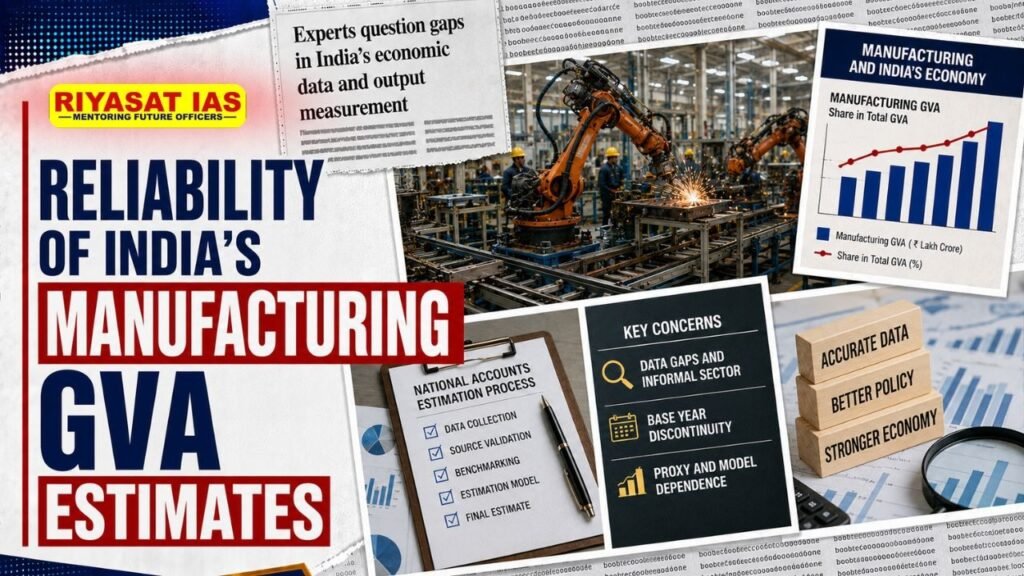
- New National Accounts Series: The National Statistical Office (NSO) released a new series of National Accounts Statistics (NAS), reporting manufacturing GVA at ₹38.6 lakh crore, equivalent to 14.7% of GDP at current prices in 2023-24.
- Statistical Concern: An alternative estimate based on official ASI and ASUSE datasets places manufacturing GVA at only ₹27.4 lakh crore, creating a 40.9% gap with the official NAS estimate.
- Core Issue: Even after accounting for residual companies and workers, around ₹7.6 lakh crore (19.7%) of the official manufacturing GVA remains unexplained.
How is Manufacturing Measured?
- Organised/Factory Sector: Covers registered factories employing 10+ workers with power or 20+ workers without power, including registered companies.
- Unincorporated Sector: Consists of informal, household and small manufacturing units outside the corporate/factory sector.
- ASI: The Annual Survey of Industries (ASI) provides production accounts for the factory sector.
- ASUSE: The Annual Survey of Unincorporated Sector Enterprises (ASUSE) covers the informal/unincorporated sector.
- Combined Coverage: GVA from the factory and unincorporated sectors together is expected to capture almost the entire manufacturing output.
The GVA Discrepancy
- Alternative Estimate: ASI + ASUSE data produce manufacturing GVA of ₹27.4 lakh crore for 2023-24.
- Official NAS Estimate: NAS reports manufacturing GVA of ₹38.6 lakh crore.
- Magnitude of Gap: The official estimate is 40.9% higher than the alternative estimate.
- Unincorporated Sector: Since both estimates use ASUSE for this component, the informal sector cannot adequately explain the gap.
- Organised Sector: Therefore, the major source of discrepancy appears to lie in the estimation of organised manufacturing output.
Role of MCA-21 Data
- Corporate Balance Sheets: NAS uses company balance-sheet information from the Ministry of Corporate Affairs’ MCA-21 database.
- Methodological Shift: Since the previous NAS revision with the 2011-12 base year, MCA-21 data have partially replaced ASI for estimating organised-sector output.
- Current Revision: The latest NAS series continues this approach with some modifications.
- Key Concern: The reliability of the final GVA estimate depends significantly on the coverage, composition and scaling-up methodology applied to MCA-21 data.



Employment-Based Validation
- PLFS Employment: The Periodic Labour Force Survey (PLFS) estimated 697.5 lakh manufacturing workers in 2023-24.
- ASI + ASUSE Employment: These datasets together account for only 532.9 lakh workers.
- Residual Workers: The difference is approximately 164.6 lakh workers.
- Potential GVA: Applying appropriate technical ratios derived from ASI and ASUSE, the potential GVA attributable to residual workers is estimated at ₹3.6 lakh crore.
The Remaining Puzzle
- Adjusted Estimate: Adding ₹3.6 lakh crore potential GVA to the alternative estimate of ₹27.4 lakh crore gives approximately ₹31.0 lakh crore.
- Remaining Gap: This remains 24.5% below the official NAS estimate of ₹38.6 lakh crore.
- Unexplained Component: Around ₹7.6 lakh crore, or 19.7% of official manufacturing GVA, remains unaccounted for.
- Coverage Issue: The potential GVA of all identified workers and enterprises explains only about 80.3% of the official estimate.
Possible Explanations
- Enterprise-Level Value Addition: NSO argues that ASI, being an establishment-based survey, may fail to capture value addition occurring outside factory premises, such as head offices, marketing, distribution and R&D.
- Evidence Challenge: The article argues that available evidence does not adequately support the claim that ASI substantially underestimates such production.
- Residual Companies: Some of the gap may arise from MCA companies not captured in the ASI coverage, including non-factory private companies.
- Residual Workers: Some workers may belong to very small unincorporated enterprises not covered by ASUSE.
- Scaling-Up Methodology: Another possibility is that scaling up sample estimates of active companies to the universe of companies may introduce uncertainty because the size and composition of the corporate universe remain unclear or insufficiently verified.
Why Reliable GVA Estimates Matter?
- GDP Accuracy: Manufacturing GVA is a major component of GDP estimation; inaccurate estimates can affect the reliability of aggregate economic statistics.
- Policy Formulation: Government decisions on industrial policy, investment and employment depend on credible sectoral data.
- Growth Assessment: Manufacturing’s actual contribution to economic growth can be misrepresented if output is over- or underestimated.
- Evidence-Based Governance: Reliable national accounts are essential for assessing whether economic policy is producing the intended outcomes.
- Investor Confidence: Transparent and verifiable economic statistics strengthen confidence among investors, researchers and international institutions.
Way Forward
- Publish MCA-21 Data: Greater transparency regarding the corporate data used for GVA estimation would enable independent scrutiny.
- Disclose Methodology: NSO should make the methodology for scaling up company-level data sufficiently transparent for external verification.
- Independent Validation: GVA estimates should be cross-checked using employment, production, enterprise and survey-based datasets.
- Harmonise Definitions: Differences in employment and enterprise definitions across PLFS, ASI and ASUSE should be carefully reconciled.
- Improve Coverage: Surveys should continuously identify residual companies and small enterprises that remain outside existing statistical frameworks.
- Strengthen Statistical Transparency: Independent researchers should be able to replicate and validate key components of national income estimates.
- Regular Reconciliation: Large differences between alternative official datasets should trigger systematic reconciliation before final estimates are published.
Conclusion
The issue is not merely about a difference between two numbers; it concerns the credibility and transparency of India’s national accounting system. The official manufacturing GVA estimate may represent a fuller measurement of economic activity, or it may reflect methodological limitations in the scaling-up of corporate data.
Therefore, the statistical debate can be resolved only through greater data transparency, methodological disclosure and independent verification. Robust national statistics are essential for credible policymaking and an evidence-based assessment of India’s economic transformation.
MAINS PRACTICE QUESTION
Q. The reliability of national income statistics is crucial for evidence-based economic policymaking. In this context, examine the concerns surrounding the estimation of India’s manufacturing GVA. (250 words, 15 marks)





 Ravi Raaz
 Hassan Khan
 Shadab Ali