
GS-II: Polity & Governance | Transparency | Accountability | Judiciary
Context
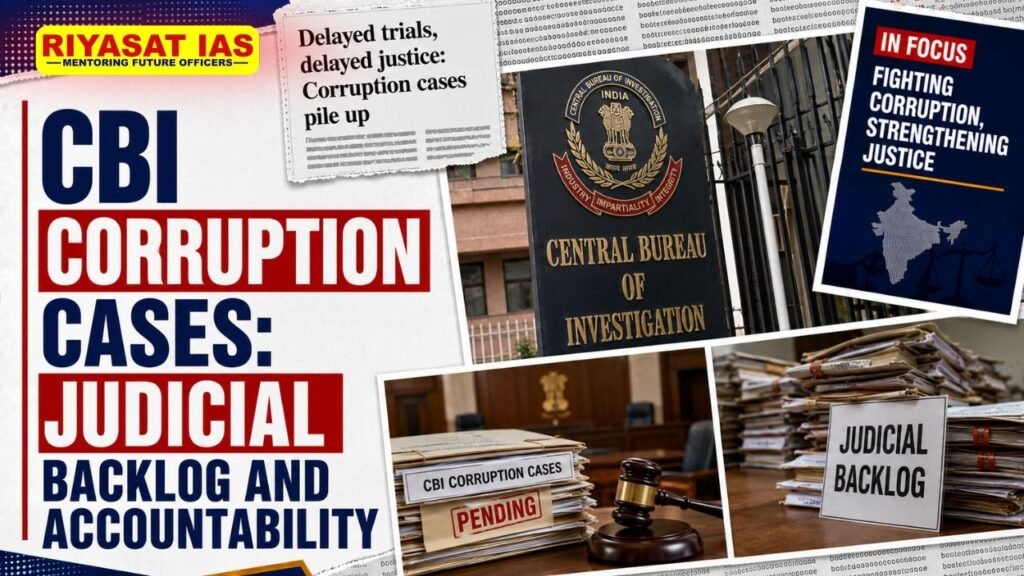
- Large Pendency: The CVC’s 2025 Annual Report noted that 7,229 corruption cases investigated by the CBI were pending trial in courts as of December 31, 2025.
- Long Delays: 409 cases had remained pending for more than 20 years, while 2,447 cases under the Prevention of Corruption Act were pending for more than 10 and up to 20 years.
- Higher-Court Backlog: Around 14,083 appeals, revisions and writ petitions relating to corruption cases were pending before the High Courts and Supreme Court.
- Pending Investigations: The CBI also had 473 corruption cases under investigation, including 39 pending for more than five years.
Why is the Pendency Significant?
- Weakens Anti-Corruption Framework: Prolonged trials reduce the deterrent effect of the Prevention of Corruption Act.
- Delayed Justice: Decades-long pendency undermines the principle of timely justice and may affect both prosecution and accused.
- Administrative Accountability: The CVC noted that CBI investigations are expected to be completed within one year of registration, wherever a chargesheet is warranted.
- Public Trust: Delays in corruption cases can weaken citizens’ confidence in institutions responsible for combating corruption.
Reasons for Delay in Investigation
- International Cooperation: Delay in obtaining responses to Letters Rogatory (LRs).
- Document Verification: Time consumed in verification of documents and title deeds, particularly in disproportionate-assets cases.
- Large Volume of Records: Economic offences and bank-fraud cases often involve extensive documentation.
- Witness Examination: Difficulty in locating and examining witnesses, particularly those living in remote areas.



Institutional Framework
- Central Vigilance Commission: The CVC exercises superintendence over the CBI in relation to investigations concerning offences under the Prevention of Corruption Act, 1988.
- CBI: Investigates corruption and other specified offences and files chargesheets before competent courts where prosecution is warranted.
- Special Courts: Dedicated courts for corruption cases are intended to facilitate focused and speedy adjudication.
Way Forward
- Time-Bound Trials: Strengthen mechanisms for expeditious disposal of long-pending corruption cases.
- Investigative Capacity: Improve manpower, forensic capabilities, digital investigation and financial-tracking expertise.
- Inter-Agency Coordination: Faster access to documents, witnesses and international evidence can reduce investigation delays.
- Court Infrastructure: Strengthen specialised courts and judicial capacity dealing with corruption and economic offences.
- Accountability for Delay: Regular monitoring of investigations and trials can identify systemic bottlenecks.
- Balance Speed with Fair Trial: Faster disposal must be accompanied by due process and adequate safeguards for the accused.
Conclusion
The 7,229 pending CBI corruption trials, including 409 pending for over two decades, highlight that the effectiveness of anti-corruption institutions depends not merely on investigation and prosecution but also on timely judicial adjudication. Reducing pendency is therefore essential for strengthening rule of law, deterrence and public trust.
UPSC Mains Practice Question
Q. “Delay in adjudication can weaken the deterrent value of anti-corruption laws.” Discuss in the context of the rising pendency of CBI corruption cases. (150 words, 10 marks)





 Ravi Raaz
 Hassan Khan
 Shadab Ali