
GS-III: Environment & Ecology | Water Resources | Wetlands | Urbanisation | Groundwater Management | Disaster Management
Context
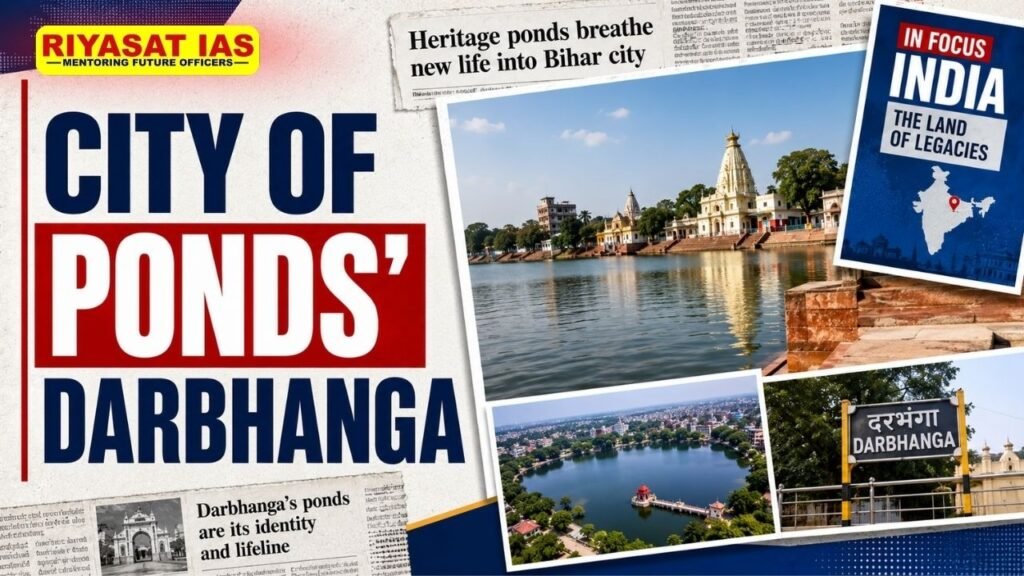
- Darbhanga’s Water Legacy: Darbhanga in Bihar’s Mithilanchal region was historically known as the “City of Ponds”. The district gazetteer recorded more than 350 ponds in 1969, while fewer than 100 reportedly remain today.
- Legal Battle: Citizens under the Talab Bachao Abhiyan (TBA) have approached the Supreme Court seeking protection and restoration of three historic water bodies—Harahi, Dighi and Ganga Sagar.
- Beautification vs Conservation: The dispute concerns a government-led ₹70.34-crore rejuvenation and beautification project for the three interconnected ponds. Residents allege that soil filling and construction could alter their ecological character.
- Supreme Court Intervention: The Court has sought the Bihar government’s response and subsequently cautioned against altering or filling water bodies in the name of beautification without judicial approval.
Why Are Darbhanga’s Ponds Important?
- Groundwater Recharge: Ponds act as natural recharge zones, allowing rainwater to infiltrate the ground and replenish aquifers.
- Flood Moderation: They temporarily store excess monsoon water and reduce urban flooding and waterlogging.
- Water Security: Loss of ponds increases dependence on groundwater and borewells, particularly during summer.
- Biodiversity: Wetlands provide habitats for aquatic organisms, birds and other species.
- Microclimate Regulation: Open water bodies can moderate local temperatures and improve urban environmental conditions.
- Cultural Significance: Darbhanga’s ponds are deeply linked with the social, religious and cultural life of Mithilanchal.
Major Threats to Urban Water Bodies
- Encroachment: Pond areas are increasingly converted for housing, commercial establishments and other construction.
- Land Filling: Soil and construction material are used to progressively reduce water-spread areas.
- Unplanned Urbanisation: Expansion of built-up areas reduces natural drainage and infiltration zones.
- Sewage Pollution: Untreated sewage and municipal waste entering ponds degrade water quality.
- Beautification Projects: Excessive paving, concrete structures and commercial construction can destroy the ecological functions of wetlands.
- Weak Enforcement: Despite judicial and statutory protections, local-level monitoring and enforcement remain inadequate.



Legal & Institutional Framework
Wetlands (Conservation and Management) Rules, 2017
- Provide a regulatory framework for the conservation and management of notified wetlands.
- Emphasise maintaining the ecological character of wetlands.
- Activities that adversely affect wetland ecosystems can be regulated or prohibited.
National Green Tribunal
- The NGT has previously directed authorities to remove encroachments and restore the three Darbhanga ponds—Dighi, Harahi and Ganga Sagar.
- It also directed measures for sewage diversion, pollution control and ecological restoration.
Constitutional Dimension
- Article 21: Right to life has been judicially interpreted to include the right to a clean and healthy environment.
- Article 48A: Directs the State to protect and improve the environment.
- Article 51A(g): Makes protection of the natural environment a fundamental duty of citizens.
- Public Trust Doctrine: Natural resources such as water bodies are held by the State in trust for the public and cannot be treated merely as disposable land assets.
Why ‘Beautification’ Can Become a Problem
- Ecology vs Aesthetics: A wetland is not merely an empty space to be landscaped; its primary function is water storage, recharge and ecological support.
- Concrete Paving: Excessive paving can reduce groundwater infiltration.
- Reduction in Water Spread: Filling portions of ponds reduces their capacity to store rainwater.
- Commercialisation: Kiosks, restaurants and recreational infrastructure can increase waste and pollution.
- Irreversible Damage: Once a wetland’s hydrological character is altered, restoration can become difficult and expensive.
Key Principle: “Restoration should mean restoring ecological functions, not merely improving visual appearance.”
Significance for India
- Urban Water Security: Traditional water bodies can supplement modern water-supply systems.
- Climate Resilience: Ponds and wetlands function as nature-based solutions for floods, heat and water scarcity.
- Sustainable Urbanisation: Cities need to treat lakes, ponds and wetlands as urban infrastructure, not vacant land.
- Community Participation: Local communities can play an important role in monitoring encroachment and pollution.
- Restoration Economy: Ecological restoration can create employment while improving urban resilience.
Way Forward
- Digital Inventory: Prepare a comprehensive GIS-based inventory and cadastral mapping of all ponds and wetlands.
- Demarcation: Clearly identify and legally protect water-spread areas, catchments and buffer zones.
- No-Net-Loss Principle: Urban development should not result in a net loss of wetland area or ecological functions.
- Scientific Restoration: Prioritise desilting, natural embankments, native vegetation and sewage diversion over excessive concrete construction.
- Strict Encroachment Control: Establish time-bound mechanisms for removal of illegal encroachments.
- Community Governance: Involve local residents, civil-society groups and traditional institutions in monitoring.
- Integrated Urban Planning: Include wetlands in master plans, drainage plans and climate-resilience strategies.
- Pollution Control: Prevent untreated sewage and solid waste from entering water bodies.
Conclusion
Darbhanga’s struggle demonstrates that water bodies are not merely environmental assets but essential urban infrastructure. The disappearance of ponds simultaneously threatens groundwater security, flood management, biodiversity and cultural heritage.
The larger lesson is that development and conservation need not be opposites. What is required is a shift from “beautification of water bodies” to “ecological restoration of water systems.” Protecting ponds today is ultimately an investment in urban water security and climate resilience tomorrow.
UPSC Mains Practice Question
Q. “Urban water bodies are ecological infrastructure rather than vacant spaces available for development.” Discuss in the context of the recent legal battle over Darbhanga’s ponds. (250 words, 15 marks)





 Ravi Raaz
 Hassan Khan
 Shadab Ali