
GS-II: Judiciary | Constitutional Governance | Social Justice | Labour Rights
GS-III: Labour & Employment | Industrial Relations | Inclusive Growth
Context
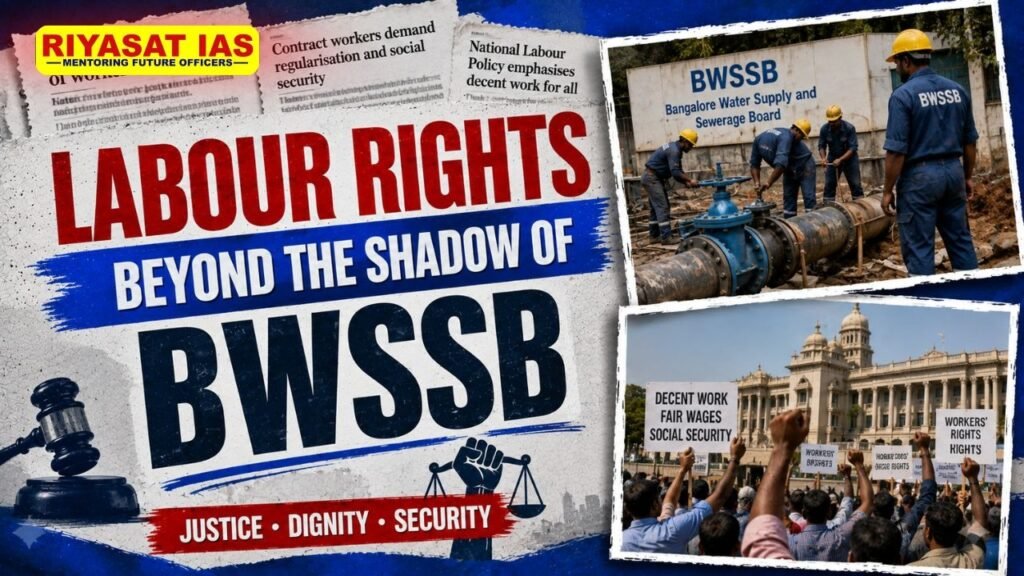
- Supreme Court Judgment: On August 20, 2026, the Supreme Court of India delivered its judgment on the Reference concerning the correctness of Bangalore Water Supply and Sewerage Board vs A. Rajappa (BWSSB), 1978, particularly the test for determining whether an activity falls within the definition of “industry” under Section 2(j) of the Industrial Disputes (ID) Act, 1947.
- Reference Origin: In State of U.P. vs Jai Bir Singh (2005), 5 SCC 1, a five-judge Bench referred the seven-judge Bench decision in BWSSB for reconsideration.
- Seven-Judge Bench: A seven-judge Bench was constituted and, by order dated January 2, 2017, referred the matter to a nine-judge Bench.
What Did the Judges Hold?
- Justice D. Datta & Justice U. Bhuyan: Held that “the reference requires no answer.”
- Justice B.V. Nagarathna: Found the exercise “unnecessary and only academic in nature.”
- Justice P.S. Narasimha: Held that an authoritative interpretation of “industry” was compelling when the Reference was made, but became unnecessary after repeal of the provision.
- CJI’s Opinion: The opinion written by the Chief Justice of India for four judges also acknowledged the changed legal position.
- Hypothetical Reformulation: The four-judge opinion nevertheless sought to re-formulate the Triple Test laid down by BWSSB.
- No Pending Application: The reformulated test was expressly described as “hypothetical” and would not apply to pending cases.
- No Future ID Act Cases: Since the ID Act has been repealed, there can be no future cases under that legislation.
BWSSB and the Industrial Relations Code, 2020
- Scope of Reference: The four questions framed on February 16, 2026 concerned only Section 2(j) of the ID Act.
- IRC Provision Not Before Court: The interpretation of Section 2(p) of the IRC was not before the Court.
- Independent Legislation: The CJI’s opinion recognises that the IRC “is an independent legislative enactment and must be interpreted on its own terms, having regard to its text, scheme, and object.”
- BWSSB as “Sheet Anchor”: The opinion states that the principles laid down in BWSSB should not be regarded as the “sheet anchor” for interpretation of the IRC if such a question arises in the future.
- Justice Narasimha: He stated that interpretation of “industry” under the IRC should “not be burdened by the existing interpretations” under the ID Act, 1947.
- Justice Nagarathna: While affirming BWSSB, she held that the extent to which its reasoning carries over to the IRC must be tested by comparing the actual text of the two provisions.
- Case-Specific Interpretation: Such comparison can meaningfully be undertaken only in a case arising under Section 2(p) and not in the abstract.
- Continuing Jurisprudence: The interpretation of “industry” under the IRC would have to be understood in light of the rich jurisprudence developed through BWSSB and subsequent cases.



Importance of BWSSB
- Deeper Anxiety: There is a deeper concern regarding the BWSSB judgment, which contributed to the Reference itself.
- Jai Bir Singh: The five-judge Bench in 2005 questioned BWSSB’s “worker-oriented approach”, stating that it was unmindful of the interests of employers or owners of industries.
- CJI’s Opinion: The CJI’s opinion echoes this concern by hypothetically reformulating the BWSSB tests.
- “Burden” of BWSSB: The opinion speaks of lifting a “burden” and permitting the law to “move forward unencumbered.”
- Justice Narasimha: He states that interpretation of “industry” under the IRC must be “freed of the bondage of ratio” in BWSSB.
Employer–Worker Inequality
- Asymmetry: There can be no dispute about the asymmetry between capital and labour and the imbalance in their bargaining power.
- Justice Bagchi: He emphasised that a workman “seldom enters the field of negotiation as an equal.”
- Constitutional Recognition: The Constitution recognises this imbalance through protections relating to labour and human dignity.
- Article 42: Requires the State to secure just and humane conditions of work.
- Article 23: Prohibits traffic in human beings, begar and other forms of forced labour.
- Continuing Relevance: The conditions that necessitated these protections have changed form but have not disappeared.
- Labour Legislation: Labour legislation recognised the extreme imbalance and sought to provide a modicum of bare protection.
- Not Merely “Pro-Worker”: Such protection is not simply a “pro-worker” approach but a check against the imbalance tilting towards the employer.
Constitutional Dimension
- Dr. B.R. Ambedkar: His warning remains relevant that liberty from State control can become another name for the “dictatorship of the private employer.”
- Kesavananda Bharati (1973): The 13-judge Bench recognised social, economic and political justice as part of the Constitution’s basic structure.
- Persistent Inequality: The underlying inequality between employer and workman has not narrowed since 1947.
- Ease of Doing Business: The policy of “ease of doing business” has widened this imbalance.
- Part IV: The social justice vision of Part IV therefore calls for more protection, not less.
Issue of Labour Rights
- Purpose of ID Act, 1947: The Act sought to maintain industrial peace.
- Basic Protection: It provided basic protections and a forum for adjudicating industrial disputes.
- Labour Courts & Tribunals: Labour courts and tribunals were given wide powers to adjudicate such disputes.
- Exclusion from “Industry”: To be excluded from the definition of “industry” was to be excluded from the bare minimum protection and the remedies available under the Act.
- Significance of BWSSB: Its definition of “industry” ensured that protection reached those whom the Act was intended to cover.
- Industrial Peace: Given the overarching objective of industrial peace, BWSSB’s interpretation could be seen as ensuring that the Act performed the function for which it was designed.
Key Concerns
- Reference Became Academic: Repeal of the ID Act rendered the Reference effectively otiose.
- Hypothetical Reformulation: The reformulated Triple Test has no application to pending cases.
- IRC Interpretation: Section 2(p) of the IRC was not before the Court.
- Future Interpretation: The meaning of “industry” under the IRC must be determined through the text, scheme and object of the new legislation.
- Worker Protection: Narrowing labour-law protection may aggravate the existing imbalance in bargaining power.
- Social Justice: Labour law must remain consistent with the constitutional commitment to social, economic and political justice.
Way Forward
- Independent Interpretation: Interpret the IRC on the basis of its own text, scheme and object.
- Constitutional Lens: Ensure that labour-law interpretation remains consistent with the constitutional commitment to social justice.
- Worker Protection: Preserve the minimum legal protections necessary to address the structural imbalance between capital and labour.
- Balanced Approach: Balance the interests of employers with the unequal bargaining position of workers.
- Industrial Peace: Keep the objective of maintaining industrial peace central to labour-law interpretation.
- Avoid Unnecessary Exclusion: Ensure that labour reforms do not unnecessarily exclude workers from statutory protection and remedies.
Conclusion
The Supreme Court’s August 20, 2026 judgment goes beyond the technical question of the definition of “industry” and raises a larger issue concerning the relationship between labour rights, economic freedom and social justice.
Although the repeal of the ID Act, 1947 has rendered the Reference largely academic, the jurisprudence surrounding BWSSB remains relevant to understanding the future interpretation of the Industrial Relations Code, 2020.
The transition to the IRC must therefore be assessed against the constitutional promise of social justice, just and humane conditions of work, industrial peace and protection against structural inequality.
UPSC Mains Practice Question
Q. “Labour legislation must balance the interests of employers with the structural inequality in bargaining power between capital and labour.” Discuss in the light of the Supreme Court’s 2026 judgment on the BWSSB Reference.




 Ravi Raaz
 Hassan Khan
 Shadab Ali