
GS-III: Employment | Human Capital | Demographic Dividend | Inclusive Growth
GS-II: Social Justice | Governance | Welfare | Vulnerable Sections
Context
- Youth Unemployment: The latest Periodic Labour Force Survey (PLFS 2025) reports an unemployment rate of 14.8% among 18–29-year-olds.
- Educated Youth: The rate rises to 29.4% among tertiary-educated youth with diploma, graduate or post-graduate qualifications.
- Broader Problem: Unemployment captures only those who are not working but are actively seeking or available for work.
- Excluded Group: It does not capture people outside the labour force, including those who may have stopped looking for work, a group that may include many young women.
- NEET Youth: 40.1% of tertiary-educated youth are neither in employment, education nor training (NEET).
- Young Women: Among tertiary-educated young women who are NEET, 74.7% are outside the labour force.
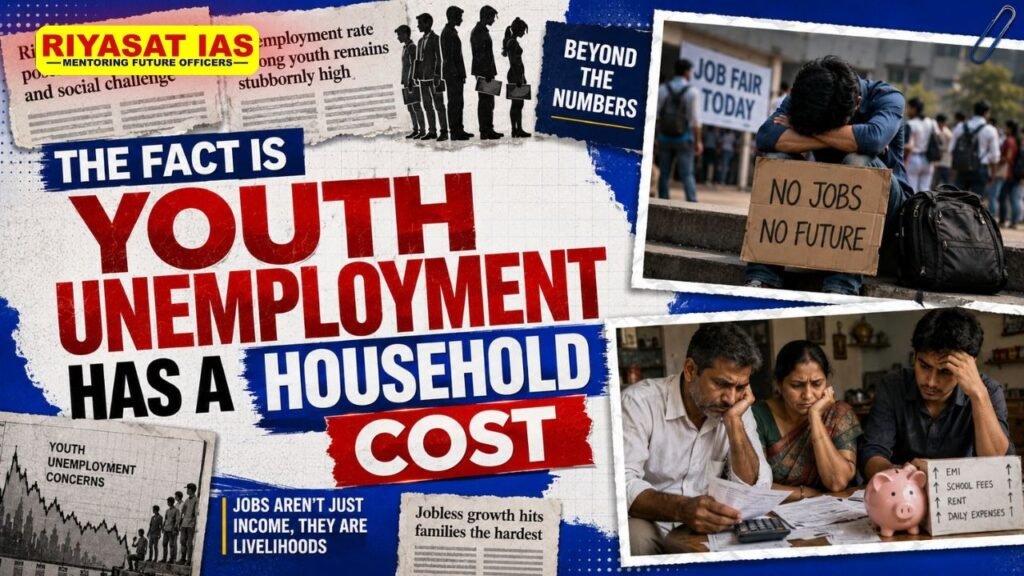
- Central Argument: Youth unemployment is therefore not merely an individual employment problem; it can become a household-level economic burden.
A Household-Level Perspective
- Individual vs Household: Unemployment is rarely experienced by the young person alone.
- Family Investment: Behind an unemployed graduate is often a household that financed the degree, adjusted its spending and continues to support the job search.
- Household Burden: The economic impact therefore depends not only on whether a young person is unemployed, but also on:
- how long the job search continues; and
- how much earning capacity the household has to sustain it.
- Policy Implication: Youth unemployment should therefore be examined through both the individual labour-market lens and the household economic lens.
Households That Invested in Education
- Tertiary-Educated Youth: Around 15.4% of Indian households have a tertiary-educated young adult aged 18–29.
- Expectation of Mobility: These households have invested in higher education expecting secure employment and upward mobility.
- Unemployed Educated Youth: Around 20.8% of households support at least one unemployed tertiary-educated young adult.
- Reduced Consumption: Compared to households without unemployed educated youth, such households spend on average:
- ₹1,087 less per month on overall consumption;
- ₹710 less per household member.
- Lower Earning Capacity: These households have, on average, only 1.5 earning members, compared with two in households without an unemployed educated youth.



Household Income Vulnerability
- No Active Earner: 14.4% of households with unemployed tertiary-educated youth have no active earning member.
- Single-Earner Dependence: 39.5% depend on only one earner.
- Regular Salaried Employment: In nearly 62.5% of such households, no one has a regular salaried job.
- Economic Vulnerability: This demonstrates that the ability of a household to sustain unemployment depends significantly on its earning capacity and employment security.
The Duration of Unemployment Matters
- Long Job Search: Nearly 58% of unemployed tertiary-educated youth have been searching for work for more than one year.
- Extended Unemployment: Around 28.9% have been unemployed for more than two years.
- Savings Pressure: Prolonged unemployment can deplete household savings.
- Consumption Reduction: Families may reduce consumption to finance the continuing job search.
- Employment Choices: Extended unemployment can force households to reconsider what type of employment the young person should accept.
- Household Capacity: A household with several earners can sustain a prolonged job search more easily than one dependent on a single income or without a regular salaried worker.
The ‘Any Job’ vs ‘Good Job’ Dilemma
- Pressure to Earn: Young people from financially vulnerable households may be pushed towards immediate employment.
- Qualification Mismatch: This can result in accepting jobs far below their qualifications.
- Economic Insecurity: For such families, the choice is not necessarily between a “good job” and a “bad job.”
- Real Choice: It can become a choice between “any job” and economic insecurity.
- Long-Term Impact: Such employment choices can contribute to underutilisation of human capital and weaken the expected benefits of higher education.
Why the Current Framing Is Incomplete
- Individual-Centric Approach: Current employment policy largely treats youth joblessness as an individual problem.
- Existing Responses: Policies focus on:
- apprenticeships;
- skilling; and
- hiring incentives.
- Missing Dimension: The evidence suggests that unemployment has consequences for the entire household supporting the jobseeker.
- Transition Period: The duration of the transition from education to employment is therefore important.
- Unequal Household Impact: Recruitment delays impose different costs on:
- households with multiple earners;
- households dependent on one income; and
- households without a regular salaried worker.
Key Concerns
- Educated Unemployment: High unemployment among tertiary-educated youth indicates a mismatch between education and employment opportunities.
- NEET Population: A large NEET population represents underutilised human capital.
- Gender Gap: The high proportion of young women outside the labour force highlights the gender dimension of labour-market exclusion.
- Household Distress: Prolonged unemployment reduces household consumption and increases financial pressure.
- Recruitment Delays: Delays in examinations, selection and recruitment extend the period during which families must finance unemployed youth.
- Skill–Job Mismatch: Young people may accept jobs significantly below their qualifications because of immediate economic pressures.
- Demographic Dividend: Persistent educated unemployment can weaken the ability to convert India’s large young population into a productive demographic dividend.
Way Forward
- Reduce Recruitment Delays: Minimise avoidable delays in examinations, selection processes and recruitment.
- Focus on Duration: Employment policy should monitor not only the incidence of unemployment but also its duration.
- Household-Sensitive Policy: Recognise the economic circumstances of households supporting unemployed youth.
- Faster Transition to Work: Reduce the period between completion of education and entry into employment.
- Strengthen Employment Pathways: Apprenticeships, skilling and hiring incentives should be complemented by faster and more predictable pathways into work.
- Support Vulnerable Households: Greater attention should be given to households with single earners or no regular salaried worker.
- Women’s Labour Force Participation: Address the factors keeping educated young women outside the labour force.
- Better Labour-Market Alignment: Strengthen the linkage between higher education, skills and actual employment opportunities.
Conclusion
India’s youth unemployment crisis cannot be understood only through the unemployment rate. The broader challenge includes NEET youth, labour-force withdrawal, prolonged job searches and the household costs of supporting unemployed educated young people.
Reducing avoidable delays in entry into work is consequently not only a labour-market objective, but also a means of reducing the economic strain on households and strengthening India’s demographic dividend.
UPSC Mains Practice Question
Q. “India’s youth unemployment crisis is not merely an individual labour-market problem but increasingly a household economic burden.” Discuss in the light of recent PLFS data.





 Ravi Raaz
 Hassan Khan
 Shadab Ali