
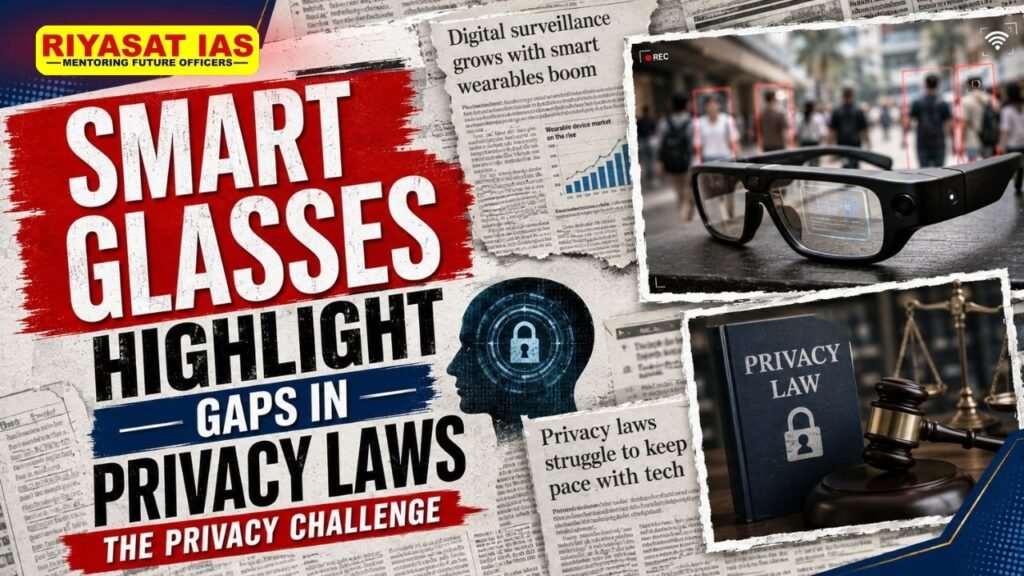
GS-II: Fundamental Rights | Judiciary | Governance | Data Protection
GS-III: Science & Technology | Artificial Intelligence | Cyber Security | Emerging Technologies
Context
- Smart Glasses: In June, reality star Kylie Jenner promoted Meta’s AI-powered smart glasses, highlighting the growing popularity of wearable technology.
- Privacy Irony: The promotion drew attention because of her earlier concerns about the lack of privacy associated with fame, while smart glasses themselves enable discreet recording.
- Technology: Meta’s smart glasses allow users to:
- answer calls, messages and notifications through voice commands;
- listen to music through built-in speakers; and
- capture photos and videos through an integrated camera.
How Do Smart Glasses Create Privacy Risks?
- Invisible Recording: The camera and other components are integrated into ordinary-looking eyewear, making recording difficult for others to recognise.
- Recording Indicator: Meta uses an LED recording indicator, but stickers claiming to cover the indicator are widely available.
- Workarounds: Such indicators can potentially be circumvented.
- Weak Warning: Although the glasses make a shutter sound when recording begins or ends, this may not provide a sufficiently strong indication that someone is being recorded.
- Asymmetric Control: Meta states that the glasses are “designed for privacy, controlled by you.”
- Key Limitation: Such control primarily rests with the wearer, rather than the person being recorded.
- Data Collection: Meta states that it collects data required to ensure that the glasses and associated application are reliable, secure and operating normally.
Privacy and Data Concerns
- Contractor Access: An investigation by Swedish newspapers Svenska Dagbladet and Göteborgs-Posten found that Meta’s contracted workers, who sometimes review data to track user experience, were able to view sensitive content filmed using the smart glasses.
- Sensitive Content: This reportedly included footage of wearers using the toilet.
- Meta’s Response: Meta told BBC News that its privacy policy states that it sometimes uses contractors to review data shared with them.
- Core Issue: The concern extends beyond the wearer’s privacy to the privacy of people captured by the device.
Risks to Women
- NCRB Data: In 2023, before these glasses entered the market, there were 3,678 cases of women-centred cybercrimes.
- Sexually Explicit Material: Of these, 2,767 cases involved the transmission or publication of sexually explicit material.
- Potential Misuse: Smart glasses could make it easier to record people without their knowledge, including in private spaces.
- Gendered Risk: Women may face heightened risks of non-consensual recording and circulation of intimate material.



Risks to Children
- Child Sexual Abuse Material: In 2023, the NCRB recorded over 698 cases related to the use or storage of child sexual abuse material.
- Consent Problem: If adults cannot easily recognise when the glasses are recording, children may be even less capable of recognising such recording.
- Vulnerability: The discreet nature of wearable cameras increases the potential for non-consensual collection of children’s images and information.
Scale of Potential Data Collection
- Battery Life: The glasses offer around 4–9 hours of active use.
- Continuous Recording: This makes prolonged recording technically possible.
- Possible Uses: The glasses could potentially be used to:
- record entire movies;
- tape university lectures;
- scan confidential documents; and
- collect patient information.
- Accidental Collection: Even users who do not intentionally engage in malpractice could capture private information within the periphery of the camera frame.
- Core Risk: The technology therefore enables extensive non-consensual collection of personal information.
Lacuna in Indian Law
Digital Personal Data Protection Act, 2023 (DPDPA)
- Technology-Neutral Framework: The DPDPA is technologically agnostic, making the purpose of data collection a key consideration.
- Public Spaces: In public spaces, individuals cannot necessarily grant consent or monitor how their information is being used.
- Publicly Available Information: The DPDPA excludes information that is made publicly available.
- Resulting Gap: This creates difficulty in regulating how an individual is recorded in a public space without their knowledge.
Right to Privacy
- K.S. Puttaswamy Judgment, 2017: The Supreme Court recognised privacy as a fundamental right under Article 21.
- Reasonable Expectation of Privacy: Individuals may retain a reasonable expectation of privacy even in public spaces.
- Public Space ≠ Unlimited Surveillance: Being in a public place does not necessarily mean that a person expects to be captured in detail and have the information subsequently used.
- Legal Gap: The reasonable expectation of privacy recognised in Puttaswamy is not fully addressed when the law does not adequately regulate recording through discreet wearable devices.
Why Existing Safeguards May Be Insufficient
- Low Visibility: Unlike smartphones, smart glasses provide minimal visible indicators that someone may be recording.
- Lack of Awareness: Individuals may not know that they are within the camera’s frame.
- Consent Problem: Meaningful consent becomes difficult when the subject is unaware of the recording.
- Secondary Use: People may have limited knowledge regarding where or how captured information is subsequently used.
- Technology–Law Gap: Rapid technological innovation has outpaced the development of corresponding legal safeguards.
- Public Awareness: Limited awareness further increases the risks associated with emerging wearable technologies.
Broader Governance Challenge
- AI and Wearables: AI-enabled wearable devices are changing how personal information is captured and processed.
- Accountability: Without appropriate safeguards, digital accountability may become an afterthought.
- Business–Rights Balance: The challenge is to protect privacy without unnecessarily preventing technological innovation and legitimate commercial activity.
- Emerging Market: Meta is currently a major player, while Google and Reliance are also entering the smart glasses market.
- Future Expansion: As wearable technology becomes more advanced, regulating it through outright prohibition will become increasingly difficult.
Way Forward
- Technology-Aware Regulation: Laws should be framed with an understanding of how AI and wearable technologies are evolving.
- Risk Assessments: Conduct assessments of:
- how technology is likely to evolve;
- the risks associated with emerging devices; and
- the government’s responsibility towards protecting citizens.
- Privacy by Design: Privacy safeguards should be incorporated into the design and operation of wearable devices.
- Stronger Indicators: Recording indicators should be sufficiently visible and difficult to circumvent.
- Consent Mechanisms: Greater emphasis should be placed on protecting the rights of people being recorded, not merely device users.
- Data Accountability: Clear safeguards are required regarding the collection, processing, storage and subsequent use of captured information.
- Protection of Vulnerable Groups: Special safeguards should address risks to women and children.
- Public Awareness: Citizens should be made aware of the privacy risks posed by emerging wearable technologies.
- Periodic Legal Review: Data-protection frameworks should evolve alongside technological developments.
Conclusion
AI-powered smart glasses represent the growing convergence of artificial intelligence, wearable technology and ubiquitous data collection. Their discreet design creates a significant challenge for conventional notions of consent and privacy.
Outright banning such devices is neither practical nor desirable from a technological or business standpoint. Instead, India needs a regulatory framework capable of anticipating technological change and addressing the risks associated with it. The objective should be to ensure that technological innovation does not come at the cost of privacy, dignity and individual autonomy, while maintaining space for responsible innovation.
UPSC Mains Practice Question
Q. “Rapid innovation in AI-enabled wearable technologies is creating new forms of surveillance that existing privacy laws may struggle to address.” Discuss with reference to smart glasses and India’s data-protection framework.





 Ravi Raaz
 Hassan Khan
 Shadab Ali