
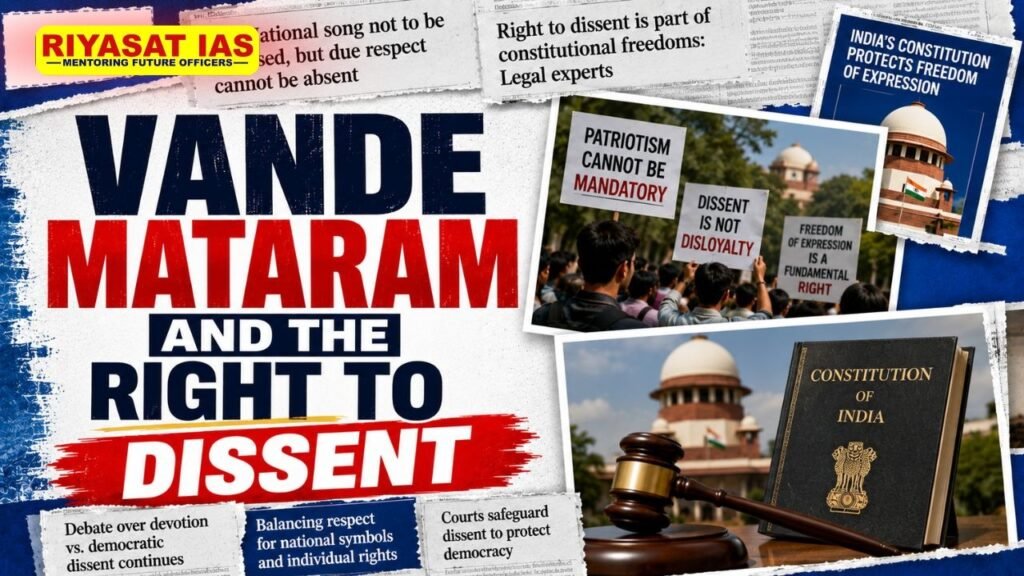
GS-II: Indian Constitution | Fundamental Rights | Freedom of Religion | Parliament & Judiciary
Context
- 2026 Amendment: Parliament extended the criminal-law protection under the Prevention of Insults to National Honour Act, 1971 to Vande Mataram, alongside the National Anthem.
- Constitutional Debate: The move has raised questions regarding freedom of conscience, religious freedom and freedom of expression.
- Key Issue: The amendment protects the performance of the national song but does not explicitly mandate participation or prescribe any particular version/stanzas.
- Judicial Relevance: The Supreme Court’s judgment in Bijoe Emmanuel v. State of Kerala (1986) provides important protection to individuals who respectfully refrain from patriotic rituals due to genuine religious convictions.
Why Vande Mataram Was Not Made the National Anthem
- Constituent Assembly: On January 24, 1950, Dr. Rajendra Prasad declared Jana Gana Mana as the National Anthem.
- Equal Honour: He stated that Vande Mataram, because of its historic role in the freedom struggle, would be honoured equally with Jana Gana Mana.
- No Constitutional Reference: The Constitution does not specifically mention the term “National Song”.
- 1937 Congress Decision: Due to objections regarding the later devotional stanzas, the Congress Working Committee decided that only the first two stanzas would be used at official gatherings.
- Reason: The first two stanzas were considered relatively secular in imagery, while the later verses contain references to Hindu goddesses.
What the 2026 Amendment Provides
- Amendment: Section 3 of the Prevention of Insults to National Honour Act, 1971 has been substituted.
- Two Prohibited Acts:
- Intentionally preventing the singing of the National Anthem or National Song.
- Causing disturbance to an assembly engaged in singing them.
- Punishment: Up to three years’ imprisonment, fine, or both, with a mandatory minimum for repeat offenders.
- No Mandatory Version: The law does not specify which stanzas of Vande Mataram must be sung.
- No Compulsory Participation: The amendment does not expressly require every person present to sing the song.
- Core Distinction: The law protects the performance from intentional obstruction, rather than compelling individual participation.



The Controversy over Later Stanzas
- First Two Stanzas: Describe the motherland through imagery of nature, rivers, fields and prosperity.
- Later Stanzas: Invoke Durga, Lakshmi and Saraswati and contain explicitly devotional imagery.
- Constitutional Concern: Compelling an individual to participate in such verses may raise questions relating to freedom of conscience and religious belief.
- Historical Context: The exclusion of the later verses from official public singing dates back to the 1937 Congress compromise.
Freedom of Conscience
- Article 25: Guarantees freedom of conscience and the freedom to profess, practise and propagate religion, subject to constitutional limitations.
- Article 26: Protects the right of religious denominations to manage their religious affairs.
- Article 19(1)(a): Protects freedom of speech and expression, which includes protection against compelled expression in appropriate circumstances.
- Fundamental Rights: Ordinary legislation cannot override constitutionally guaranteed fundamental rights.
- Key Principle: Respect for national symbols cannot automatically become a justification for compelling an individual to act against genuine religious conscience.
Bijoe Emmanuel v. State of Kerala (1986)
- Background: Three Jehovah’s Witness students respectfully stood during the National Anthem but did not sing it because of their religious beliefs.
- Action Against Students: They were expelled from school.
- Supreme Court: The Court protected their right to remain silent while respectfully standing.
- Article 19(1)(a): The Court recognised that freedom of expression also includes, in the circumstances, the freedom to remain silent.
- Article 25(1): Genuine freedom of conscience was protected.
- Article 51A: Fundamental duties cannot be used to override fundamental rights.
- Important Principle: Respect for the National Anthem does not necessarily require active participation in singing.
- Broader Message: Constitutional patriotism must coexist with tolerance, pluralism and individual conscience.
Legal Position after the Amendment
- No Compulsory Singing: The amendment does not expressly require every citizen to sing Vande Mataram.
- No Fixed Version: It does not prescribe that all six stanzas must be sung.
- Protection from Disruption: It primarily criminalises intentional prevention or disturbance of an ongoing performance.
- Right to Refrain: A citizen with a genuine conscientious or religious objection may refrain from singing, provided they do not intentionally disrupt the performance.
- Bijoe Emmanuel Principle: Respectful silence remains constitutionally significant.
- Constitutional Balance: The State must protect both national symbols and individual liberty.
Key Constitutional Concerns
- Freedom of Conscience: Criminal law should not indirectly compel an individual to participate in religiously objectionable conduct.
- Compelled Expression: Patriotism cannot ordinarily be reduced to compulsory verbal or symbolic expression.
- Religious Pluralism: India’s constitutional framework protects diverse faiths and beliefs.
- Majoritarian Pressure: Protection of national symbols should not become a means of imposing a particular religious interpretation.
- Rule of Law: Enforcement must follow the actual statutory text, rather than political rhetoric surrounding it.
- Constitutional Morality: National unity should be promoted through respect and tolerance, not coercion.
Way Forward
- Respect Constitutional Rights: Enforcement should remain consistent with Articles 19, 25 and 26.
- Clear Guidelines: Authorities should clarify that respectful non-participation is distinct from intentional disruption.
- Avoid Coercion: No citizen should be compelled to participate merely because of political or social pressure.
- Promote Constitutional Patriotism: National symbols should inspire voluntary respect and national unity.
- Public Awareness: Citizens and institutions should be made aware of the principles laid down in Bijoe Emmanuel.
- Maintain Pluralism: Protection of national symbols must remain compatible with India’s religious and cultural diversity.
Conclusion
The 2026 amendment strengthens legal protection for the National Anthem and Vande Mataram, but its implementation must remain within the limits of fundamental rights and freedom of conscience.
The principle established in Bijoe Emmanuel remains crucial: respect for national symbols does not necessarily mean compelled participation. India’s constitutional patriotism should therefore combine national respect with individual liberty, religious freedom and tolerance.
UPSC Mains Practice Question
Q. “Respect for national symbols must coexist with freedom of conscience and individual liberty.” Discuss in the light of the 2026 amendment relating to Vande Mataram and the Supreme Court’s judgment in Bijoe Emmanuel v. State of Kerala.




 Ravi Raaz
 Hassan Khan
 Shadab Ali