
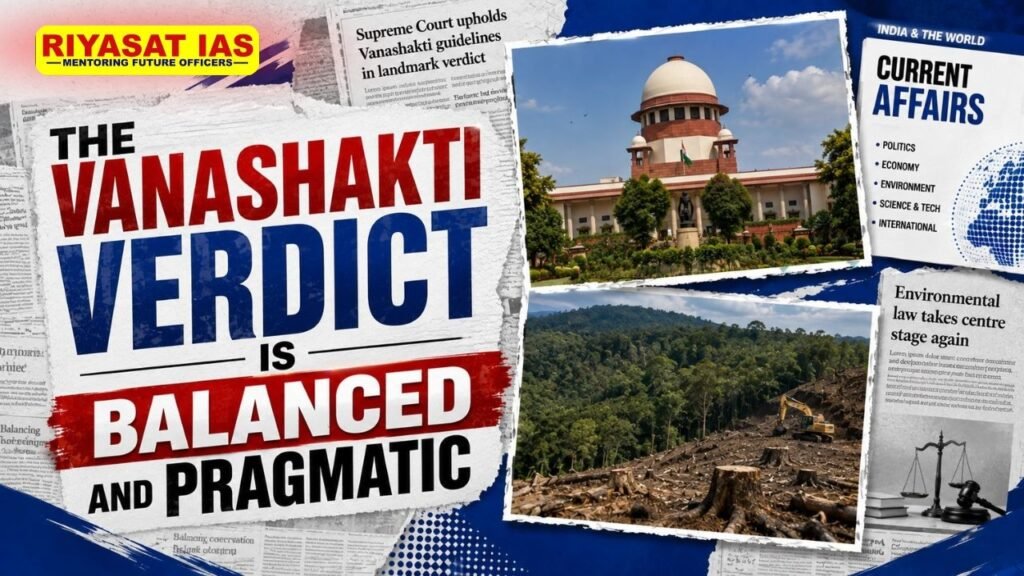
GS-III: Environment & Ecology | Environmental Governance | EIA | Environmental Clearance | Sustainable Development
Context
- Supreme Court judgment: On July 29, 2026, the Supreme Court in Vanashakti v. Union of India brought clarity to the issue of projects that commenced without obtaining prior Environmental Clearance (EC).
- Core principle: The Court firmly reiterated that prior EC is mandatory under the EIA Notification, 2006.
- Old mechanisms: Project proponents who commenced construction or operations without prior EC and did not apply under earlier violation mechanisms cannot now seek regularisation under the 2017 Notification or 2021 Office Memorandum.
- Policy significance: While closing the earlier regulatory routes, the judgment leaves open the possibility of a fresh statutory mechanism for dealing with certain legacy violation cases.
What Did the Supreme Court Hold?
- Prior EC mandatory: Projects requiring EC must obtain it before commencement of construction or operations.
- No fresh regularisation: Projects that violated this requirement cannot now seek regularisation through the 2017 Notification or 2021 Standard Operating Procedure (Office Memorandum).
- Earlier mechanisms unavailable: These mechanisms are no longer available for fresh cases.
- Administrative vs statutory mechanism: The Court distinguished between:
o Office Memorandum: Cannot override the statutory requirement of prior EC.
o Statutory Notification: The Central Government may issue one under the powers available under environmental legislation, subject to legal safeguards.
Role of Section 3 of the Environment (Protection) Act, 1986
- Statutory power: The Central Government continues to possess powers under Section 3 of the Environment (Protection) Act, 1986.
- Fresh mechanism: The government may, if considered necessary in the larger public interest, frame a fresh statutory mechanism for dealing with violation cases.
- Not a direction: The Supreme Court has not directed the government to introduce such a mechanism.
- Policy choice: Whether to formulate such a framework rests entirely with the Central Government.



Why is the Judgment Significant?
- Large number of projects: Numerous industrial units, commercial developments, infrastructure projects and public utility projects remain in violation of EC requirements.
- Different reasons for violations: Some projects proceeded because of regulatory uncertainty, incorrect interpretation of law or failure to obtain necessary approvals.
- Legacy cases: Some projects never applied under earlier violation windows and have been left without a legal pathway after closure of the 2017 scheme and striking down of the 2021 Office Memorandum.
- Practical approach: The judgment recognises this practical reality while maintaining that prior EC remains mandatory.
Balancing Environmental Protection and Public Interest
- No routine regularisation: Environmental law cannot encourage a “violate first, regularise later” approach.
- One-time mechanism: Any future mechanism should be strictly one-time.
- Statutory authority: It must be based on proper statutory authority.
- Environmental safeguards: A future framework should incorporate:
o Environmental damage assessment
o Remediation measures
o Environmental compensation
o Strict compliance conditions
- Public interest: Indiscriminate closure or demolition of every violation project may not always serve environmental protection or the larger public interest, particularly where projects are otherwise environmentally acceptable and substantial investments have already been made.
Key Environmental Governance Principle
- Strict enforcement: Environmental laws must continue to enforce the requirement of prior EC.
- Practical solutions: At the same time, regulatory responses should address genuine legacy violations through practical and scientifically sound solutions.
- Environmental governance: The judgment seeks to combine strict enforcement with scientifically sound regulatory solutions.
Implications for Project Developers
- No fresh applications: Fresh applications cannot now be made under the earlier violation mechanisms.
- Regulatory uncertainty: Pending violation projects remain dependent on any future policy decision of the Central Government.
- Future framework: A fresh statutory framework, if introduced, would need to comply with environmental law and statutory safeguards.
- Compliance message: The immediate message for developers and infrastructure agencies is that prior EC cannot be bypassed.
Way Forward
- Prior EC: Maintain the principle that Environmental Clearance must precede commencement of projects.
- Statutory framework: Any future regularisation mechanism should be based on statutory authority, not merely an administrative Office Memorandum.
- One-time solution: If introduced, it should provide only a one-time opportunity for specified categories of genuine legacy violations.
- Environmental safeguards: Incorporate damage assessment, remediation, compensation and strict compliance conditions.
- Transparency: Any future mechanism should be lawful, transparent and environmentally robust.
- Public interest: Balance environmental protection with the larger public interest, without creating incentives for deliberate violations.
Conclusion
The Vanashakti judgment closes the old regulatory route for post-facto regularisation while leaving legislative space for a carefully structured statutory solution to genuine legacy violations. It therefore preserves the integrity of the prior Environmental Clearance regime while recognising the need for a lawful, transparent and environmentally robust approach to existing cases.
UPSC Mains Practice Question
Q. “Environmental governance must balance strict enforcement of prior Environmental Clearance with practical solutions for genuine legacy violations.” Discuss in the context of the Supreme Court’s judgment in Vanashakti v. Union of India (2026).



 Ravi Raaz
 Hassan Khan
 Shadab Ali