
GS-III: Indian Economy | Public Finance | Taxation | Fiscal Policy | Government Budgeting
Context
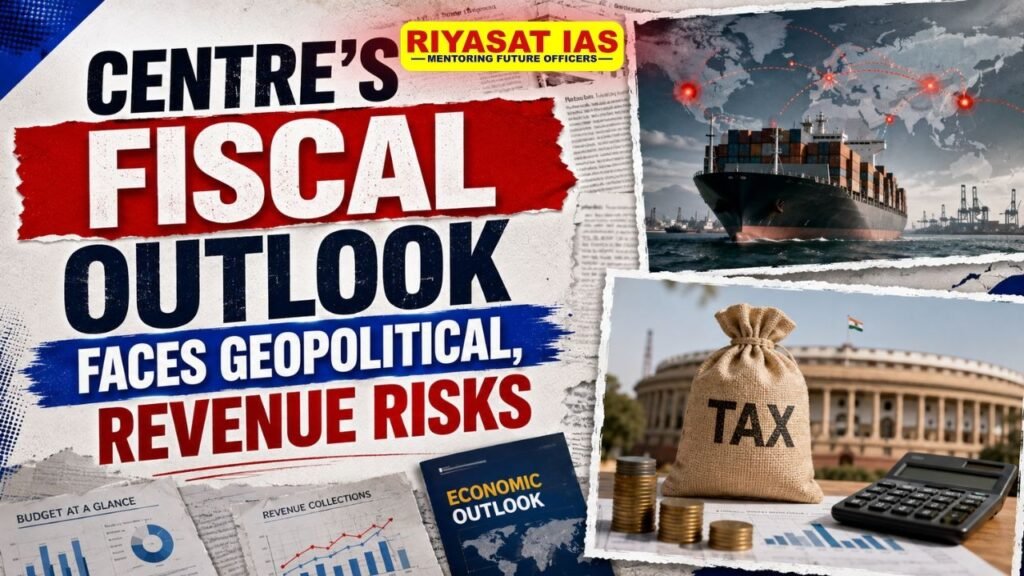
- Fiscal outlook: Geopolitical headwinds, along with recently introduced tax changes, are likely to shape the Centre’s fiscal outlook for 2026-27.
- Broadly on track: Despite pressure on tax revenues and subsidies, strong non-tax receipts and policy interventions may keep fiscal outcomes broadly on track.
- Gross Tax Revenue: According to CGA data, Centre’s GTR grew by only 3.7% in Q1 of 2026-27.
- Main reason: The subdued performance of Personal Income Tax (PIT) and GST, both of which underwent significant modifications in 2025-26.
Centre’s Revenue Receipts
1. Tax Revenue
- Tax rationalisation: Extensive rate rationalisation was undertaken in both PIT and GST.
- GST: There was a substantive reduction in GST rates.
- Initial revenue sacrifice: These reforms were expected to cause an initial revenue loss, which would subsequently be offset through expansion of the tax base.
- PIT: Revenue growth in 2025-26 was only 0.037%, implying zero tax buoyancy.
- GST: Revenue growth in the second half of 2025-26 was 4.67%.
- Q1 2026-27: PIT grew by 6.8%, while GST revenue contracted by 11%.
2. Impact of West Asian Crisis
- Crude oil: The West Asian crisis resulted in high and volatile global crude oil prices.
- Supply-side uncertainty: The crisis also created broader supply-side uncertainties for the Indian economy.
- Excise duty reduction: To protect consumers from rising retail fuel prices, the government reduced excise duties.
- Revenue impact: Union excise duty revenue consequently contracted by 22.4% in Q1 of 2026-27.
Government’s Remedial Revenue Measures
- HSNS Cess: A Health Security and National Security (HSNS) Cess was introduced from February 1, 2026, while the GST Compensation Cess was discontinued.
- Windfall tax: The windfall tax on exports of diesel, petrol and aviation turbine fuel was increased from August 3, 2026.
- Import duties: Duties were increased on gold and silver bullion and other specified precious-metal articles, sweepings and clad metals.
- Purpose: These measures aim to compensate for revenue shortfalls arising from tax reductions and geopolitical pressures.



Nominal GDP and Revenue Outlook
- Higher nominal GDP: Nominal GDP growth is expected to be higher than the budgeted 10.04%.
- Expected nominal GDP growth: 12.5%-13% in 2026-27.
- Real GDP growth: Expected at around 7%.
- IPD-based inflation: Expected at 5%-5.5%.
- Q1 inflation: CPI inflation stood at 3.9%, while WPI inflation stood at 9.3%.
- Nominal GDP: Estimated at ₹391 lakh crore, compared with the budgeted ₹393 lakh crore.
- GTR outlook: Estimated GTR is expected to be realised or fall short only by a small margin.
- Fuel excise: The reduction in fuel excise duty should be restored at a suitable time.
Transfers to States
- Net tax revenue: A 65% ratio of net to gross tax revenue can be applied, based on 2025-26 and 2026-27 Budget Estimates.
- States’ share: The Sixteenth Finance Commission (FC16) retained States’ share in the divisible pool at 41%.
- HSNS Cess: Since HSNS Cess is non-shareable, the divisible pool may marginally decline.
- Possible compensation: Some HSNS Cess revenue may reach States through non-FC grants.
- Tax devolution: Tax devolution to States contracted by 19.5% in Q1 of 2026-27.
- Future transfers: An increase in assignment of central tax revenues to States is expected in subsequent months.
- FC grants: Finance Commission grants to States are budgeted to contract by ₹23,556 crore in 2026-27.
Non-Tax Revenue and Expenditure
- RBI dividend: The RBI provided major fiscal support through dividends transferred to the Centre in May 2026.
- Coverage: 77% of the budgeted dividends and profits for the full year had already been received in the first three months.
- Non-tax receipts: Budgeted amounts for non-tax and non-debt capital receipts are expected to be realised.
- Contribution: Non-tax revenues contributed 37% of the Centre’s net revenue receipts in Q1 of 2026-27.
Subsidies and Capital Expenditure
- Subsidies: Major subsidies increased by 37.4% due to the unexpected rise in global crude oil prices.
- Revenue expenditure: Despite higher subsidies, revenue expenditure growth was contained at 7.4%.
- Capital expenditure: Capital expenditure grew by 23.7% in Q1 of 2026-27.
- Previous quarter: This compares with a contraction of 23.3% in Q4 of 2025-26.
- Subsidy risk: If Q1 subsidy levels continue throughout the year, realised subsidies could exceed the budgeted amount by around ₹50,000 crore.
Debt and Fiscal Deficit
- Fiscal deficit: Q1 fiscal deficit accounted for 18.2% of the annual budgeted magnitude.
- Revenue deficit: Revenue deficit accounted for only 0.4% of the annual budgeted magnitude.
- Reason for strong revenue account: Mainly due to the contribution of non-debt receipts.
- Fiscal deficit: Estimated at ₹18.16 lakh crore.
- Fiscal deficit-to-GDP: Estimated at 4.6% under the new GDP series.
- Debt-to-GDP: Estimated at 55.8%.
- Overall position: These levels remain close to the budgeted position after accounting for the impact of the new GDP series.
Key Risks
- Tax revenue shortfall: Weaker-than-expected tax collections could cause fiscal slippage.
- Higher subsidies: Additional subsidy expenditure due to crude oil prices could increase the fiscal burden.
- External debt: Sustained pressure on the Indian rupee may lead to slightly higher external debt.
- Geopolitical uncertainty: Continued instability in West Asia could keep global crude oil prices under pressure.
- War escalation: Escalation of the conflict could deliver a major shock to the economy and central finances.
Overall Assessment
- Broadly on track: Significant deviations from budgeted fiscal outcomes appear unlikely at present.
- Revenue support: Strong non-tax receipts, particularly RBI dividends, provide important fiscal support.
- Expenditure management: Revenue expenditure growth remains relatively contained.
- Capex: Strong capital expenditure growth indicates continued public investment.
- Fiscal risks: Weak tax revenues and higher subsidies remain the major areas of concern.
Conclusion
The Centre’s fiscal outlook for 2026-27 remains broadly stable, supported by strong non-tax receipts and policy interventions. However, subdued tax revenues, higher subsidy requirements and geopolitical uncertainty pose risks to fiscal consolidation. An escalation of the West Asian crisis could significantly alter the current fiscal trajectory.
UPSC Mains Practice Question
Q. “Geopolitical shocks can simultaneously affect government revenues, subsidies, public debt and fiscal deficits.” Examine the Centre’s fiscal outlook for 2026-27 in the light of recent tax changes and geopolitical uncertainties.




 Ravi Raaz
 Hassan Khan
 Shadab Ali