
GS-III: Agriculture | Renewable Energy | Groundwater | Energy Subsidies | Climate Change
Context
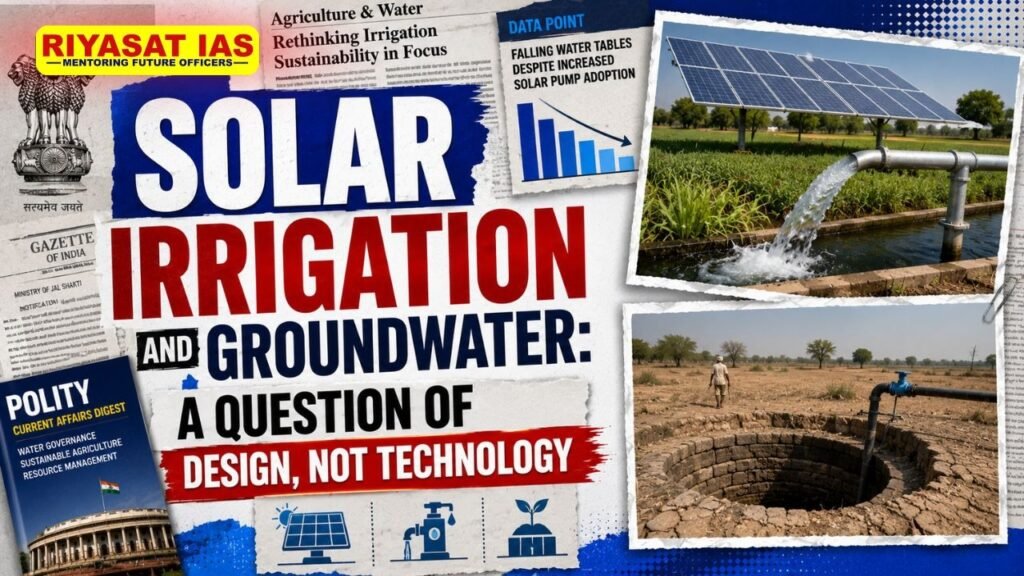
- Groundwater concern: Rapid expansion of solar irrigation has raised concerns that almost-free electricity may encourage excessive groundwater pumping.
- Existing crisis: Subsidised or free electricity has contributed to falling water tables, aquifer depletion and growing fiscal burdens on energy utilities.
- Central argument: Solar irrigation is not inherently good or bad for groundwater. Its impact depends on the model deployed, location and incentives provided.
- Broader perspective: Solar irrigation must be assessed across the water–energy–food nexus, rather than as only a groundwater or energy intervention.
Solar Irrigation Models Matter
- Standalone solar pumps: A farmer operates an individual pump and may have little incentive to conserve groundwater when solar power is almost free.
- Grid-connected solar: Farmers can sell surplus solar electricity to the grid, creating an incentive to reduce electricity consumption and pumping.
- Gujarat’s SKY scheme: Under the Suryashakti Kisan Yojana (SKY), around 100 agricultural feeders were transitioned to solar energy.
- Water-use outcome: Solar farmers showed slower growth in energy consumption and irrigation application than non-solar farmers.
- Feed-in tariff: The scheme offered around ₹7 per unit, creating an incentive to conserve electricity and export surplus energy.
- Farmer income: Farmers earned approximately ₹21,900 annually on average by exporting electricity, shifting from energy consumers to energy producers.
Bangladesh’s Fee-for-Service Model
- Centralised solar model: Pump owners supply irrigation water to multiple farmers within a fixed command area.
- Economic incentive: Excessive irrigation by one farmer reduces the operator’s ability to serve other farmers.
- Outcome: Solar-irrigating farmers did not apply more water than diesel-irrigating farmers despite solar irrigation being 20–30% cheaper.
- Key lesson: Business sustainability can create incentives for efficient and equitable groundwater use.
PM-KUSUM: Diverse Outcomes
- Standalone pumps: Under PM-KUSUM, solar pump utilisation varies considerably.
- Key factors: Outcomes depend on:
o Installed capacity
o Depth of water table
o Years of operating experience



o Extent to which solar replaces diesel or grid electricity
- Implication: Solar irrigation cannot be treated as a single uniform model.
Punjab and Haryana
- Existing irrigation: Irrigation is already widespread.
- Water-intensive crops: Agriculture is dominated by rice and wheat.
- Limited scope for expansion: Since irrigation coverage is already high, there is limited scope for expanding irrigated areas.
- Key question: The issue is less about whether solar irrigation will cause further groundwater exploitation and more about whether it can make water, energy and food systems more sustainable.
- Potential benefits: Replacing subsidised fossil-fuel electricity with grid-connected solar can:
o Reduce subsidy costs
o Lower emissions
o Encourage efficient water and energy use
Eastern India: A Different Situation
- Limited irrigation: Large areas remain rainfed.
- Energy constraint: Irrigation expansion is constrained more by access to energy than access to water.
- High diesel costs: Farmers face high costs of diesel-based irrigation.
- Unreliable electricity: Unreliable power supply further limits irrigation.
- Solar opportunity: Solar irrigation can improve agricultural productivity and climate resilience.
- Policy priority: In such regions, the priority should be expanding irrigation access, rather than restricting water use.
Water–Energy–Food Nexus
- Emissions: Groundwater irrigation in India is estimated to generate 45–62 million tonnes of CO₂ annually.
- Electricity subsidies: Agricultural electricity subsidies across States amount to over ₹1 lakh crore annually.
- Potential benefits of solar irrigation: It can simultaneously reduce emissions and electricity subsidy burdens.
- Gujarat evidence: Each grid-connected solar farmer offsets approximately 12.3 tonnes of CO₂ annually through on-farm solar use and electricity exports.
- Fiscal benefit: Subsidies covered nearly one-fourth of government investments within the first two years.
- National scale: With more than 25 million agricultural pumps, the mitigation and fiscal implications are substantial.
PM-KUSUM and Expansion
- Solar pumps: Over the past five years, PM-KUSUM has installed more than 2.5 million solar pumps.
- Affordability: Subsidies have made solar pumps more accessible to smallholder farmers.
- PM-KUSUM 2.0: The challenge is to expand clean energy without worsening India’s over-exploited groundwater.
- Water-stressed regions: Grid-connected solar can be expanded through:
o Individual pumps
o Solarisation of entire agricultural feeders
Limitations of Current Models
- Individual pump model: Paying farmers to save water by selling surplus electricity to the grid has seen limited uptake.
- Feeder-level solarisation: Has performed better, but currently does little to change pumping behaviour.
- Need for refinement: Both models require improvements to simultaneously achieve energy transition and groundwater conservation.
Way Forward
- Individual pumps: Simplify grid connection procedures and provide attractive buyback prices reflecting the local value of water and crops.
- DISCOM incentives: Distribution companies should be incentivised to support grid-connected solar pumps.
- Feeder-level solarisation: Pair solarised feeders with water-saving incentives.
- Micro-irrigation: Promote water-saving technologies alongside solar irrigation.
- Direct incentives: Provide cash payments for reduced pumping, similar to Punjab’s ‘Pani Bachao, Paisa Kamao’ and Haryana’s ‘Mera Pani Meri Virasat’ schemes.
- Water-stressed regions: Combine solarisation with stronger groundwater monitoring and adaptive management.
- Low irrigation regions: Where farmers lack reliable irrigation and groundwater risk is low, standalone solar pumps should remain preferred.
- Collective models: Scale solar irrigation through water-user associations, water-selling entrepreneurs and farmer cooperatives, particularly in irrigation-deprived regions.
Conclusion
The question is not whether solar irrigation is inherently harmful or beneficial to groundwater. Its impact depends on the irrigation model, local hydrogeology, cropping pattern, water availability and economic incentives.
India therefore needs a differentiated regional strategy: conserve groundwater where irrigation is already intensive, while expanding irrigation access where energy constraints limit agricultural productivity. The objective should be to maximise the combined benefits of clean energy, sustainable water use and agricultural resilience.
UPSC Mains Practice Question
Q. “The impact of solar irrigation on groundwater depends more on the model, location and incentives than on the technology itself.” Discuss in the context of India’s groundwater crisis and PM-KUSUM.





 Ravi Raaz
 Hassan Khan
 Shadab Ali