
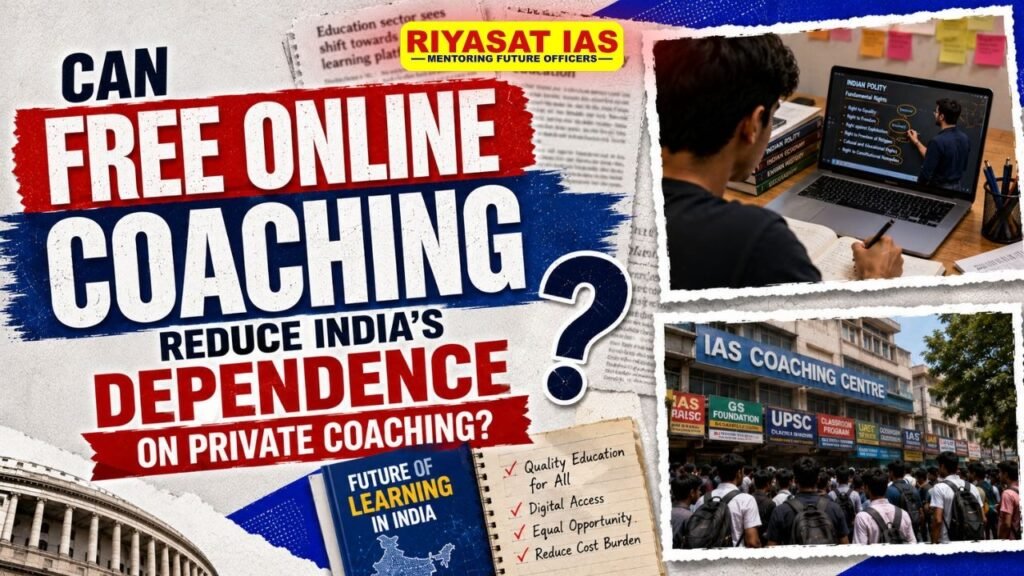
GS-II: Education | Social Justice | Digital Public Infrastructure | Educational Equity
GS-III: Technology | Artificial Intelligence | Digital Inclusion
Context
- PM’s announcement: In his 2026 Independence Day address, Prime Minister Narendra Modi announced that the government would roll out free online coaching for competitive examinations using India’s Digital Public Infrastructure.
- Target group: The initiative seeks to reach Gen-Z youth, particularly amid widespread student concerns following the NEET paper leak.
- Objective: To reduce the financial burden on poor and middle-class families and enable students to prepare without leaving their homes.
- Core question: Whether free public technology can reduce India’s dependence on the private coaching industry.
Why is Coaching Important?
- School vs competitive exams: Schools focus mainly on conceptual learning and board examinations, while competitive examinations test the ability to outperform millions of candidates under severe time pressure.
- Different skill set: Competitive exams require:
o Rapid problem-solving
o Test-taking strategies
o Option elimination
o Time management
o Performance under pressure
- Coaching ecosystem: Private coaching provides a structured environment that goes beyond lectures.
Limitations of Existing Digital Platforms
- Existing platforms: India already has public digital education platforms such as SWAYAM and Saathi.
- Traditional design: Existing platforms are viewed as relatively traditional and may not fully match the expectations of Gen-Z learners.
- Gen-Z expectations: Young learners increasingly seek:
o Mobile-based learning
o Quick content delivery
o Different content formats
o Immersive learning experiences
- Video library problem: Merely uploading free lectures may turn the initiative into another video library rather than a genuine alternative to coaching.
What Does the Coaching Industry Provide?
- Structured classes: Courses are systematically organised around the examination.
- Regular assessment: Students receive weekly assessments.
- Doubt resolution: Coaching provides doubt-solving forums.
- Personalised feedback: Teachers can identify individual weaknesses and guide students accordingly.
- Mentorship: Students receive both academic and emotional mentoring.
- Competitive environment: Peer interaction creates a competitive learning environment.
- Exam-specific preparation: Different examinations require different teaching approaches even for the same subject.



Need for a Hybrid Model
- Online + offline: Free online coaching alone may not address all requirements; a hybrid mechanism combining digital learning with human assistance is needed.
- Skill hubs: Schools could function as skill hubs, where students attend physically and receive periodic mentoring alongside online classes.
- Digital twin: A digital twin of the learning ecosystem can allow students to customise their learning according to individual needs.
- Human assistance: Technology should remain digital-first but supported by human mentoring.
Common Competitive Learning Stack
Argument in Favour
- Common requirements: Around 70%-80% of national-level competitive examinations may have similar requirements relating to:
o Reasoning
o Language
o General awareness
o Current affairs
- National learning grid: A national competitive learning and opportunity grid could provide common foundational preparation.
- Layered model: Students could select additional layers depending on the specific examination.
Concerns
- Exam-specific nature: A common stack may not be feasible for all examinations.
- Different requirements: Even subjects such as Physics require different approaches for JEE and NEET.
- Dedicated platforms: A separate platform for each examination may therefore be more practical.
Bridging the Last Mile
- Digital divide: Students in remote areas may face:
o Poor Internet connectivity
o Unreliable electricity
o Long distances to examination centres
- Satellite technology: In difficult terrains, satellite connectivity can be explored.
- Remote examination model: A compact ground antenna could connect to LEO or GEO satellites.
- Offline server: The local base station could receive and store examination material and function as an offline server.
- Digital answer capture: Students could write answers on a smart digital pad, which captures and encrypts responses locally.
- Secure transmission: Encrypted answer files could be uploaded to the central examination authority once satellite connectivity becomes available.
- Existing infrastructure: Alternatively, smart boards and local mentoring centres can help deliver online classes to students in areas near cities.
Key Challenges
- Beyond lectures: Free access to content alone cannot replicate the entire coaching ecosystem.
- Personalisation: Students require individual feedback and doubt resolution.
- Mentorship: Human and emotional mentoring remains important.
- Exam diversity: Different competitive examinations require different preparation strategies.
- Digital divide: Connectivity and electricity remain barriers for some students.
- Quality: Covering more than 100 major national-level examinations could risk diluting quality.
Way Forward
- Structured ecosystem: Build a complete coaching ecosystem rather than merely providing free lectures.
- Hybrid learning: Combine online classes with physical mentoring and skill hubs.
- AI-based learning: Develop Agentic AI-based personalised and customised learning systems.
- Exam-specific design: Maintain dedicated preparation modules wherever examinations have significantly different requirements.
- Last-mile connectivity: Use smart boards, local centres and satellite technology where required.
- Mentorship: Ensure access to teachers, doubt-solving mechanisms and regular assessments.
- Quality over scale: Expansion should not compromise the quality of preparation.
Conclusion
Free online coaching can become a major instrument of educational equity, but technology alone cannot eliminate dependence on private coaching. The real challenge is to replicate the structure, assessment, mentorship, personalised feedback and competitive environment provided by coaching centres. A digital-first, human-assisted and hybrid model can make public coaching more effective and accessible.
UPSC Mains Practice Question
Q. “Free access to digital learning content alone cannot dismantle India’s dependence on private coaching.” Discuss the potential and limitations of using Digital Public Infrastructure to democratise competitive examination preparation.





 Ravi Raaz
 Hassan Khan
 Shadab Ali