
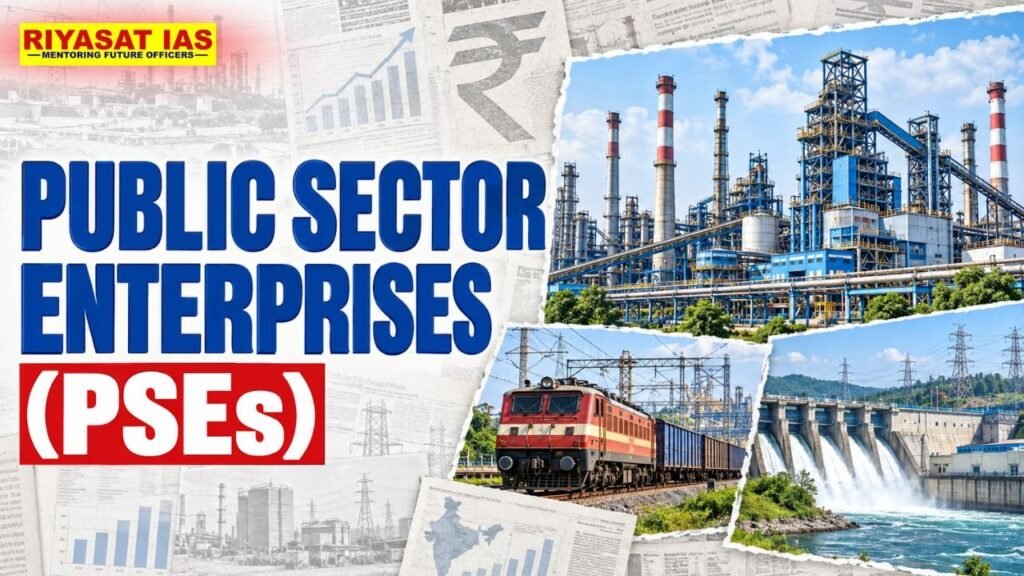
The global decline in centralised economic planning has had a marked impact on the role of state-owned enterprises. Governments increasingly expect them to be more efficient and competitive and to generate innovative products and services. India has also pursued a similar agenda, albeit with a continued public-sector presence in strategically important areas.
Public Sector Enterprises:
- Public Sector Enterprises (PSEs) are enterprises owned or controlled by the government, and operate across sectors, including energy, steel, telecommunications, transport and finance.
- At the central level, these are referred to as Central Public Sector Enterprises (CPSEs), while similar entities also operate at the state level — popularly termed as State-Level Public Enterprises (SLPEs).
- CPSEs are under the administrative control of their respective ministries/departments, while the Department of Public Enterprises (DPE) under the Ministry of Finance is the nodal department for CPSE policy.
Classification of CPSEs
CPSEs broadly fall into:
Why PSE Reforms Matter
- State-owned enterprises continue to play a major role across strategic sectors and economies globally. Reforms have increasingly focused on improving corporate governance, adopting innovative technologies and achieving financial and service excellence.
- PSEs also continue to play an important role in key sectors, including infrastructure, energy security and the transition to a low-carbon economy.
- According to the OECD, public entities owned more than 25% of 2,037 listed companies globally in 2023, representing almost 12% of global market capitalisation.
Key Challenges Facing India’s PSEs
Technology and Digital Transformation
- Many PSEs continue to deal with legacy IT systems and processes. Slow adoption of AI, automation and data analytics and increasing cybersecurity challenges remain a concern.
Skill Gaps and Workforce Transition
- Technological advancements have led to a skills mismatch, limiting the ability of many PSEs to employ specialised talent, exacerbated by inadequate reskilling initiatives and rigid HR processes.
Governance and Autonomy
Some enterprises continue to wrestle with:
- Excessive administrative control
- Slow decision-making in procurement and capital allocation
- Limited operational flexibility
- Administrative interference in some cases
Capital Allocation and Returns
- A large degree of capital efficiency continues to vary widely. Some decisions can be influenced by policy considerations, while underperforming assets can tie up capital.
Research and Development Deficit
- Many PSEs invest significantly less in R&D than comparable global counterparts, constraining product innovation and improvements, and reliance on imported technology in key strategic sectors.
Market Competition
- PSEs increasingly find themselves competing with private players, while often grappling with social obligations or pricing constraints in key sectors such as energy and transport.



Sustainability and Climate Risks
- The switch to a low-carbon economy will bring opportunities and challenges. Fossil-fuel-intensive PSEs will incur significant transition costs and face increasing pressure to invest in renewables and green technologies.
Geopolitical and Global Risks
- PSEs operating abroad are exposed to a wide range of risks, including geopolitical tensions, sanctions, exchange-rate fluctuations, commodity cost variations and host-governance risks.
State-Level Public Enterprises
- Many state-level enterprises continue to grapple with weak financial discipline, limited transparency, government dependence and slow reforms.
India’s Shift Towards Strategic Sectors
- The New Public Sector Enterprise Policy was notified in 2021 under the Atmanirbhar Bharat framework, which classified CPSEs into strategic and non-strategic sectors.
- The policy aims to retain a limited public-sector presence in strategic sectors, while withdrawing the government’s presence in non-strategic sectors through privatisation, mergers, subsidiarisation or closure, as appropriate.
Performance of CPSEs:
The latest Public Enterprises Survey 2024–25 provides the latest comprehensive snapshot of CPSEs.
Number of CPSEs
As of 31 March 2025:
- Total CPSEs: 475
- Operating CPSEs: 291
- CPSEs under construction: 81
- CPSEs under closure/liquidation/non-operating: 75
- Listed CPSEs: 66
Profitability
- Out of 291 operating CPSEs, 226 reported profits in FY2024–25, while 63 reported losses. One CPSE reported neither profit nor loss and another did not furnish the necessary information.
- The aggregate net profit of profit-making CPSEs stood at ₹3.09 lakh crore in FY2024–25 compared with ₹3.43 lakh crore in FY2023–24. Thus, the aggregate profit declined by about ₹0.33 lakh crore during the year.
- Loss-making CPSEs reported aggregate net losses of about ₹0.18 lakh crore in FY2024–25.
Overall Net Profit
- The aggregate net profit of CPSEs across sectors stood at approximately ₹2.91 lakh crore in FY2024–25 compared with ₹3.22 lakh crore in FY2023–24.
- The drop was associated with lower profits in sectors such as manufacturing, processing and generation, and mining, though services recorded improvement.
Number of Listed CPSEs
- The number of listed CPSEs remained at 66 in FY2024–25 compared with 66 in FY2023–24.
Contribution to the Economy
- CPSEs continue to contribute significantly to industrial, infrastructure and employment development, as well as public service delivery. The latest DPE survey also tracks their contributions to the Central Exchequer, foreign-exchange earnings, investment, R&D and employment.
Public-Sector Banks
- Public-sector banks have also witnessed significant transformation following the twin balance-sheet crisis, including consolidation, improved governance, technology adoption and balance-sheet repair.
Exports and Global Presence
- CPSEs continue to be significant contributors to exports, particularly in defence, engineering, energy and commodities. Their overseas presence also exposes them to global market and geopolitical risks.
Green Transition
- Large public enterprises are increasingly participating in the energy transition and decarbonisation process, particularly through renewable energy, electrification, energy efficiency and emerging technologies.
Way Forward for India’s PSEs
- Strengthen Governance and Board Autonomy: PSE boards should transform to be more professional and independent, with increased participation of domain experts. Administrative controls should be delinked, while owners and managers remain distinct.
- Increase Operational and Financial Autonomy: Eligible Maharatna and Navratna enterprises should gain greater flexibility in capital expenditure, joint ventures and asset monetisation. Performance should increasingly be assessed on outcomes.
- Improve Capital Allocation: The government can rationalise its portfolio by withdrawing its presence in non-core and non-strategic enterprises where appropriate, while focusing public capital on strategic sectors such as defence, energy and infrastructure.
- Accelerate Digital Transformation: PSEs need to upgrade legacy systems and processes, and embrace AI, automation, data analytics and cloud technologies, as well as cybersecurity systems.
- Build a Future-Ready Workforce: Large-scale reskilling and upskilling programmes, flexible HR policies and lateral recruitment can help PSEs prepare for the impact of technological change.
- Strengthen R&D and Innovation: Public enterprises should increase R&D investment and collaborate with IITs, research institutions, startups and private firms to enhance innovation.
- Balance Public Obligations with Financial Viability: When PSEs perform non-commercial social functions, the costs should be clearly and transparently compensated. Targeted subsidies and DBT can be utilised to reduce financial distortions where appropriate.
- Accelerate the Green Transition: High-emission PSEs should adopt time-bound decarbonisation plans and enhance investment in renewable energy, hydrogen, energy storage and other green technologies.
- Manage Global Risks: PSEs expanding overseas should manage geopolitical, currency, commodity and regulatory risks.
- Reform State-Level PSEs: State governments should enhance financial disclosure, performance benchmarks and reform-linked support. Consolidation and public-private partnerships can be considered where appropriate.
FAQs on Public Sector Enterprises
What are Public Sector Enterprises?
PSEs are enterprises owned or controlled by the government, operating across sectors such as energy, infrastructure, manufacturing, transport and finance.
How many CPSEs were operating in FY2024–25?
According to the latest Public Enterprises Survey, 291 CPSEs were operating as of 31 March 2025.
How many CPSEs were profitable in FY2024–25?
226 operating CPSEs reported profits with aggregate net profit of ₹3.09 lakh crore.
How many CPSEs reported losses?
63 operating CPSEs reported aggregate net losses of about ₹0.18 lakh crore in FY2024–25.
How many CPSEs were listed?
There were 66 listed CPSEs as of 31 March 2025.
What are the major challenges facing PSEs?
The major challenges include technology disruption, skills gaps, limited autonomy, inefficient capital allocation, inadequate R&D, competition, climate risks and geopolitical exposure.
What is the broad direction of PSE reform in India?
The broad direction is towards greater autonomy and efficiency, strategic-sector focus, professional governance, selective privatisation/disinvestment, technology adoption and improved financial performance.



 Ravi Raaz
 Hassan Khan
 Shadab Ali