
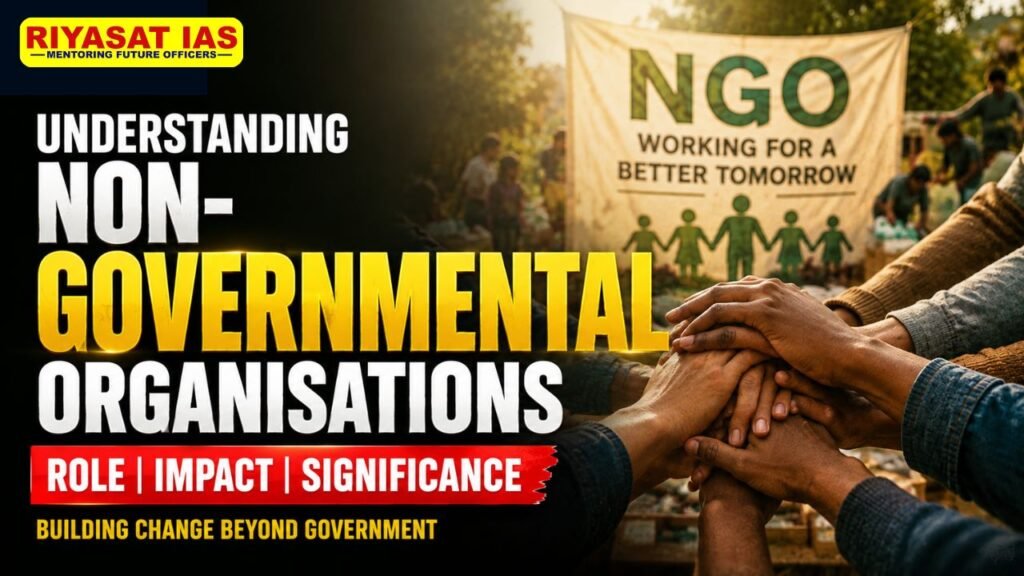
What is an NGO?
A Non-Governmental Organisation (NGO) is a voluntary, non-profit and non-state organisation that works independently or in partnership with the government to pursue social, economic, environmental, humanitarian and developmental objectives.
In India, NGOs can be registered as societies, charitable trusts or Section 8 companies under the relevant legal frameworks.
Why are NGOs Important?
NGOs act as a bridge between the State and citizens, particularly by reaching vulnerable and marginalised communities and bringing grassroots experiences into policymaking.
- Last-mile delivery: NGOs can reach remote, tribal and vulnerable communities where government capacity may be limited.
- Community participation: They promote people’s involvement in identifying problems and implementing solutions.
- Social empowerment: They work with women, children, tribal communities, persons with disabilities and other marginalised groups.
- Innovation: NGOs can test locally appropriate solutions that may later be adopted or scaled by governments.
- Policy advocacy: They provide ground-level evidence and recommendations to policymakers.
- Social accountability: NGOs facilitate tools such as RTI, social audits, public hearings and community monitoring.
NITI Aayog recognises the voluntary sector as an important contributor to development and public-service delivery and operates the Voluntary Action Cell to promote government–voluntary-sector partnerships.
Role of NGOs in Development
Community Development: NGOs promote community participation, capacity building and local ownership instead of relying only on top-down development.
Major Contributions
· Organising SHGs and community institutions.
· Promoting rural livelihoods and entrepreneurship.
· Improving access to government schemes.
· Supporting education, healthcare, sanitation and nutrition.
· Developing local leadership and community capacity.
PRADAN NGO
· PRADAN (Professional Assistance for Development Action) works with poor rural communities, particularly through women’s collectives, SHGs and livelihood development.
· It currently works directly with around 1 million families across seven of India’s poorest States and supports 116 NGOs; its models involving SHGs, natural-resource management and tasar silk have been adopted in government programmes.
· Community participation helps build local institutions, which strengthen livelihoods and ultimately contribute to sustainable development.
NGOs in Education: NGOs complement government efforts by addressing learning gaps, school access, foundational literacy and vocational skills.
Pratham NGO
· Pratham Education Foundation works in school education, foundational learning, youth skilling and employability.
· Its programmes have expanded from Mumbai to more than 26 States and UTs, and its work has contributed to evidence-based approaches to improving learning outcomes.
NGOs in Women’s Empowerment
NGOs promote women’s empowerment through:
· SHGs and collective action.
· Livelihood development.
· Financial inclusion.
· Skill development.
· Legal awareness.
· Leadership and political participation.
Self-Employed Women’s Association (SEWA) organises women workers in the informal economy and works on livelihoods, financial inclusion, social security and collective empowerment.
NGOs in Rehabilitation: NGOs play an important role in post-disaster and social rehabilitation, moving beyond immediate relief towards restoration of livelihoods and community infrastructure.
Major Areas
· Rebuilding homes.
· Restoring schools and health facilities.
· Livelihood rehabilitation.
· Psychosocial support.
· Skill development.
· Rehabilitation of displaced and vulnerable communities.
SEEDS India works in disaster preparedness, response, rehabilitation and resilient reconstruction, particularly focusing on homes, schools and community infrastructure.
NGOs in Disaster Management: Effective disaster management involves preparedness and early warning, followed by timely response and relief, and then rehabilitation, reconstruction and long-term resilience building.
Major Contributions
· Community-based disaster preparedness.
· Emergency food, water and shelter.
· Evacuation and awareness.
· Rebuilding houses and schools.
· Climate-resilient infrastructure.
· Community training and capacity building.
SEEDS India has responded to 69 emergencies, built or restored more than 63,000 shelters and worked on over 670 schools and Anganwadis, according to its reported impact figures.
o It also received the Subhash Chandra Bose Aapda Prabandhan Puraskar 2021 for its contribution to disaster management.
NGOs and Rural Development
NGOs contribute to rural development by promoting:
· SHGs and micro-enterprises.
· Agriculture and allied activities.
· Natural resource management.
· Skill development.
· Financial inclusion.
· Market linkages.
· Women’s entrepreneurship.
PRADAN works with rural communities to develop livelihoods, SHGs, natural-resource management and agricultural value chains; its field models have influenced government and civil-society programmes.



o The rural development model progresses from community mobilisation and skill development to livelihood generation, enterprise creation, market access and ultimately higher incomes.
o PRADAN states that its work on SHGs, natural-resource management and tasar silk has been adopted by governments and other civil-society organisations.
NGOs in Health and Nutrition
NGOs supplement public health systems by working on:
· Maternal and child health.
· Nutrition.
· Sanitation.
· Health awareness.
· Disease prevention.
· Mental health.
· Healthcare access in underserved areas.
They are particularly useful where geographical isolation, social exclusion or inadequate public-health capacity creates last-mile delivery gaps.
NGOs and Advocacy: NGOs act as voices of marginalised communities and convert grassroots problems into policy demands.
How NGOs contribute to advocacy
NGOs can transform ground-level problems into evidence, raise public awareness, generate policy demands and ultimately contribute to institutional reforms.
They:
- Conduct research and surveys.
- Generate evidence.
- Create public awareness.
- File public-interest litigation where appropriate.
- Participate in policy consultations.
- Advocate for legislative reforms.
- Facilitate RTI and social audits.
₹The Mazdoor Kisan Shakti Sangathan (MKSS) played an important role in the grassroots movement for transparency and the Right to Information, particularly through public hearings and demands for access to government records.
NGOs and Social Accountability: NGOs can strengthen democratic accountability by enabling citizens to monitor public institutions.
Tools
- RTI
- Social audits
- Public hearings
- Community monitoring
- Citizen report cards
- Participatory budgeting
- Public consultations
MKSS: MKSS’s use of Jan Sunwai (public hearings) demonstrated how ordinary citizens could scrutinise government expenditure and demand accountability.
NGOs and Environmental Protection
- Biodiversity conservation.
- Climate action.
- Pollution control.
- Environmental awareness.
- Sustainable livelihoods.
- Forest and wildlife conservation.
- Community-based natural resource management.
For Examples
- WWF-India: Wildlife and biodiversity conservation.
- Centre for Science and Environment (CSE): Environmental research, pollution, sustainable development and public policy.
- PRADAN: Community-based natural-resource management.
NGOs and Tribal Development
NGOs can help tribal communities address:
- Livelihood insecurity.
- Land and forest-related issues.
- Education and healthcare gaps.
- Market access.
- Skill development.
- Access to government entitlements.
PRADAN works in some of India’s poorest regions to help vulnerable communities, particularly women, organise into collectives, strengthen livelihoods and access government programmes.
NGOs and Good Governance: NGOs strengthen several principles of good governance:
| Principle | Role of NGOs |
| Participation | Mobilise citizens and communities. |
| Transparency | Promote access to information. |
| Accountability | Monitor government programmes. |
| Responsiveness | Highlight people’s grievances. |
| Inclusiveness | Represent marginalised groups. |
| Effectiveness | Improve last-mile delivery. |
Legal and Institutional Framework
· Societies Registration Act, 1860:Provides a framework for registering societies formed for charitable, literary, scientific and other public purposes.
· Public Charitable Trusts: Charitable organisations may operate through public charitable trusts, subject to applicable State-specific laws and regulations.
· Section 8 Companies – Companies Act, 2013: Section 8 allows the establishment of companies for objectives such as social welfare, education, research, charity, environmental protection and other non-profit purposes.
· Foreign Contribution Regulation Act, 2010: The FCRA, 2010 regulates the acceptance and utilisation of foreign contributions and foreign hospitality by specified individuals and organisations.
Key provisions
o Registration/Prior Permission: Organisations seeking foreign contributions must obtain FCRA registration or prior permission from the Central Government.
o Renewal: FCRA registration is valid for five years and requires renewal six months before its expiry.
o Designated Bank Account: Foreign contribution must be received through the designated FCRA account at the SBI Main Branch, New Delhi, with utilisation accounts permitted subsequently.
o Prohibition on Transfer: The 2020 amendment prohibited an organisation from transferring foreign contributions to another person or organisation.
o Administrative Expenses: The permissible limit for administrative expenditure was reduced from 50% to 20% of foreign contributions received in a financial year.
o Identity Verification: The 2020 amendment mandated Aadhaar for Indian office-bearers/key functionaries and passport/OCI details for foreign members for identification purposes.
o Government Powers: The Central Government can suspend or cancel FCRA registration for violations and take other regulatory action.
Government–NGO Partnership
The government increasingly treats NGOs as development partners rather than merely welfare organisations.
o NGO-DARPAN: NITI Aayog’s NGO-DARPAN provides a platform for interaction between Voluntary Organisations/NGOs and government departments and provides a unique identification mechanism for registered organisations.
o Significance: Transparency in NGO operations builds credibility, improves coordination and strengthens partnerships between the government and civil society.
| NGO | Sector | Government Partnership / Role |
| Pratham | Education | Works with State and district governments on foundational literacy, early childhood education and school learning programmes; its government-partnership programmes are implemented with relevant departments. |
| SEEDS India | Disaster Management | Works with local governments and communities on reconstruction planning, contingency plans, early-warning systems and disaster resilience. |
| PRADAN | Rural Development | Works with rural communities, SHGs and government programmes on livelihoods, natural-resource management and community institutions; its models have been adopted in government programmes. |
| SEWA | Women Empowerment | Works with government and public institutions on women’s livelihoods, social security, financial inclusion and informal-sector workers’ rights. |
| Goonj | Rural Development & Disaster Relief | Partners with government agencies and communities for disaster response, rural development and community-led infrastructure initiatives. |
| CRY (Child Rights and You) | Child Rights | Works with government systems and local communities on child protection, education, healthcare and prevention of child labour. |
| HelpAge India | Elderly Welfare | Works with government institutions on elderly healthcare, social protection and rights of senior citizens. |
| CSE (Centre for Science and Environment) | Environment | Provides research, training and policy inputs to government institutions on pollution, climate change and sustainable development. |
Challenges Faced by NGOs
· Financial Dependence: Dependence on grants and donations can create problems of financial sustainability and institutional independence.
· Accountability Deficit: Weak internal governance, inadequate audits or poor disclosure can undermine public trust.
· Regulatory Compliance: Compliance requirements under laws such as the FCRA can be particularly demanding for smaller organisations.
· Political Influence: Excessive political alignment may compromise the independence and neutrality of civil society organisations.
· Capacity Constraints: Smaller NGOs may lack trained personnel in:
o Financial management
o Technology
o Impact assessment
o Fundraising
o Legal compliance
· 7. Urban Concentration: Some NGOs remain concentrated in urban areas, while remote and vulnerable populations may receive less attention.
· 8. Coordination Gap: Poor coordination between government and NGOs can cause duplication, fragmentation and inefficient resource utilisation.
Contemporary Debate
· NGO Autonomy vs Government Regulation: NGOs need adequate autonomy to perform their watchdog, advocacy and community mobilisation roles, while the State has a legitimate responsibility to ensure financial transparency, legal compliance and national security.
o hallenge: “Regulate without weakening legitimate civil society.”
· Foreign Funding- Openness vs National Interest: Foreign funding can support development, humanitarian assistance, research and capacity building, but inadequate oversight may create concerns about foreign influence, misuse of funds and national security.
o Therefore, regulation should be transparent, proportionate and risk-based.
Way Forward
· Strengthen Self-Regulation: NGOs should adopt stronger standards of financial disclosure, internal audit, ethical governance and impact assessment.
· Outcome-Based Funding: Funding should increasingly be linked to measurable social outcomes rather than merely expenditure.
· Improve Government–NGO Coordination: Institutionalise mechanisms for joint planning, implementation, monitoring and feedback.
· Encourage Local NGOs: Community-based organisations should be strengthened because they possess better knowledge of local needs and social conditions.
· Strengthen Digital Transparency: Use technology for fund tracking, beneficiary monitoring, impact assessment and public disclosure.
· Build Institutional Capacity: Provide training in financial management, digital technology, impact evaluation, governance and legal compliance.
· Protect Legitimate Civil Society Space: Regulation should be rule-based, transparent and proportionate, preventing misuse without unnecessarily restricting genuine civil-society activities.
NGOs vs SHGs
| Basis | NGOs | SHGs |
| Nature | Formal civil-society organisations | Community-based groups |
| Primary focus | Development, advocacy and public welfare | Savings, credit and livelihoods |
| Scale | Local to national/international | Generally local |
| Membership | Organisation-specific | Usually small and relatively homogeneous |
| Key role | Service delivery, advocacy, innovation, accountability | Financial inclusion, livelihood and collective empowerment |
| Example | PRADAN, Pratham, SEEDS | Women’s SHGs under DAY-NRLM |
Conclusion
NGOs are an important pillar of civil society and participatory governance, complementing the State through grassroots reach, social innovation, advocacy and accountability; the objective should be to build “autonomy with accountability and partnership with the State.”
FAQs
Q1. What is an NGO?
Ans: An NGO is a voluntary, non-profit and non-state organisation working for social, developmental, humanitarian or environmental objectives.
Q2. How do NGOs contribute to development?
Ans: NGOs contribute through community mobilisation, service delivery, capacity building, innovation, advocacy, rehabilitation and social accountability.
Q3. Which NGO is associated with rural livelihoods and SHGs?
Ans: PRADAN works extensively on rural livelihoods, women’s collectives, SHGs and natural-resource management.
Q4. Which NGO is a useful example for disaster management?
Ans: SEEDS India is a prominent example, working in disaster preparedness, response, rehabilitation and resilient reconstruction.
Q5. What is the key challenge in regulating NGOs?
Ans: The challenge is to balance legitimate civil-society autonomy with financial transparency, accountability and national-interest requirements.


 Ravi Raaz
 Hassan Khan
 Shadab Ali