
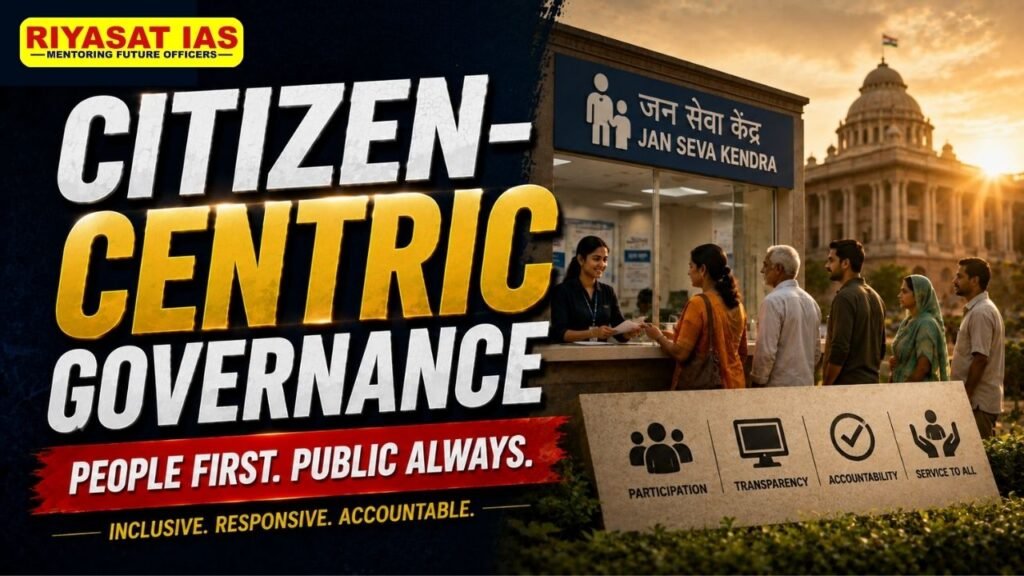
What is Citizen-Centric Governance?
· Citizen-centric governance is an approach in which the needs, rights, convenience, participation and satisfaction of citizens remain at the centre of policy formulation, public service delivery and administrative decision-making.
· It seeks to transform the citizen from a passive beneficiary into an active stakeholder and partner in governance.
Historical Background
The idea of citizen-centric administration has evolved from welfare-oriented administration to participatory and service-oriented governance.
· Constitutional Foundation: The Preamble, Fundamental Rights, Directive Principles of State Policy and Panchayati Raj provisions establish the foundation for accountable, inclusive and people-oriented governance.
· Gandhian Perspective: Mahatma Gandhi’s idea of Gram Swaraj emphasised decentralisation, self-governance and empowerment of local communities.
· Governance should reach the last person rather than remain concentrated at the top.
· 73rd and 74th Constitutional Amendments, 1992–93: These amendments strengthened Panchayats and Urban Local Bodies, creating institutional mechanisms for grassroots participation.
· Citizen’s Charter – 1997: Following the Conference of Chief Ministers in May 1997, Citizen’s Charters began to be formulated by Central and State governments, initially in sectors with large public interfaces such as Railways, Telecom, Posts and PDS. They were intended to specify service standards, time limits and grievance-redress mechanisms.
· Right to Information Act – 2005: The RTI Act strengthened the citizen’s ability to access government information and demand transparency and accountability.
· Second Administrative Reforms Commission: The 12th Report of the 2nd ARC, “Citizen Centric Administration – The Heart of Governance,” provided a comprehensive framework for making administration transparent, accountable and citizen-friendly.
Mechanisms to Strengthen Citizen–Government Partnership
Citizen’s Charters
Citizen’s Charters define:
- Services provided
- Quality/service standards
- Time limits
- Grievance-redress mechanisms
- Responsibilities of service providers
· Grievance Redressal:An effective grievance-redressal system gives citizens a mechanism to report administrative failures and obtain remedies.
· CPGRAMS:The Centralised Public Grievance Redress and Monitoring System (CPGRAMS) has evolved since 2007 and allows citizens to lodge grievances relating to Central Government organisations and participating State/UT authorities. It also includes an appeal mechanism for dissatisfied citizens.
o Reform: CPGRAMS 7.0 introduced features such as guided registration, direct routing to field-level offices and AI/ML-based analysis of grievance patterns to identify systemic problems.
· MyGov: MyGov is the Government of India’s citizen-engagement platform, Launched in 26 July 2014 enabling citizens to participate through:
o Discussions
o Polls and surveys
o Tasks
o Blogs
o Quizzes
o Campaigns
o Pledges
o Policy consultations
· Social Audits: Social audits enable citizens and communities to scrutinise the implementation, expenditure and outcomes of government programmes.



o For example Under MGNREGA, social audits are conducted with the active involvement of primary stakeholders and are intended to ensure public accountability. The Social Audit Unit facilitates the process through trained resource persons and the Gram Sabha.
· RTI: The Right to Information Act, 2005 empowers citizens to access information held by public authorities.
o RTI reduces information asymmetry between citizens and the State and strengthens democratic oversight.
· Decentralisation: The 73rd and 74th Constitutional Amendments institutionalised grassroots participation through Gram Sabhas, Panchayats, Municipalities and ward-level institutions, bringing governance closer to citizens.
· Digital Governance: Platforms such as UMANG, DigiLocker, Aadhaar-enabled services, DBT, Common Service Centres and e-District services reduce physical interfaces, transaction costs and administrative delays; however, digitalisation must remain inclusive to prevent the digital divide from creating new forms of exclusion.
Administrative Reforms and Government Initiatives
Sevottam Model: Sevottam means “Uttam Seva” or service excellence. It emerged from the recommendations of the 2nd ARC and provides a framework for improving citizen-centric service delivery.
Three Core Components
1. Citizen’s Charter: Define services and service standards.
2. Grievance Redressal: Provide an effective mechanism for resolving citizen complaints.
3. Service Delivery Capability: Build organisational capacity to actually meet the promised standards.
Seven-Step Model for Citizen-Centricity The 2nd ARC’s model broadly seeks to:
- Define services and identify citizens/clients.
- Set measurable service standards and norms.
- Develop organisational capability to meet those standards.
- Deliver services according to the prescribed standards.
- Monitor performance.
- Establish an effective grievance-redress mechanism.
- Continuously improve service delivery based on citizen feedback.
Mission Karmayogi
o The National Programme for Civil Services Capacity Building (Mission Karmayogi) seeks to create a professional, competency-driven and future-ready civil service.
o Its focus includes improving the citizen-government interface, ease of living and ease of doing business through functional and behavioural competencies.
Digital India: To transform India into a digitally empowered society and knowledge economy.
Citizen-Centric Contribution
- Digital service delivery.
- Reduced physical visits to offices.
- Greater transparency.
- Online access to documents and benefits.
- Improved portability of services.
Direct Benefit Transfer (DBT): Direct Benefit Transfer (DBT) transfers eligible benefits directly into beneficiaries’ bank accounts, reducing intermediaries and leakages, speeding up delivery and enhancing transparency.
Common Service Centres (CSCs)
· CSCs provide digital government and other services to citizens, particularly in rural and remote areas.
· They help bridge the digital and geographical divide by bringing e-governance services closer to citizens.
Aspirational Districts Programme: The Aspirational Districts Programme uses data-driven monitoring and district-level competition to improve outcomes in relatively under-developed districts.
Challenges to Citizen-Centric Governance
· Bureaucratic Mindset: A traditional rule-centric and procedure-oriented culture can prioritise compliance over citizen satisfaction.
· Accountability Gap: Citizens may have limited remedies when public authorities fail to meet service standards.
· Weak Citizen Charters: Many Charters may remain generic, non-enforceable and poorly monitored, rather than functioning as measurable service commitments.
· Digital Divide: Poor connectivity, lack of devices and low digital literacy can exclude rural, elderly, tribal and economically vulnerable citizens.
· Information Asymmetry: Citizens may not know their rights, entitlements, procedures or available grievance mechanisms.
· Tokenistic Participation: Consultations may sometimes become merely procedural exercises without meaningful incorporation of citizen feedback.
· Privacy and Data Risks: Digital governance can create concerns regarding data protection, surveillance, profiling and cybersecurity.
· Last-Mile Implementation Gap: Reforms introduced at the headquarters level may not always translate into improved behaviour and service delivery at the cutting edge of administration—a concern highlighted by the 2nd ARC.
Suggestions for a Better Pathway
· From Government-Centric to Citizen-Centric Administration: Administrative success should be measured by citizen outcomes and satisfaction, not merely expenditure or procedural compliance.
· Make Citizen Charters Enforceable: Citizen Charters should contain specific, measurable and time-bound service standards, with clearly defined remedies for non-compliance.
· Strengthen Grievance Redressal: Grievances should not merely be closed; governments should identify recurring grievance patterns and address their root causes.
· Deepen Jan Bhagidari: Citizen participation should extend beyond consultation to co-design, co-implementation and social monitoring.
· Strengthen Local Governments: Provide Panchayats and Urban Local Bodies with the 3Fs — Functions, Funds and Functionaries so that citizens can participate meaningfully at the local level.
· Build a Citizen-Centric Civil Service: Mission Karmayogi should strengthen:
o Empathy
o Ethical behaviour
o Problem-solving
o Communication
o Digital skills
o Field-level responsiveness
· Use Data for Better Services
o Citizen feedback, grievance data and service-delivery data should be analysed to identify systemic bottlenecks and vulnerable groups.
o The recent CPGRAMS reforms already use AI/ML to identify recurring grievance clusters and potential policy-level or implementation-level causes.
· Strengthen Social Accountability
o Expand:
o Social audits
o Public hearings
o RTI
o Citizen report cards
o Community monitoring
o Participatory planning
Conclusion
Citizen-centric governance requires the State to move from rule-bound administration to responsive public service, where citizens are not merely beneficiaries but rights-holders, participants and partners in governance.
“Good governance is ultimately measured not by how efficiently government functions internally, but by how effectively it improves the everyday experience and dignity of citizens.”
FAQs
Q1. What is citizen-centric governance?
Ans: It is an approach that places citizens’ needs, rights, participation, convenience and satisfaction at the centre of governance and service delivery.
Q2. Which 2nd ARC report specifically deals with citizen-centric administration?
Ans: The 12th Report, “Citizen Centric Administration – The Heart of Governance.”
Q3. What are the three components of Sevottam?
Ans: Citizen’s Charter, grievance redressal and service-delivery capability.
Q4. How does MyGov promote citizen-centric governance?
Ans: MyGov enables citizens to participate in policy discussions, polls, consultations, tasks and campaigns, thereby promoting participatory governance.
Q5. What is the key shift required for citizen-centric governance?
Ans: Governance should shift from treating citizens as passive beneficiaries to recognising them as active stakeholders and partners in policy formulation and service delivery.


 Ravi Raaz
 Hassan Khan
 Shadab Ali