
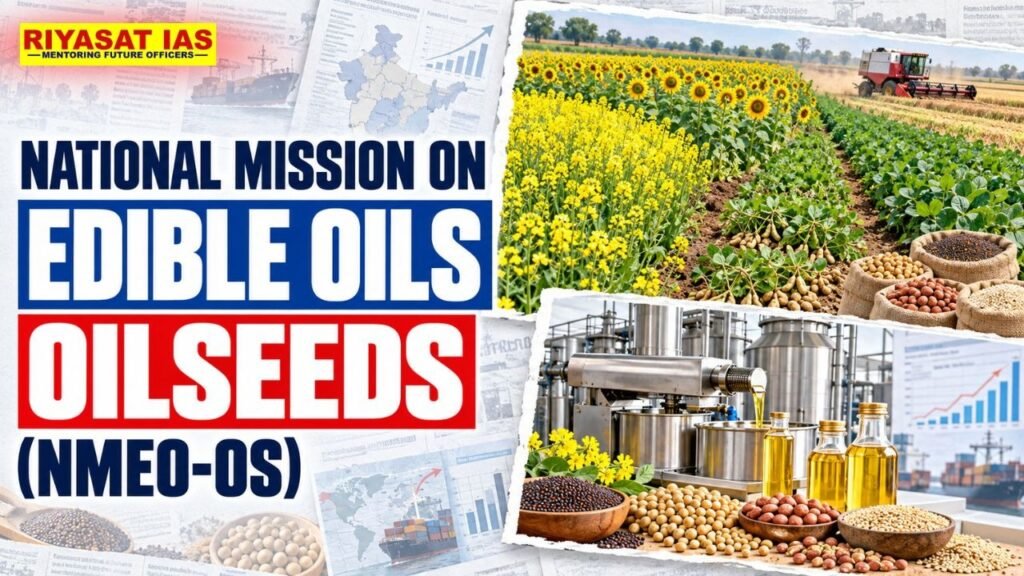
India is one of the leading producers of oilseeds in the world, at the same time, its heavy reliance on overseas shipping of edible oils makes it particularly dependent on imports. In order to reduce this dependence and achieve self-sufficiency in the domestic edible oils market, the Union Cabinet approved the National Mission on Edible Oils–Oilseeds (NMEO-OS) on 3 October 2024.
This ambitious seven-year mission with a budget of ₹10,103 crore targets to address all the existing gaps in the oilseed production and supply chain, ranging from laboratory-developed seeds to processors’ crushers, farmer-processor partnerships, and secondary oil extraction.
Objectives of NMEO-Oilseeds
The main objective of the mission is to increase the production of primary oilseeds from the current 39 million tonnes (as of 2022-23) to 69.7 million tonnes by 2030-31.
In line with the objectives of the sister mission, National Mission on Edible Oils–Oil Palm (NMEO-OP), the target production of edible oils from domestic sources under NMEO-OS is 25.45 million tonnes by 2030-31, which would meet approximately 72% of the country’s demand for edible oils.
The mission will focus on several key interventions, including:
- Enhancing crop production through promotion of high-yielding varieties with higher oil content;
- Expanding cultivation on fallows, particularly rice and potato fallows;
- Encouraging intercropping and reducing dependence on water-intensive crops;
- Improving seed multiplication systems to ensure the availability of quality oilseed;
- Adopting modern breeding techniques, including genome editing, for creating climate-resilient and pest-resistant varieties;
- Upgrading traditional crushing and extraction units;
- Facilitating linkages between cultivating farmers and processors;
Among the five major crops under NMEO-OS are rapeseed-mustard, groundnut, soybean, sunflower, and sesame. In addition to the traditional crops, the mission also targets secondary utilization of industrial crops, including cottonseed, rice bran, and tree-borne oils (TBO).
Major Targets of NMEO-Oilseeds
Besides the targets mentioned above, the mission also has several other key performance indicators, including:
| Indicator | Base year (2022-23) | Target year (2030-31) |
| Total area under oilseeds | 29 million hectares | 33 million hectares |
| Total primary oilseed production | 39 million tonnes | 69.7 million tonnes |
| National average productivity | 1,353 kg/ha | 2,112 kg/ha |
| Net additional area to be brought under cultivation | – | 40 lakh ha |
| Combined domestic edible oil production (with NMEO-OP) | – | 25.45 million tonnes |
Thus, while the emphasis will be on increasing the share of oilseeds in total cropped area, special focus will be on improving yield, which is expected to contribute to a higher percentage increase in production.
Seed Infrastructure Development under NMEO-OS
- The success of any farm production depends directly on the quality of seeds, which is why one of the key pillars of NMEO-OS is the enhancement of seed infrastructure.
- Under the mission, a five-year rolling plan for the seed sector has been developed and made available to the states on the Seed Authentication, Traceability & Holistic Inventory (SATHI) portal.
- This plan helps the state farm departments to identify breeder and foundation seed requirements well in advance, based on the area under cultivation and sown through various agencies, including cooperatives, Farmer Producer Organizations (FPOs), and private agencies.
- While the original proposal to the Union Budget 2024-25 allocated funds for the creation of 65 new seed hubs and 50 specialized public warehouses for oilseed storage, the work has already begun on 60 seed hubs and 50 specialized seed storage units for the storage of breeder seeds of new varieties.
Cluster-based Interventions under NMEO-Oilseeds
- Another important element of NMEO-OS is the organization of cluster-based interventions through Value Chain Clusters.
- More than 600 such clusters across the country involve more than 10 lakh hectares in cultivation every year. These clusters are managed by Value Chain Partners (VCPs), which can include FPOs, primary marketing societies, specialized public agencies, and private enterprises.
- Farmers who join the clusters managed by these VCPs benefit from their extensive experience and networks. They receive guidance on best practices in cultivation, including recommendations on Good Agricultural Practices (GAP), weather forecasting, and integrated pest management.
Latest Developments in Value Chain Clusters
- The work on value chain clusters has begun earlier than expected, with the involvement of 13.52 lakh hectares under quality seed cultivation for the 2025-26 season, against the annual target of 10 lakh hectares.
- In addition, the development of seed hubs and specialized seed storage units has also begun. As of the latest available official information, 60 seed hubs and 50 specialized seed storage units have been reported under the mission.



Crop Diversification and Expansion of Oilseed Area under Cultivation
- One of the main challenges in the current expansion of the oilseed sector is the need to find additional 40 lakh hectares of cultivation under oilseeds without sacrificing the area under food grains.
- To address this challenge, NMEO-OS will prioritize the use of fallows, especially those associated with the rice and potato harvests.
- In addition, the mission will promote intercropping and diversification, including the introduction of oilseeds into crop rotations to improve soil fertility and maximize the use of natural resources.
- The use of intercropping will be especially useful in the rain-fed areas of the country, where farmers grow water-intensive crops.
Latest Oilseed Production Trends in India
India’s oilseed production has fluctuated across recent seasons. According to the Department of Agriculture & Farmers Welfare, national crop production data for the past three seasons are as follows:
| Year | Area | Production | Yield / Productivity |
| 2022–23 | 302.39 lakh ha | 413.55 lakh tonnes | 1,368 kg/ha |
| 2023–24 | 301.92 lakh ha | 396.69 lakh tonnes | 1,314 kg/ha |
| 2024–25 | 304.40 lakh ha | 429.89 lakh tonnes | 1,412 kg/ha |
As can be seen from the data, India’s oilseed production declined in 2023-24 compared to the previous season, but it increased significantly in 2024-25. According to the Third Advance Estimates, India’s primary oilseed production for 2025-26 is 43.06 million tonnes (430.59 lakh tonnes).
Major Oilseed-Producing States in India
- India has a wide range of climatic conditions, which allows it to grow oilseeds in most parts of the country.
- According to the latest data, the largest oilseed-producing states are the western and central states of Rajasthan, Madhya Pradesh, Gujarat, and Maharashtra, as well as the northern states of Haryana and Uttar Pradesh.
- The eastern and southern states of West Bengal, Karnataka, Tamil Nadu, and Telangana are also significant producers of oilseeds.
- India’s primary oilseeds are divided among soybean, rapeseed-mustard, and groundnut, which account for the majority of the country’s production:
| Commodity | 2024–25 (lakh tonnes) |
| Soybean | 152.68 |
| Rapeseed-Mustard | 126.67 |
| Groundnut | 119.42 |
India’s Dependence on Imported Edible Oils
- India has a huge appetite for edible oils, which is driven by the population’s taste for fried foods and the growing demand for packaged products.
- According to the NITI Aayog data for 2024, the country’s per capita consumption of edible oils is about 19.7 kg per year.
- However, domestic production is insufficient to meet the demand, with India being forced to rely on imports. According to the NITI Aayog data for 2022-23, India imported 16.5 million tonnes of edible oils, which was about 56% of the demand, while domestic production met around 40-45% of the need.
- Nevertheless, according to Economic Survey 2025–26, India’s dependence on edible oil imports has declined from 63.2% in 2015–16 to 56.25% in 2023–24.
- During the same period, India’s oil production increased from 86.30 lakh tonnes to 121.75 lakh tonnes.
- According to the latest data, India’s total edible oil imports in 2024–25 amounted to 160.72 lakh tonnes, of which about 75.17 lakh tonnes or 46.77% were accounted for by crude palm oil.
India’s Role in the Global Edible Oil Market
- India plays a significant role in the global edible oil market as one of the top producers and consumers in the world.
- According to NITI Aayog, India ranks among the top 4 oil-producing countries in the world in vegetable oils.
- India’s share in the global production of oilseeds is 15–20%, while its share in world vegetable oil production is 6–7%. In addition, India ranks among the leading countries in global edible oil production and consumption. Trends in India’s edible oil market have a profound impact on global markets.
- India is also a significant producer of several specialty oils, including castor, safflower, sesame, and niger seed, while it has an important role in rice bran oil recovery.
Measures to Reduce India’s Dependence on Imported Edible Oils
India needs to take a comprehensive approach to reducing its dependence on imported edible oils, which includes short-term and long-term measures.
Minimum Support Price for Oilseeds
- The government has been taking steps to boost oilseed production by keeping an appropriate Minimum Support Price (MSP) for mustard, groundnut, sunflower, and other strategic crops.
- By doing so, the government wants to encourage farmers to grow oilseeds instead of wheat and paddy.
PM-AASHA
- Under the Pradhan Mantri Annadata Aay Sanrakshan Abhiyan (PM-AASHA), the government has introduced a Price Support Scheme (PSS) to procure oilseeds from growers at the time of peak arrivals of produce to regulate prices and ensure remunerative prices to farmers.
National Mission on Edible Oils–Oil Palm
- The National Mission on Edible Oils–Oil Palm (NMEO-OP) is the sister mission of NMEO-OS, which was launched in 2021.
- Since palm oil production is estimated to be 4–5 times higher than that of traditional oilseeds, expanding palm oil cultivation in the country will reduce India’s dependence on crude palm oil imports.
Import Duty on Edible Oils
- India has a policy of imposing duties on edible oil imports to protect domestic producers and prevent prices from rising.
- In June 2025, the Basic Customs Duty (BCD) for crude sunflower, soybean, and palm oils was reduced from 20% to 10%.
- Furthermore, on 24 September 2026, the government reduced the BCD on crude sunflower oil to zero and the BCD on crude soybean and crude palm oil to 5%. At the same time, there is a differential duty of 19.25% for crude and refined oils, which is intended to protect domestic reprocessing mills.
IEC Campaign on Edible Oils under NMEO-OS
- The Ministry of Food Processing Industries has launched a campaign to create awareness among the public about the healthy use of oils and fats to promote balanced nutrition and reduce the incidence of lifestyle diseases.
Way Forward on Edible Oil Self-Sufficiency
India’s self-sufficiency in edible oils requires a multi-pronged approach and the use of all available tools to increase domestic production and ensure food security.
The following steps can help achieve the goal of edible oil self-sufficiency in India:
- Increasing the production of oilseeds through the promotion of genetically improved and climate-resilient varieties;
- Creating an environment for profitable cultivation of oilseeds by expanding cultivation in winter rice and potato fallows in the states of Bengal, Bihar, Assam, and Odisha and promoting intercropping in rain-fed areas;
- Ensuring transparency in seed multiplication through the use of the digital SATHI platform;
- Promoting the production of oilseeds by installing modern expellers and micro-refineries;
- Expanding the use of by-products from cotton, solvent-extracted rice bran, and tree-borne oils;
- Ensuring the organization of farmers’ collectives that can sell their produce to processors on a contract basis;
- Creating alternative procurement mechanisms for farmers, including the timely procurement of oilseeds by the government under the Minimum Support Price (MSP) scheme;
- Ensuring the availability of credit at reasonable rates to collectives and processors;
- Regulating import duties on crude and refined edible oils to prevent their growth;
- Promoting the processing of oilseeds into value-added products;
- Creating an integrated supply chain for oilseeds and edible oils;
- Organizing training courses for farmers on modern technologies;
- Creating awareness among consumers about the benefits of healthy diets and the importance of choosing the right type of oil;
FAQs on National Mission on Edible Oils–Oilseeds
What is NMEO-Oilseeds?
National Mission on Edible Oils–Oilseeds (NMEO-OS) is a flagship program launched by the central government in 2024 to increase domestic oilseed production and reduce the country’s dependence on imported edible oils.
When was NMEO-Oilseeds launched?
The Union Cabinet approved the National Mission on Edible Oils–Oilseeds (NMEO-OS) on 3 October 2024. The seven-year mission will run through the financial years 2024–25 to 2030–31.
What is the target of NMEO-Oilseeds?
The target of NMEO-Oilseeds is to increase India’s primary oilseed production from the current 39 million tonnes to 69.7 million tonnes by 2030-31 and raise the average yield to 2,112 kg per hectare.
What is the edible oil production target under NMEO-OS and NMEO-OP?
The target of NMEO-OS and its sister mission, National Mission on Edible Oils–Oil Palm (NMEO-OP), is to increase domestic edible oil production to 25.45 million tonnes by 2030-31, which would meet approximately 72% of India’s demand for edible oils.
Which crops are covered under NMEO-Oilseeds?
The mission covers five primary crops, namely rapeseed-mustard, groundnut, soybean, sunflower, and sesamum. In addition, NMEO-OS will also focus on the secondary utilization of cottonseed, rice bran, and Tree-Borne Oils (TBO).
How many Value Chain Clusters are covered under NMEO-OS?
More than 600 Value Chain Clusters are covered under NMEO-OS. These clusters have an aggregate cultivated area of over 10 lakh hectares.
What is the latest oilseed production in India?
According to the latest crop estimates, India produced 429.89 lakh tonnes of oilseeds in 2024-25. This marks an increase of approximately 8.37% compared to 396.69 lakh tonnes in 2023-24. The Third Advance Estimates for 2025–26 indicate that India is set to produce 43.06 million tonnes (430.59 lakh tonnes) of primary oilseeds.
How dependent is India on imported edible oils?
India’s dependence on imported edible oils has decreased from 63.2% in 2015–16 to 56.25% in 2023–24. India imported 15.66 million tonnes of edible oils in 2023–24. According to the latest data, India’s total edible oil imports in 2024–25 amounted to 160.72 lakh tonnes, of which about 75.17 lakh tonnes or 46.77% were accounted for by crude palm oil.
Is the 20% import duty on edible oils still applicable?
No. The import duty structure has changed. In June 2025, the BCD on crude sunflower, soybean, and palm oils was reduced from 20% to 10%. Subsequently, on 24 September 2026, the BCD on crude sunflower oil was reduced to zero, while the BCD on crude soybean and crude palm oil was reduced to 5%. A 19.25% differential duty between crude and refined oils is also applicable.



 Ravi Raaz
 Hassan Khan
 Shadab Ali