
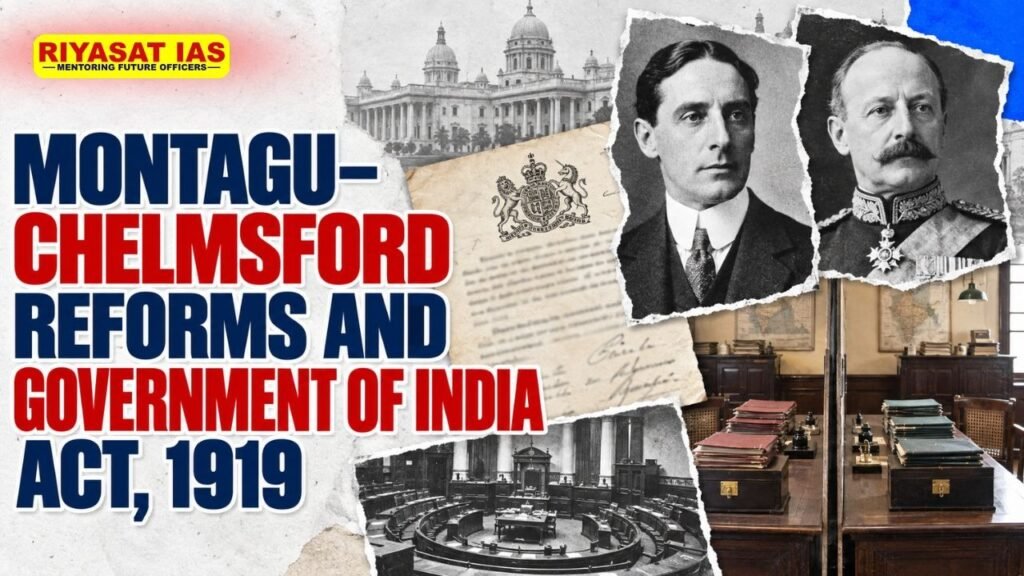
The Montagu–Chelmsford Reforms were introduced on the basis of the Report of 1918 and were given legal form through the Government of India Act, 1919. The reforms represented an important stage in the constitutional development of British India, particularly because they introduced dyarchy in the provinces and expanded legislative representation.
· At the same time, the reforms stopped well short of responsible government at the Centre. Real authority continued to remain with the British executive, especially the Governor-General and the Secretary of State.
Background
· The reforms came after the growing political pressure created by the Swadeshi Movement, Home Rule Movement and the First World War. The August Declaration of 1917, made by Secretary of State Edwin Montagu, had already promised the gradual development of self-governing institutions in India.
· Montagu visited India in 1917 and, along with Lord Chelmsford, prepared a report in 1918. Its recommendations formed the basis of the Government of India Act, 1919.
· The central idea was to increase Indian participation in administration while retaining substantial safeguards and powers in British hands.
Main Features of the Government of India Act, 1919
The most important changes can be understood under two levels: provincial government and central government.
Provincial Government
· The most significant experiment at the provincial level was the introduction of dyarchy. The provincial subjects were divided into two categories:
· Reserved subjects remained under the control of the Governor and his Executive Councillors. They included important areas such as law and order, police, justice, land revenue, finance and irrigation.
· Transferred subjects were placed under Indian ministers who were appointed by the Governor from among the elected members of the provincial legislature. These included areas such as education, public health, local self-government, agriculture and industries.
· Ministers were responsible to the legislature and had to resign if a no-confidence motion was passed against them, whereas members of the Governor’s Executive Council were not accountable to the legislature.
· The Secretary of State for India and the Governor-General could intervene in ‘reserved subjects’ when necessary, but they lacked the authority to interfere in ‘transferred subjects’.
Provincial Executive
· The Governor remained the head of the provincial executive and was appointed by the British Crown.
· Indian ministers were given responsibility for transferred subjects and were expected to work with the provincial legislatures. However, their position remained weak because they depended heavily on the Governor.
· The Governor retained special powers and discretionary authority, particularly in matters connected with the reserved side of administration. Consequently, the ministers could not exercise complete control over provincial administration. This system therefore introduced a limited form of responsible government but did not establish full responsible government in the provinces.
Provincial Legislature
· The Act considerably expanded the provincial legislative councils and introduced a greater elected element.



· The number of members in the provincial legislative assemblies was increased; 70 percent of the members in these assemblies were elected.
· The franchise was expanded, and the system of communal representation was further extended.
· Women were granted the right to vote, and the provincial councils were designated as legislative councils.
· For the first time, non-official elected members formed a majority in the provincial legislatures, although the franchise remained restricted. The legislatures received wider powers to:
o discuss the provincial budget;
o ask questions and seek information from the executive;
o move resolutions on matters of public interest; and
o introduce legislation within their prescribed sphere.
Introduction of Dyarchy
· Dyarchy was the most distinctive feature of the 1919 reforms.
· Its basic principle was to divide provincial administration into reserved and transferred subjects.
· The arrangement was intended as a gradual experiment in responsible government. Indians would gain experience by administering relatively less controversial departments, while the British would retain control over departments considered essential to imperial interests.
· In practice, however, the two parts of administration were closely connected. Finance, for example, remained a reserved subject, while several transferred departments depended upon financial resources. This made it difficult for Indian ministers to implement policies effectively.
· The experiment ultimately proved unsatisfactory and was abolished by the Government of India Act, 1935, which introduced provincial autonomy instead.
Central Government: No Responsible Government
· The position at the Centre was quite different from that in the provinces.
· No responsible government was introduced at the Centre. The Governor-General continued to remain the real head of the central executive, and his Executive Council remained responsible to the British authorities rather than to the Indian legislature.
Central Executive
· The Governor-General remained the most powerful authority in the central administration.
· Three Indians were appointed to the Governor-General’s Executive Council, and they were assigned the portfolios of Law, Education, Labour, Health, and Industries.
· He continued to exercise extensive executive, legislative and financial powers. His executive council assisted him in administration, but its members were not responsible to the Central Legislature.
· The Governor-General also possessed important special responsibilities and discretionary powers. These powers allowed the executive to protect British interests even when the legislature expressed a different opinion.
· Therefore, although the Act increased Indian representation, effective executive authority at the Centre remained outside legislative control.
Central Legislature
· One important change was the introduction of bicameralism at the Centre. The Central Legislature was divided into two Houses ; Council of State, which became the Upper House and Legislative Assembly, which became the Lower House.
· The Central Legislative Assembly had a membership of 145, comprising 104 elected and 41 nominated members.
· The Council of State had a five-year term and was open only to men, whereas the Central Legislative Assembly had a three-year term, though this could be extended with the Governor-General’s permission.
· Both Houses contained an elected element, making the Central Legislature more representative than before. The legislature received greater opportunities to:
o discuss the budget;
o ask questions;
o move resolutions;
o debate public issues; and
o participate in law-making.
· The Act also introduced a more developed system of legislative control over financial proposals. The legislature could assent to, refuse assent to, or reduce certain demands for expenditure. However, 75% portion of expenditure remained outside effective legislative control, and the executive could override legislative opposition in important circumstances.
Major Drawbacks
- Dyarchy was structurally weak. Important departments such as finance and police remained reserved, while ministers handling transferred subjects lacked adequate control over resources.
- The Governor retained overriding powers. His discretionary and special powers considerably restricted the authority of Indian ministers and legislatures.
- There was no responsible government at the Centre. The central executive remained outside the effective control of the elected legislature.
- The franchise remained very limited. Only a small section of the population could participate in elections because voting rights were based on qualifications such as property, taxation and education.
- The Governor-General retained extensive powers. He could influence legislation, finance and administration and could act independently in matters considered essential to British interests.
- Separate electorates continued. The communal representation introduced under the Morley–Minto reforms was retained and extended, strengthening the communal basis of electoral politics.
- British control remained fundamental. The Secretary of State, Governor-General and other colonial authorities continued to exercise decisive influence over Indian administration.
Congress Reaction
· Lack of responsible government was the main reason for dissatisfaction within the Indian National Congress. Nationalists expected a much greater transfer of political authority, but the reforms continued to keep real power in British hands.
· Limited franchise, continuation of dyarchy, executive supremacy and the absence of responsible government at the Centre made the 1919 Act inadequate from the nationalist point of view.
· Disappointment deepened with the Rowlatt Act of 1919, which allowed extraordinary powers of repression despite the British promise of gradual constitutional development. The Jallianwala Bagh massacre further destroyed nationalist confidence in British intentions and helped create the political conditions for Gandhi’s mass movements.
· Despite its limitations, the reforms gave Indian leaders greater experience in legislative work, elections and ministerial administration. Problems created by dyarchy also became an important reason for seeking further constitutional reforms, eventually leading to its abolition under the Government of India Act, 1935.
Conclusion
The Government of India Act, 1919 marked a limited advance towards representative government but retained decisive British control over the executive. Dyarchy introduced Indians to provincial administration, while bicameralism expanded legislative politics at the Centre. Its limitations, however, made clear that constitutional concessions without responsible government could not satisfy Indian nationalism.
FAQs
1. What was the most important feature of the Government of India Act, 1919?
The introduction of dyarchy in the provinces was its most distinctive feature.
2. What were reserved and transferred subjects?
Reserved subjects remained under the Governor and his Executive Councillors, while transferred subjects were administered by Indian ministers responsible to the provincial legislature.
3. Was responsible government introduced at the Centre?
No. The central executive remained responsible to the British authorities rather than to the Central Legislature.
4. What major change was made in the Central Legislature?
The Act introduced bicameralism, consisting of the Council of State and the Legislative Assembly.
5. Why did dyarchy fail?
The division between reserved and transferred subjects created administrative difficulties, while Indian ministers lacked adequate control over finance and depended on a Governor who retained overriding powers.




 Ravi Raaz
 Hassan Khan
 Shadab Ali