
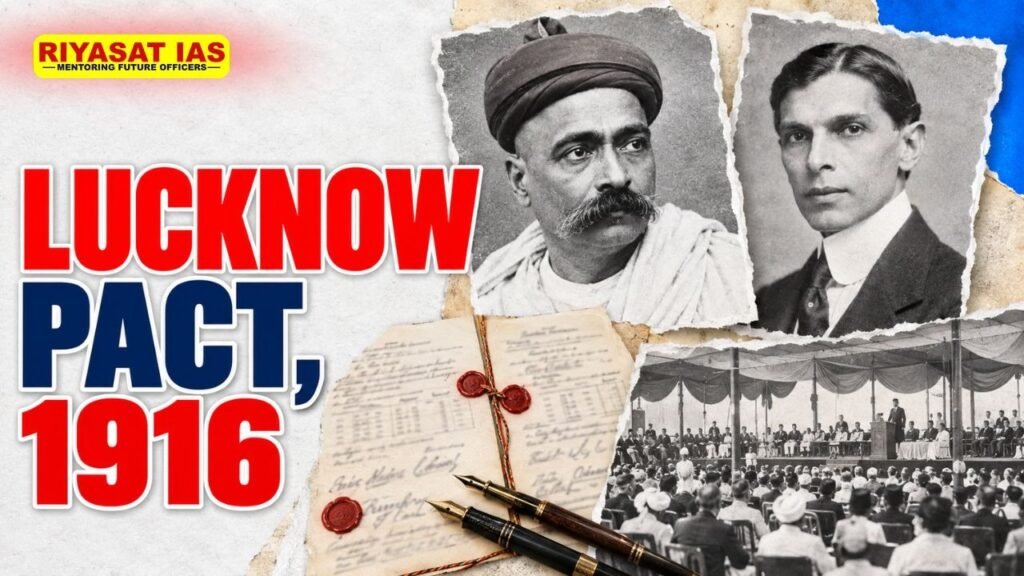
The Lucknow Pact of 1916 was an agreement between the Indian National Congress and the All-India Muslim League on a common scheme of constitutional reforms. The agreement was reached at Lucknow in December 1916, at a time when nationalist politics was once again becoming active after several years of political division and repression.
· Importance of Lucknow lay not only in the agreement between the Congress and the League. The Moderates and Extremists also came together again within the Congress, giving the national movement a greater degree of unity.
Background
· After the Surat Split of 1907, the Congress remained divided between the Moderates and Extremists. The split weakened the organisation, while the British Government adopted a policy of repression against several nationalist activities. The Swadeshi movement also gradually declined after its initial phase.
· The political atmosphere began to change with Tilak’s release in 1914. He returned to active politics and, together with Annie Besant, worked to bring the different sections of the nationalist movement closer. At the same time, the First World War placed greater demands on India’s military and financial resources. Indian leaders saw this as an opportunity to press the British for political concessions, and the demand for self-government consequently gained fresh strength.
· Home Rule Movement of 1916, led by Tilak and Annie Besant, further strengthened this political atmosphere. The idea of self-government was being discussed outside the limited circle of established Congress politics, and there was a growing feeling that a united national demand would have greater impact.
· A change was also taking place within the Muslim League. A section of Muslim leaders had begun to favour cooperation with the Congress on constitutional questions. Muhammad Ali Jinnah was particularly important in bringing the two organisations closer.
Readmission of Extremists to the Congress
· Reunion of the Moderates and Extremists was one of the major developments at Lucknow. Two sections had remained apart since 1907, but the political circumstances of the 1910s made such a division increasingly difficult to maintain. Tilak’s return and the growth of the Home Rule agitation provided a common ground for political cooperation.
· At the Bombay Congress of 1915, efforts were made to settle the differences. The process was completed at Lucknow in 1916, when the Extremists were brought back into the Congress.
· This reunion strengthened the Congress at an important moment. A divided organisation could hardly present a strong constitutional demand before the British Government, whereas the reunion gave the nationalists a more united platform.
Congress–Muslim League Understanding
· The Congress and the Muslim League held their annual sessions at Lucknow in December 1916. Discussions between the two organisations resulted in an agreement on a common constitutional programme, which became known as the Lucknow Pact.



· The agreement was essentially a political compromise. The Congress wanted the support of the Muslim League for its wider constitutional demands, while the League sought definite safeguards for Muslim political representation.
Main Provisions of the Lucknow Pact
· Enlargement of Legislative Councils: Existing Central and Provincial Legislative Councils were to be enlarged considerably. The elected members were to form a substantial majority, reducing the dominance of nominated and official members. This idea was to make the councils more closely connected with Indian public opinion.
· Greater Legislative Powers: Councils were to receive wider powers over legislation and finance, with members getting greater opportunities to discuss the budget, ask questions and move resolutions, thereby allowing Indian representatives to exercise a more meaningful influence over administration.
· Responsible Government: One of the broader demands was that the executive should gradually become responsible to the elected representatives. This went beyond the limited changes introduced by the Indian Councils Act of 1909, under which elected Indians could participate in legislative discussion but had little control over the executive.
· Provincial Autonomy: The Pact favoured a greater measure of provincial autonomy. Provincial governments were expected to have more authority over matters concerning their own administration.
· Separate Electorates for Muslims: The Congress agreed to accept separate electorates for Muslims, a system that had already been introduced by the Morley–Minto Reforms of 1909. Muslim voters would elect Muslim representatives from separate constituencies.
o This Pact also accepted fixed proportions of Muslim representation in the provincial legislatures. At the centre, one-third of the elected members of the Imperial Legislative Council was to consist of Muslims.
· Safeguards for Communal Interests: A further safeguard was proposed for questions affecting particular communities. If three-fourths of the representatives of a particular community in a legislative council opposed a measure on the ground that it affected their communal interests, the measure was not to be proceeded with.
Demands Presented Before the British Government
· The Congress and the Muslim League now had a common set of demands which they could put before the British authorities.
· The legislative councils were to be enlarged and given a greater elected element. Their powers over legislation and finance were to be increased, while the executive was expected to become more responsible to elected representatives.
· Greater participation of Indians in the executive and administrative services was also demanded. Along with this came the demand for greater powers for the provinces.
· Taken together, these demands represented a movement towards self-government in India, although complete independence from British rule was not yet the stated objective of the Pact.
Significance of the Lucknow Pact
· Political unity was one of the most important outcomes of the Lucknow Pact. With the return of the Extremists, the Congress became more united, and leaders who had remained separated since the Surat Split of 1907 could once again work together within the same organisation.
· A temporary phase of Congress–Muslim League cooperation also emerged. Both organisations accepted a common constitutional programme and agreed to place their demands jointly before the British Government. It was one of the important phases of Hindu–Muslim political cooperation before differences between the two organisations became more pronounced.
· The agreement also reflected the growing importance of the demand for self-government. Indian politics was gradually moving beyond the earlier demand for limited administrative reforms, and the question of giving Indians a greater share in governing their own country was becoming central to nationalist politics.
· Political pressure during this period was followed by the August Declaration of 1917, in which Secretary of State Edwin Montagu announced that British policy would aim at the gradual development of self-governing institutions in India. Although the declaration did not fulfil the demands made at Lucknow, it showed that the British Government could no longer ignore the growing demand for constitutional reform.
· The period also brought Muhammad Ali Jinnah into greater prominence as a supporter of cooperation between the Congress and the Muslim League. At this stage of his political career, he remained closely associated with constitutional methods and the cause of Hindu–Muslim political cooperation.
Limitations and Long-Term Consequences
· The political unity achieved at Lucknow involved a significant compromise. The Congress accepted separate electorates for Muslims in order to reach an agreement with the League.
· In the immediate situation, this helped the two organisations come together. But separate electorates also strengthened the principle that different religious communities should have separate political representation. This became increasingly important in later constitutional reforms.
· Pact itself remained within the framework of self-government under the British Empire and did not demand complete independence. Moreover, the unity achieved in 1916 did not last indefinitely. Relations between the Congress and the Muslim League changed considerably in the following years.
Conclusion
Lucknow Pact marked a high point of political cooperation in the pre-Gandhian period. The reunion of the Moderates and Extremists strengthened the Congress, while the agreement with the Muslim League created a temporary united front for constitutional reform. Its acceptance of separate electorates, however, gave communal representation a stronger constitutional foundation. The Pact therefore remains a significant example of both nationalist unity and political compromise in the freedom struggle.
FAQs
1. What was the Lucknow Pact of 1916?
The Lucknow Pact was an agreement between the Indian National Congress and the Muslim League on a common scheme of constitutional reforms.
2. What happened to the Extremists at Lucknow?
The Extremists were readmitted to the Congress, ending the organisational division that had followed the Surat Split of 1907.
3. What was the most important concession made by the Congress?
The Congress accepted separate electorates for Muslims and agreed to specific proportions of Muslim representation in the legislatures.
4. What were the major demands of the Pact?
The demands included enlarged legislative councils, a greater elected element, wider legislative and financial powers, greater Indian participation in administration, provincial autonomy and progress towards self-government.
5. Why is the Lucknow Pact considered a mixed development?
It brought the Congress and Muslim League together and strengthened nationalist politics, but the acceptance of separate electorates also reinforced the communal basis of political representation.



 Ravi Raaz
 Hassan Khan
 Shadab Ali