
About
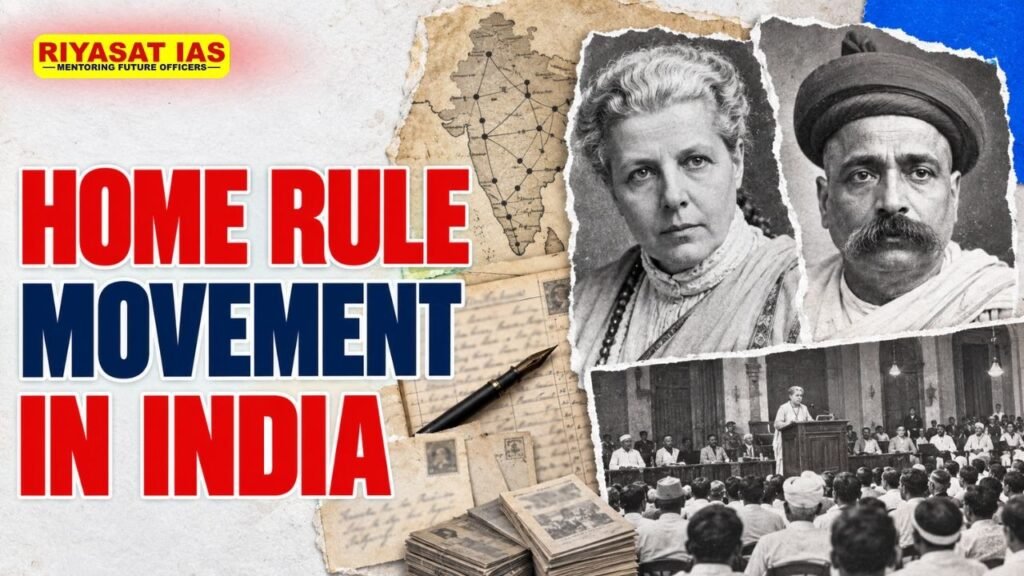
The Home Rule Movement was an important phase in India’s freedom struggle during the First World War. It was led mainly by Bal Gangadhar Tilak and Annie Besant, who sought to revive nationalist politics after the decline of the Swadeshi movement and the political inactivity that followed the Surat split.
The movement demanded Home Rule or self-government for India within the British Empire, broadly on the lines of the self-governing dominions such as Canada and Australia. It did not initially demand complete independence.
Factors Leading to the Home Rule Movement
· Political stagnation after 1908: After the decline of the Swadeshi movement, the nationalist movement entered a relatively inactive phase. The revolutionary movement remained limited, while the Moderates had not been able to achieve substantial constitutional reforms. Tilak returned from imprisonment in 1914 and began working towards bringing different sections of nationalists together.
· Failure of the Morley–Minto Reforms: The Indian Councils Act, 1909 enlarged legislative councils but did not establish responsible government. The limited nature of these reforms disappointed many nationalists and strengthened the demand for self-government.
· Reunion of Moderates and Extremists: The Lucknow Congress of 1916 brought the Moderates and Extremists together after years of division. This created a more favourable political atmosphere for a fresh nationalist campaign. The same session also witnessed the Congress–Muslim League Lucknow Pact, in which the two organisations agreed on a common constitutional programme. Tilak and Annie Besant played an important role in this political reconciliation.
· Impact of the First World War: The First World War created a new political situation. Britain was fighting a major international war while repeatedly claiming that it was fighting for democracy and the rights of nations. Indian nationalists therefore argued that India, which was contributing men and resources to the war, could no longer be denied the right to govern itself.
· Influence of the Irish Home Rule Movement: The idea of Home Rule was inspired partly by the Irish movement for self-government. Annie Besant particularly popularised the idea in India and argued that Indians were entitled to govern their own country.
The Home Rule Leagues
· Tilak’s Home Rule League: Bal Gangadhar Tilak established his Home Rule League in April 1916 at the Bombay Provincial Conference held at Belgaum. Tilak’s League mainly worked in Maharashtra, Karnataka, the Central Provinces and Berar, while Bombay city was outside its main area of operation. It concentrated on organising local branches, public meetings, lectures and political education. Tilak travelled extensively to mobilise people and used pamphlets in Marathi, English, Gujarati and Kannada to spread the demand for Home Rule. The Ministry of Culture records that his League had around 14,000 members by April 1917.



· Annie Besant’s Home Rule League: Annie Besant launched her Home Rule League in September 1916 at Madras, with its headquarters at Adyar. Her League had a wider, practically all-India sphere of activity, with a particularly strong presence in southern India. It organised branches, lectures, discussion groups and reading rooms and circulated political literature. Besant used her newspapers, especially New India and Commonweal, to explain the meaning of Home Rule and create public opinion in its favour. The two Leagues did not merge, but they generally divided their areas of work and cooperated rather than competing with each other.
Home Rule League Programme
- They organised public meetings, lectures, study circles and reading rooms to spread political awareness.
- They distributed pamphlets, newspapers and nationalist literature in English and Indian languages.
- They established local branches and trained volunteers who could carry the movement beyond the major political centres.
- They tried to create a strong all-India public opinion in favour of self-government.
- They criticised colonial policies and encouraged people to question the political and economic structure of British rule.
- They sought to bring different sections of nationalists together and revive the Indian National Congress as an active political organisation.
- They demanded Home Rule for India within the British Empire, rather than complete independence at this stage.
Government Attitude towards the Home Rule Movement
· The British government initially watched the movement carefully and gradually became increasingly hostile as its popularity grew. The government regarded the movement as a serious challenge because it was creating an organised, united and increasingly popular opposition to colonial rule. Tilak faced restrictions on his political activities, while the Madras Government took measures against Besant’s League. The situation became particularly serious in June 1917, when Annie Besant, B. P. Wadia and George Arundale were interned by the government. The arrest produced a strong reaction across India. Leaders who had earlier remained cautious, including M. A. Jinnah, Surendranath Banerjee and Madan Mohan Malaviya, joined the protest. The government eventually changed its approach.
· On 20 August 1917, Secretary of State Edwin Montagu announced that British policy would aim at the gradual development of self-governing institutions in India. Besant was released in September 1917, and she was subsequently elected President of the Indian National Congress at its Calcutta session in December 1917.
Why Did the Home Rule Agitation Fade by 1919?
· Government concessions: The Montagu Declaration of 1917 and the subsequent Montagu–Chelmsford Reform proposals gave many Moderates hope that constitutional progress was possible. This weakened the unity that had supported the Home Rule agitation.
· Differences among nationalists: There were disagreements over how the proposed constitutional reforms should be treated. Annie Besant adopted a more accommodating position at different stages, while Tilak remained more critical of the reforms. These differences weakened the leadership of the movement.
· Tilak’s absence: Tilak went to England in 1918 to pursue his libel case against Valentine Chirol. His absence removed one of the movement’s strongest organisers from India at an important stage.
· Besant’s political inconsistency: Besant’s position towards the proposed reforms and the question of passive resistance became increasingly uncertain. This reduced the political coherence of the movement.
· Lack of a mass programme: The movement succeeded in reaching a much wider section of society, but it remained primarily a middle-class political movement. It did not develop a sustained mass programme comparable to the movements that Gandhi would later lead.
· Emergence of Gandhi: The return of Mahatma Gandhi and the development of his method of Satyagraha and mass mobilisation provided a new direction to Indian nationalism. The Home Rule Leagues had created political awareness and organisational networks, but Gandhi was able to convert this political awakening into a much broader mass movement.
Positive Gains of the Home Rule Movement
· It revived the national movement: The Home Rule Movement ended the political stagnation that had followed the decline of the Swadeshi movement. It brought nationalist politics back into public life during the First World War.
· It popularised the idea of self-government: The demand for Home Rule became a widely discussed political issue. It helped move Indian politics beyond the earlier demand for limited administrative reforms.
· It widened political participation: The Leagues reached many towns and areas that had previously remained outside active national politics. Their meetings, pamphlets, reading rooms and lectures helped create a larger politically conscious public.
· It helped reunite nationalists: Tilak and Besant worked to bring the Moderates and Extremists together. Their efforts contributed to the political atmosphere that produced the Lucknow Pact of 1916.
· It created a new generation of political workers: The Leagues trained and connected a large number of activists. Several future nationalists received their early political experience through the Home Rule organisations.
· It prepared the ground for Gandhian mass politics: This was perhaps its most lasting contribution. The movement created political networks, public enthusiasm and an organised cadre of nationalist workers that could later be used in wider mass movements.
Conclusion
· The Home Rule Movement was a bridge between the earlier phase of constitutional and militant nationalism and the Gandhian era of mass politics. It did not achieve Home Rule, but it revived political activity, popularised self-government, brought nationalists together and created a wider political base. Its greatest contribution was preparing the organisational and political ground for the mass movements of the 1920s.
FAQs
1. When did the Home Rule Movement begin in India?
The movement took organised form in 1916, when Tilak and Annie Besant established separate Home Rule Leagues.
2. Who started the Home Rule Leagues?
Bal Gangadhar Tilak established his League in April 1916, while Annie Besant launched hers in September 1916.
3. What was the main objective of the Home Rule Movement?
Its principal objective was to secure self-government or Home Rule for India within the British Empire.
4. What was the difference between Tilak’s and Besant’s Leagues?
Tilak’s League mainly operated in Maharashtra, Karnataka, the Central Provinces and Berar, while Besant’s League had a broader all-India reach, with Madras as its main centre.



 Ravi Raaz
 Hassan Khan
 Shadab Ali