
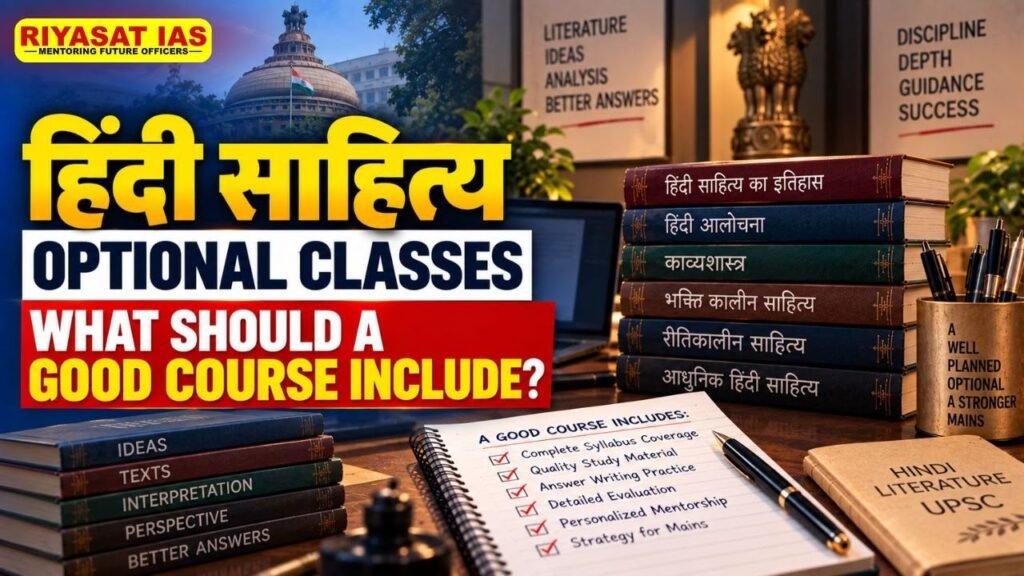
Every institute offering Hindi Literature optional classes will tell you that its course is complete. But “complete” can mean very different things — from a set of recorded lectures with no tests, to a structured programme with a fixed number of teaching hours, evaluated tests and regular mentorship.
This guide is part of our complete guide to the Hindi Literature optional. Use it as a checklist, and compare it point by point with the Hindi Sahitya optional foundation course at Riyasat IAS.
This article lists what a good Hindi Literature (हिंदी साहित्य) optional course for UPSC should include, so you can compare options on facts rather than promises.
Quick answer: A good Hindi Literature optional course should include full coverage of Paper 1 and Paper 2 in a defined number of hours, teaching from the original prescribed texts, faculty with academic depth and UPSC experience, unit-wise study material, an evaluated test series, answer-writing practice, weakness analysis, mentorship, small batches, online access and a free demo.
First, Know What the Course Must Cover
The UPSC syllabus for Hindi Literature has two papers.
Paper 1 — History of Hindi Language and Literature
Section A — History of Hindi language and Nagari script
- Grammatical and applied forms of Apabhramsha, Avahatta and early Hindi
- Development of Braj and Avadhi as literary languages in the medieval period
- Siddha and Nath literature, Khusro, Sant literature, Rahim and others; early Khari Boli in Dakkhini Hindi
- Development and standardisation of Khari Boli and Nagari script in the nineteenth century
- Development of Hindi as the national language during the freedom movement and as the official language of the Indian Union
- Scientific and technical development of Hindi; major dialects and their inter-relationship
- Salient features of Nagari script, efforts for its reform, and the grammatical structure of standard Hindi
Section B — History of Hindi literature
- Relevance and tradition of literary history writing
- Adikal, Bhaktikal, Ritikal and the modern period, with their major poets and tendencies
- Fiction, drama and theatre, criticism, and other prose forms such as Lalit Nibandh, sketches, memoirs and travelogues
Paper 2 — Prescribed Texts
- Poetry: Kabir, Surdas, Tulsidas, Jayasi, Bihari, Maithilisharan Gupt, Jaishankar Prasad, Nirala, Dinkar, Agyeya, Muktibodh and Nagarjun
- Prose: Bharatendu, Mohan Rakesh, Ramchandra Shukla, Nibandh Nilay, Premchand, Prasad, Yashpal, Renu, Mannu Bhandari and Ek Duniya Samanantar (ed. Rajendra Yadav)



Any course you consider must teach every one of these units — not just the popular ones. The full unit-wise breakdown is in our
10 Things a Good Hindi Literature Course Must Include
1. A defined number of teaching hours
A fixed programme (for example, 200 hours) tells you the course has been planned unit by unit. Ask how the hours are divided between the two papers.
2. Teaching from the original texts
Paper 2 questions come from the texts themselves. The teacher should read and explain the actual lines, not just summarise the story or theme.
3. Faculty with both academic depth and UPSC experience
Literature teaching needs a scholar; UPSC preparation needs a strategist. The best courses have both.
4. Unit-wise study material
Printable notes for each unit, focused on the exam, save you from collecting ten different books for one topic.
5. Regular answer-writing practice
Writing should begin during the course, not after it. Look for practice in the UPSC Mains format with evaluated feedback.
6. A structured, evaluated test series
Topic-wise tests, section-wise tests and full-length tests — each with detailed feedback.
7. Weakness analysis
After each test you should know which units and which skills to work on.
8. Mentorship
Scheduled sessions with the faculty to discuss strategy, performance and planning.
9. Small batch size
Personal attention is only possible when the batch is small enough for the faculty to know your writing.
10. Online access and recordings
Recordings help you revise and protect you from gaps when you miss a class. If you are outside Delhi, compare online hindi lecture coaching; if you are in Delhi, see how to choose Hindi Literature coaching in Delhi.
Bonus: a free demo class. You should be able to watch a class before you pay.
Course Checklist: Riyasat IAS Hindi Sahitya Optional
Here is how the Riyasat IAS Hindi Sahitya optional foundation course matches each point:
| Must-have feature | Included? | Details |
| Defined teaching hours | Yes | 200 hours covering Paper 1 and Paper 2 completely |
| Teaching from original texts | Yes | Every prescribed text in Paper 2 is part of the programme |
| Academic faculty | Yes | Dr. Puneet Chaturvedi Sir — Ph.D. (Hindi Literature), NET cleared four times, teaching UPSC aspirants since 2015 |
| UPSC strategy faculty | Yes | Riyasat Ali Sir — founder, mentoring UPSC aspirants since 2011 |
| Study material | Yes | Handout notes for every unit — printable and exam-focused |
| Answer-writing practice | Yes | UPSC Mains format, evaluated with margin comments |
| Test series | Yes | 14 evaluated tests: 8 Mini Mock, 4 Sectional, 2 Full Length |
| Weakness analysis | Yes | After every test |
| Language accuracy | Yes | Grammar and spelling checked in every evaluated answer |
| Mentorship | Yes | 2 live mentorship sessions every month |
| Batch size | Yes | Only 50 seats per batch |
| Online access | Yes | Online and offline modes; live streaming and recordings on the student portal |
| Flexible tests | Yes | Take tests any day and time after the scheduled date |
| Free demo | Yes | Free demo class and free counselling |
How to Evaluate a Demo Class
When you watch a demo, ask yourself:
- Did the teacher explain the text or only the story?
- Did the class connect the topic to how UPSC asks questions?
- Were critics’ views and quotations used?
- Could you follow the language and pace comfortably?
- Would you be able to write an answer on this topic after the class?
Questions to Ask the Counsellor
- When does the next batch start, and how many seats are left?
- How are the 200 hours scheduled per week?
- How are answer copies submitted and returned for online students?
- Who conducts the mentorship sessions?
- Can I see the course and test series brochures?
Related Guides
- Best Online Hindi Literature Optional Coaching for UPSC
- Best Hindi Literature Optional Test Series for UPSC Mains
Frequently Asked Questions
How long does a Hindi Literature optional course take?
It depends on the schedule, but a structured programme should define its total hours. The Riyasat IAS foundation course covers both papers in 200 hours of teaching.
Are both papers taught in the same course?
In a good foundation course, yes. At Riyasat IAS, the full syllabus of Paper 1 and Paper 2 is part of the same 200-hour programme, and the 14 tests are divided evenly between the two papers.
Can I write answers in Hindi?
Yes. Hindi Literature is the most natural optional for Hindi-medium aspirants, and all answers can be written in Hindi.
Compare for Yourself
Download the free course and test series brochures, watch the demo class, and then book a counselling call.
- Course page: Hindi Sahitya Optional Classes — Foundation Course 2027
- Call or WhatsApp: +91 93196 12575 / +91 80905 28260




 Ravi Raaz
 Hassan Khan
 Shadab Ali