
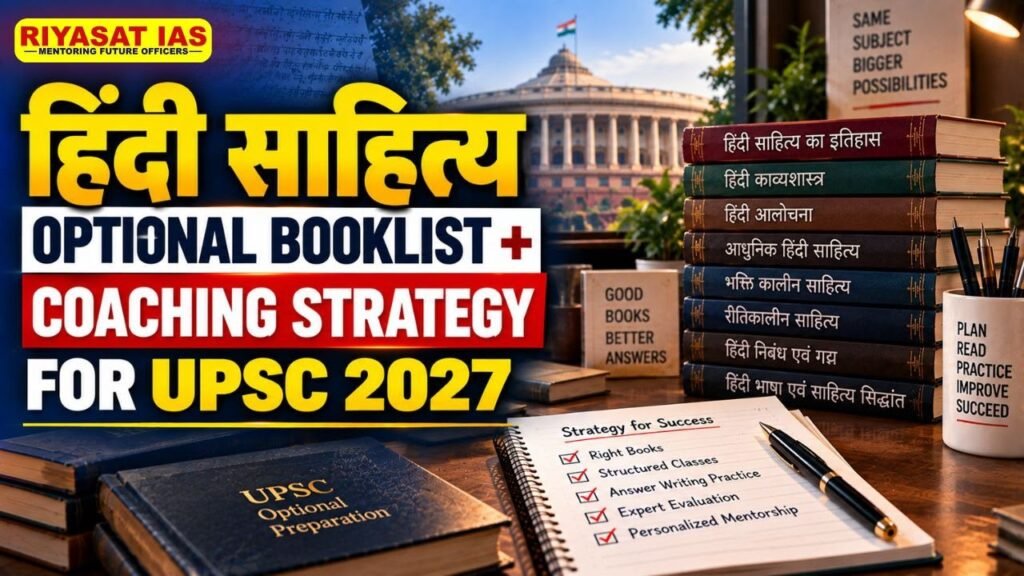
The Hindi Literature optional has one of the longest reading lists in UPSC — and one of the easiest to get lost in. Aspirants often buy three histories of literature, five critical books on Kabir and a stack of guides, then struggle to finish any of them.
The booklist below is aligned with the syllabus taught in the Hindi Literature optional course at Riyasat IAS.
A good booklist is short, mapped to the syllabus, and used alongside a clear strategy. This article gives you both: a focused booklist for Paper 1 and Paper 2, and a phase-wise plan for UPSC CSE 2027.
Quick answer: For Paper 1, use one standard book on the history of the Hindi language and Nagari script and one or two standard histories of Hindi literature. For Paper 2, read every prescribed text in the prescribed edition, and add one respected critical work for each major author. Combine this with class notes and an evaluated test series.
Principle 1: The Prescribed Texts Come First
Paper 2 is built on prescribed texts, and the UPSC syllabus names the editions for several of them. Buy these first and read them in the original. No guide can replace the lines themselves, because the compulsory reference-to-context questions are drawn directly from them.
Paper 2: Prescribed Texts (Primary Reading)
Section A — Poetry
| Poet | Prescribed text |
| Kabir | Kabir Granthavali (first 100 pads), ed. Shyam Sundar Das |
| Surdas | Bhramargeet Saar (first 100 pads), ed. Ramchandra Shukla |
| Tulsidas | Ramcharitmanas (Sundar Kand); Kavitavali (Uttar Kand) |
| Jayasi | Padmavat (Sinhaldweep Khand and Nagmati Viyog Khand), ed. Shyam Sundar Das |
| Bihari | Bihari Ratnakar (first 100 dohe), ed. Jagannath Das Ratnakar |
| Maithilisharan Gupt | Bharat Bharati |
| Jaishankar Prasad | Kamayani (Chinta and Shraddha Sarg) |
| Nirala | Rag-Virag (Ram ki Shakti Puja, Kukurmutta), ed. Ramvilas Sharma |
| Dinkar | Kurukshetra |
| Agyeya | Aangan ke Paar Dwar (Asadhya Veena) |
| Muktibodh | Brahmarakshas |
| Nagarjun | Badal ko Ghirte Dekha Hai; Akal aur Uske Baad; Harijan Gatha |
Section B — Prose
| Author | Prescribed text |
| Bharatendu | Bharat Durdasha |
| Mohan Rakesh | Ashadh Ka Ek Din |
| Ramchandra Shukla | Chintamani (Part 1): Kavita Kya Hai, Shraddha-Bhakti |
| Nibandh Nilay (ed. Dr. Satyendra) | Essays of Balkrishna Bhatt, Premchand, Gulab Rai, Hazari Prasad Dwivedi, Ramvilas Sharma, Agyeya, Kubernath Rai |
| Premchand | Godan; Sarvashreshth Kahaniyan, ed. Amrit Rai |
| Prasad | Skandagupta |
| Yashpal | Divya |
| Phanishwarnath Renu | Maila Anchal |
| Mannu Bhandari | Mahabhoj |
| Rajendra Yadav (ed.) | Ek Duniya Samanantar |



Always cross-check this list with the latest official UPSC syllabus before buying.
Paper 1: Standard Books
For how to use these books section by section
Section A — Hindi language and Nagari script
- हिंदी: उद्भव, विकास और रूप — Hardev Bahri. A compact standard reference for the development of Hindi, dialects and Nagari script.
- हिंदी भाषा — Bholanath Tiwari. Useful for linguistic features and grammatical structure.
Choose one as your main book and use the other only for topics where you need more depth. Supplement with notes on Hindi as the official language, including the relevant constitutional provisions (Articles 343–351).
Section B — History of Hindi literature
- हिंदी साहित्य का इतिहास — Acharya Ramchandra Shukla. The foundational history; essential for the critical views that examiners expect.
- हिंदी साहित्य का दूसरा इतिहास — Bachchan Singh. A readable history that is especially helpful for the modern period.
- हिंदी साहित्य का इतिहास — ed. Dr. Nagendra. A useful reference for dates, writers and works.
- हिंदी साहित्य और संवेदना का विकास — Ramswaroop Chaturvedi. Good for understanding tendencies and connections between periods.
You do not need all four. One primary history (usually Shukla, read selectively) plus one modern, readable history is enough when combined with class notes.
Critical Works for Major Authors (Selective Reading)
Use these to sharpen your critical perspective, not to read cover to cover:
- Kabir — Hazari Prasad Dwivedi
- Goswami Tulsidas — Ramchandra Shukla
- Shukla’s introductions to Bhramargeet Saar and Jayasi Granthavali
- Kamayani: Ek Punarvichar — Muktibodh
- Nirala ki Sahitya Sadhana — Ramvilas Sharma
- Premchand aur Unka Yug — Ramvilas Sharma
- Kavita ke Naye Pratiman — Namvar Singh (for modern poetry, including Muktibodh)
Principle 2: Books Need a Strategy
A booklist without a plan leads to uneven preparation. Here is a phase-wise approach for UPSC CSE 2027. Confirm exact exam dates on the official UPSC calendar.
Phase 1 — Foundation (first 4–5 months)
- Complete Paper 1 Section A and Section B with class notes and one standard book each.
- Begin reading the Paper 2 poetry texts in the original.
- Write two answers a week from week one.
Phase 2 — Texts and tests (next 3–4 months)
- Finish all Paper 2 texts, poetry and prose.
- Prepare one-page notes for each author: context, themes, style, two or three key quotations, and one critic’s view.
- Write topic-wise (mini) tests as each unit is completed.
Phase 3 — Prelims period
- Keep the optional alive with light, regular revision — one text or one literary period each week.
- Do not start new books.
Phase 4 — After Prelims to Mains
- Write sectional and full-length tests.
- Rewrite weak answers and revise your one-page notes and quotation lists.
Where Coaching Fits Into This Strategy
Coaching should reduce your booklist, not add to it. A structured course gives you notes mapped to the syllabus, tells you which parts of each book matter, and tests you at every stage.
The Riyasat IAS Hindi Sahitya optional course supports this plan with:
- 200 hours of teaching across Paper 1 and Paper 2.
- Unit-wise handout notes — printable and exam-focused.
- 14 evaluated tests (8 Mini Mock, 4 Sectional, 2 Full Length) aligned with the phases above.
- Flexi test format so tests fit your reading pace.
- 2 live mentorship sessions a month with Riyasat Ali Sir and Dr. Puneet Chaturvedi Sir (Ph.D. in Hindi Literature, cleared NET four times).
- Online and offline modes with recordings on the student portal.
- Best Online Hindi Literature Optional Coaching for UPSC
- Best Hindi Literature Optional Test Series for UPSC Mains
Mistakes to Avoid With Books
- Reading guides instead of the original prescribed texts.
- Using three histories of literature for the same topic.
- Neglecting Paper 1 Section A because it feels “technical”.
- Reading critical works cover to cover instead of selectively.
- Making detailed notes from every book and never revising them
Frequently Asked Questions
What are the best books for Hindi Literature optional?
The prescribed texts in the original, one standard book on the history of the Hindi language (such as Hardev Bahri), and one or two histories of Hindi literature (such as Ramchandra Shukla and Bachchan Singh), supported by selective critical works.
Is Ramchandra Shukla’s history enough for Paper 1?
It is essential for critical views, but it is dense and does not fully cover later developments. Pair it with a readable modern history and class notes.
Do I need to read the full Ramcharitmanas?
No. The syllabus prescribes Sundar Kand of Ramcharitmanas and Uttar Kand of Kavitavali. Read the prescribed portions thoroughly.
Get the Complete Study Plan
Download the free course brochure and speak to a counsellor about a plan for your target year.
- Course page: Hindi Literature Optional Foundation Course 2027
- Call or WhatsApp: +91 93196 12575
- Related: UPSC Books and UPSC Syllabus



 Ravi Raaz
 Hassan Khan
 Shadab Ali