
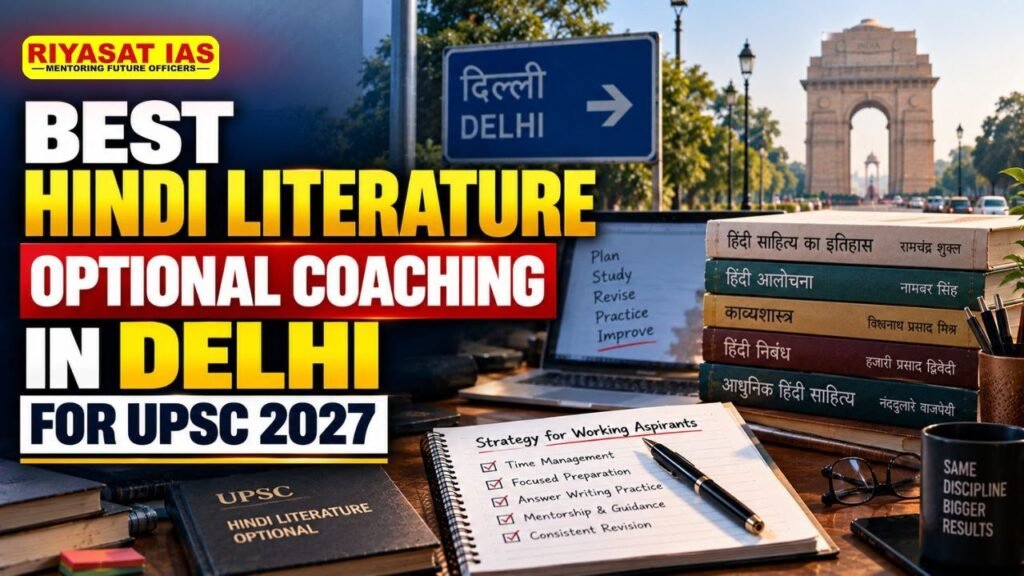
If you are preparing for UPSC CSE 2027 and have chosen Hindi Literature (हिंदी साहित्य) as your optional, the coaching you pick will shape 500 of your 1,750 written marks. The best Hindi Literature optional coaching in Delhi is not the one with the biggest banner. It is the one that finishes both papers inside a fixed number of hours, makes you read the prescribed texts in the original, evaluates your answers line by line, and gives you direct access to the faculty when you get stuck.
This guide is part of our complete guide to the Hindi Literature optional. If you want to see how one programme matches every point on the checklist below.
This guide gives you a practical checklist to judge any institute in Delhi, the questions to ask at the counselling desk, and the warning signs to avoid.
Quick answer: Choose a Hindi Literature coaching in Delhi that offers (1) faculty with a research-level command of the subject, (2) complete coverage of Paper 1 and Paper 2 in a defined number of hours, (3) an evaluated test series mapped to the syllabus, (4) small batches, (5) regular mentorship sessions and (6) a free demo class so you can judge the teaching style first.
Why Hindi Literature Is a Strong Optional for UPSC 2027
Before you compare institutes, be sure of the subject itself. Hindi Literature suits a particular kind of aspirant very well.
- The syllabus is static. Unlike subjects driven by current affairs, the history of the Hindi language, the history of Hindi literature and the prescribed texts do not change every year. What you study once stays useful for every attempt.
- It rewards structured writing. Paper 1 (Hindi language and history of literature) is highly scoreable when answers are precise, well organised and supported by the right examples and quotations.
- Hindi-medium aspirants write in their strongest language. There is no translation barrier between what you think and what you write.
- It feeds your Essay and GS papers. Literary history, modern poetry, prose and social themes in novels such as Godan and Maila Anchal give you examples, quotations and perspective for the Essay paper and GS Paper 1.
If you enjoy reading and can write with clarity, Hindi Literature can become the most predictable part of your Mains preparation.
Why Delhi Is Still the Preferred Base for Optional Coaching
Delhi, especially Old Rajendra Nagar and its neighbourhood, remains the centre of UPSC preparation for good reasons:
- Peer group: You study alongside serious aspirants who have taken the same optional, which helps with discussion and revision.
- Access to faculty: Offline classes allow you to clear doubts immediately, which matters in a subject where interpretation of a poem or a critical view can be subtle.
- Libraries and bookshops: Original texts, critical editions and standard histories of literature are easy to find.
- Test environment: Writing a full-length test in a hall, under time pressure, is the closest you get to the real Mains experience.
That said, a Delhi address alone does not make a coaching good. Use the checklist below. If you are still deciding on the subject itself, first read.



The 8-Point Checklist to Choose the Best Hindi Literature Coaching in Delhi
1. Faculty depth in the subject
Hindi Literature is an academic subject. Your teacher should be able to explain Apabhramsha and Avahatta, the standardisation of Khari Boli and Nagari script, the Bhakti and Riti traditions, Chhayavad and Nayi Kavita, and then turn that knowledge into answers that fit UPSC word limits. Look for a formal academic background in Hindi literature combined with years of experience with UPSC aspirants specifically.
2. Complete coverage of Paper 1 and Paper 2 in fixed hours
Ask how many teaching hours the course has and how they are divided between Paper 1 (language and literary history) and Paper 2 (prescribed texts). An open-ended course that “finishes when it finishes” often leaves the last few texts rushed. A defined programme tells you exactly what you are paying for.
3. Reading of the original texts
Paper 2 expects you to have read the prescribed texts: Kabir Granthavali, Bhramargeet Saar, Ramcharitmanas (Sundar Kand), Padmavat, Bihari Ratnakar, Kamayani, Ram ki Shakti Puja, Kurukshetra, Asadhya Veena, Brahmarakshas, Bharat Durdasha, Ashadh Ka Ek Din, Godan, Skandagupta, Divya, Maila Anchal, Mahabhoj and others. The coaching should teach from the texts, not only from summaries, because the compulsory reference-to-context questions come directly from the original lines.
4. An evaluated test series mapped to the syllabus
A good test series moves from small, topic-wise tests to section-wise tests and finally to full-length papers. Each copy should come back with comments in the margin, not just a number. Here is what the best Hindi Literature test series should include.
5. Batch size
In a batch of several hundred students, your answer copy becomes one among a pile. Smaller batches mean the faculty knows your writing and your weak areas.
6. Regular mentorship
Classes teach the subject; mentorship teaches you how to manage it alongside GS, Essay and Prelims. Check whether mentorship sessions are scheduled and who conducts them.
7. Online backup
Even if you join offline, you will miss a class sometime. (If you cannot move to Delhi at all, read our guide to the best online Hindi Literature optional coaching.) Recorded lectures and a student portal protect you from gaps.
8. A free demo class
The teaching style of a literature faculty is personal. Watch a demo class before you decide.
How the Riyasat IAS Hindi Literature Programme Measures Up
The Hindi Sahitya optional course at Riyasat IAS in Old Rajendra Nagar is built around the same checklist. Here is how it compares, point by point:
| What to look for | What the Riyasat IAS course offers |
| Faculty depth | Dr. Puneet Chaturvedi Sir — Ph.D. in Hindi Literature, cleared NET four times, guiding UPSC aspirants since 2015 |
| UPSC strategy | Riyasat Ali Sir — founder, mentoring UPSC aspirants since 2011 (15+ years) |
| Coverage | 200 hours of classroom teaching covering the full Paper 1 and Paper 2 syllabus |
| Test series | 14 evaluated tests: 8 Mini Mock, 4 Sectional and 2 Full Length |
| Batch size | Only 50 seats per batch |
| Mentorship | 2 live mentorship sessions every month |
| Study material | Unit-wise handout notes, printable and exam-focused |
| Answer evaluation | Margin comments, weakness analysis after every test, and a grammar and spelling check on every evaluated answer |
| Flexibility | Flexi test format — write a test on any day and time after its scheduled date |
| Mode | Online and offline; live sessions are streamed and recordings stay on the student portal |
| Try before you join | Free demo class and free counselling |
A Suggested Timeline for UPSC CSE 2027
Always confirm exact dates on the official UPSC calendar, but the broad pattern of the exam lets you plan backwards:
- Now to the end of the year: Complete the first full reading of Paper 1 (language and literary history) and begin the prescribed texts of Paper 2.
- Early next year: Finish the Paper 2 texts, start the Mini Mock tests and build short notes for each poet and prose writer.
- Prelims phase: Keep optional revision light but regular — one text or one period of literary history a week — so you do not lose touch.
- After Prelims: Move to Sectional and Full Length tests, rewrite weak answers and memorise key quotations.
Joining a structured 200-hour programme early gives you enough room to finish the optional before Prelims pressure begins.
Questions to Ask Before You Enrol
- How many teaching hours are there, and how are they split between Paper 1 and Paper 2?
- Who teaches the prescribed texts, and what is their academic background?
- How many tests are there, and are all of them evaluated with written comments?
- What is the maximum batch size?
- Are recordings available if I miss a class?
- Can I attend a demo class first?
Red Flags to Avoid
- No clear number of teaching hours or a syllabus that is “covered as per pace”.
- Test copies returned with only marks and no comments.
- Teaching only from summaries and guidebooks, with no reading of the original texts.
- Very large batches with no scheduled one-to-one or small-group interaction.
- Pressure to pay immediately without a demo class or counselling session.
Frequently Asked Questions
Which is the best Hindi Literature optional coaching in Delhi?
The best coaching is the one that meets your needs on faculty depth, full syllabus coverage, evaluated tests, batch size and mentorship. Use the 8-point checklist above, attend demo classes, and compare the answers you get to the questions listed in this guide.
Is Hindi Literature a good optional for UPSC 2027?
Yes, for aspirants who enjoy reading and writing in Hindi. The syllabus is static, Paper 1 is highly scoreable with structured answers, and the subject strengthens your Essay and GS Paper 1 preparation.
Can English-medium aspirants take Hindi Literature?
Yes, but the Hindi Literature papers are written in Hindi (Devanagari), so you must be comfortable writing long answers in Hindi. Read our guide and confirm the medium rules in the current UPSC notification.
Is the Riyasat IAS Hindi Literature course available online?
Yes. The course runs in both online and offline modes. Live sessions are streamed and recordings are available on the student portal.
Take the Next Step
Watch the free demo class, then speak to a counsellor about the next batch. Seats are limited to 50 per batch.
- Course page: Hindi Sahitya Optional — Foundation Course and Test Series
- Call or WhatsApp: +91 93196 12575 / +91 80905 28260
- Visit: 64, Top Floor, Bada Bazar Marg, Old Rajendra Nagar, Delhi-60 (Monday to Saturday, 10 am to 7 pm)



 Ravi Raaz
 Hassan Khan
 Shadab Ali