
Applied ethics involves the philosophical examination of specific moral issues in both private and public life, making moral judgments about these issues.
Normative Principles in Applied Ethics
● Personal Benefit: Actions should produce beneficial consequences for the individual involved.
● Social Benefit: Actions should benefit society as a whole.
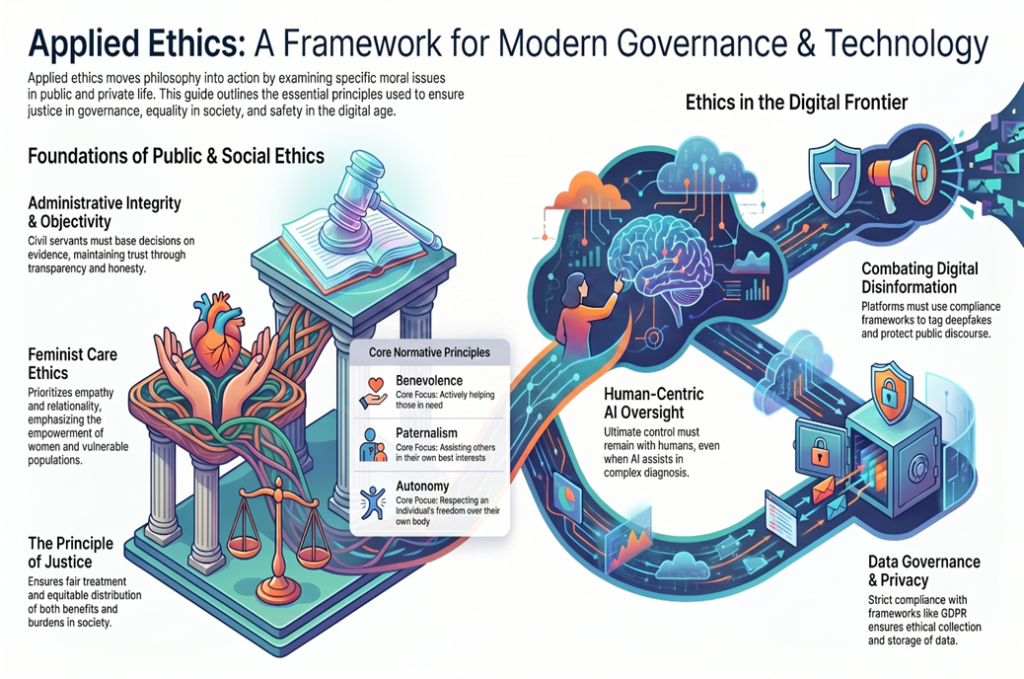
● Benevolence: Emphasizes helping those in need.
● Paternalism: Assists others in pursuing their best interests.
● Harm: Actions should not cause harm to others.
● Honesty: Requires individuals to refrain from deception.
● Lawfulness: Actions should not violate the law.
● Autonomy: Acknowledges individuals’ freedom over their actions and bodies.
● Justice: Emphasizes fair treatment and equitable distribution of benefits and burdens.
● Rights: Recognizes individuals’ rights to life, privacy, and free expression.
Administrative Ethics
● Transparency: Involves adhering to laws and voluntarily disclosing information to the public to prevent corruption and ensure accountability. For example, the District of Columbia’s “Open Data DC” initiative allows the public to explore web maps and download data for analysis.
● Integrity: Unwavering adherence to moral and ethical principles, essential for maintaining trust in public service. For example, Sanjiv Chaturvedi, an Indian Forest Service officer, exposed significant corruption in Haryana’s forest department, demonstrating exceptional integrity.
● Objectivity: Requires civil servants to base decisions on facts and evidence, avoiding personal bias or external influences. For example, Dr. Anthony Fauci provided evidence-based public health advice during the COVID-19 pandemic, maintaining objectivity despite political pressures.
● Compassion: Addressing the needs of vulnerable populations and ensuring their welfare. For example, during the COVID-19 crisis, Kerala’s government ran an inclusive food distribution program for migrant workers.
● Commitment to Public Service: Dedication to serving the public interest, maintaining motivation and resilience despite challenges. For example, frontline workers during the COVID-19 pandemic risked their lives to provide essential services.
● Impartiality: Ensures equal treatment for all citizens, upholding the rule of law and maintaining public trust.
Feminist Ethics



● Care Ethics: Carol Gilligan emphasizes the importance of care, empathy, and relationality in ethical decision-making, particularly in caregiving roles. For example, in India, SEWA (Self Employed Women’s Association) embodies care ethics by prioritizing the welfare and empowerment of women.
● Gender Justice: Addresses gender biases inherent in traditional ethical frameworks by advocating for the inclusion of gender perspectives in ethical analysis. For example, the “One Million Signatures” campaign in Iran mobilized women to advocate for legal reforms addressing gender discrimination.
● Intersectionality: Kimberlé Crenshaw’s analytical framework examines how identities like race, class, and sexuality intersect with gender, showing how African American women face compounded discrimination.
● Ethics of Autonomy and Agency: Advocates for recognizing women’s autonomy and agency in decision-making processes, opposing paternalistic attitudes, and promoting women’s empowerment in exercising control over their lives and choices.
● Feminist Critique: Examines traditional ethical theories and their gender biases, arguing for the inclusion of feminist perspectives to challenge hierarchical power structures and transform social norms.
Artificial Intelligence Ethics
● Human Agency and Oversight: Ensures that while AI can assist and enhance human capabilities, ultimate control and decisions remain with humans. For example, Qure.ai developed AI tools that assist radiologists in diagnosing COVID-19 from chest X-rays while keeping the human doctor in the loop.
● Transparency: Involves making the workings of AI systems understandable to users and stakeholders. For example, the European Union’s AI Act requires companies to disclose the logic, significance, and consequences of their AI systems.
● Diversity & Non-discrimination: Focuses on designing AI systems that are fair and unbiased, promoting equality and preventing discrimination. For example, IBM’s Watson AI incorporated diverse datasets to reduce biases and improve healthcare recommendations for minority groups.
● Robustness and Safety: The ability of AI systems to operate correctly under various conditions, including unexpected situations or adversarial attacks. For example, Tesla updated its Autopilot AI safety features to improve hazard detection and emergency braking systems.
● Accountability: Setting up mechanisms to ensure that AI systems and their operators can be held responsible for their actions.
● Environmental and Societal Well-being: Developing and using AI technologies in ways that are sustainable and beneficial to society.
Example: DeepMind’s Envisage and GraphCast AI architectures deployed globally to optimize complex power grids and predict severe, volatile climate anomalies. This directly prevents power failures and accelerates regional disaster preparedness.
● Data Governance: Establishing policies and procedures for the ethical collection, storage, and use of data. For example, the European Union’s GDPR mandates strict guidelines addressing AI data usage to ensure ethical management and security of user data.
Cyber Ethics
● Compliance with the Law: Internet users must adhere to laws and avoid engaging in illegal activities such as hacking, defrauding, stalking, and harassment.
● Intellectual Property Rights (IPR): Respecting copyrights protecting online content to foster innovation and maintain authenticity on the web.
● Privacy: Despite mass surveillance and spyware, platforms must respect privacy and obtain informed consent before collecting personal data.
● Free and Open Internet: Stakeholders must collaborate to ensure the internet remains accessible to all and free from barriers, maintaining net neutrality as a critical pillar.
● Respect in Online Behavior: Demonstrating courtesy online to maintain a safe environment and prevent trolling, abuse, and shaming.
● Public Decency: Ensuring content on public platforms is appropriate for all audiences and avoids offensive material.
● Honesty and Sincerity: Users and platforms must share only true, complete, and accurate information to prevent rumors and fake news.
Example: The enforcement of stringent international compliance frameworks on social media conglomerates to rapidly tag synthetically altered content, deepfakes, and algorithmic bots. This structurally protects public discourse from coordinated disinformation campaigns.
Previous Year Questions
Q. What is meant by ‘environmental ethics? Why is it important to study? Discuss any one environmental issue from the viewpoint of environmental ethics.
Q. Online methodology is being used for day-to-day meetings, institutional approvals in the administration and for teaching and learning in education sector to the extent telemedicine in the health sector is getting popular with the approvals of the competent authority. No doubt it has advantages and disadvantages for both the beneficiaries and system at large. Describe and discuss the ethical issues involved in the use of online method particularly to vulnerable section of society.
Q. Impact of digital technology as reliable source of input for rational decision making is a debatable issue. Critically evaluate with suitable example.
Q. Increased national wealth did not result in equitable distribution of its benefits. It has created only some “enclaves of modernity and prosperity for a small minority at the cost of the majority.” Justify.
Practice Questions
| Question 1In the era of digital media and instant news, what are the primary ethical dilemmas faced by journalists in India? Evaluate the role of journalistic ethics in combating misinformation and ensuring responsible journalism. (10 Marks, 150 Words) |
| Question 2Deepfakes have the potential to undermine democratic processes by spreading false information. Discuss the ethical concerns of using deepfakes in political campaigns and elections. What measures can be implemented to detect and mitigate their impact on public trust in political institutions? (10 Marks, 150 Words) |
| Question 3“Feminist Care Ethics and Administrative Objectivity are not mutually exclusive, but complementary virtues required for inclusive public service delivery.” Critically analyze this statement in light of modern governance challenges. (10 Marks, 150 Words) |



 Ravi Raaz
 Hassan Khan
 Shadab Ali