
Ethics encompasses various dimensions that guide moral philosophy and human behavior. These dimensions help in understanding the complexity of ethical decision-making and the principles that underpin ethical theories. There are four primary branches of ethics:
Descriptive Ethics
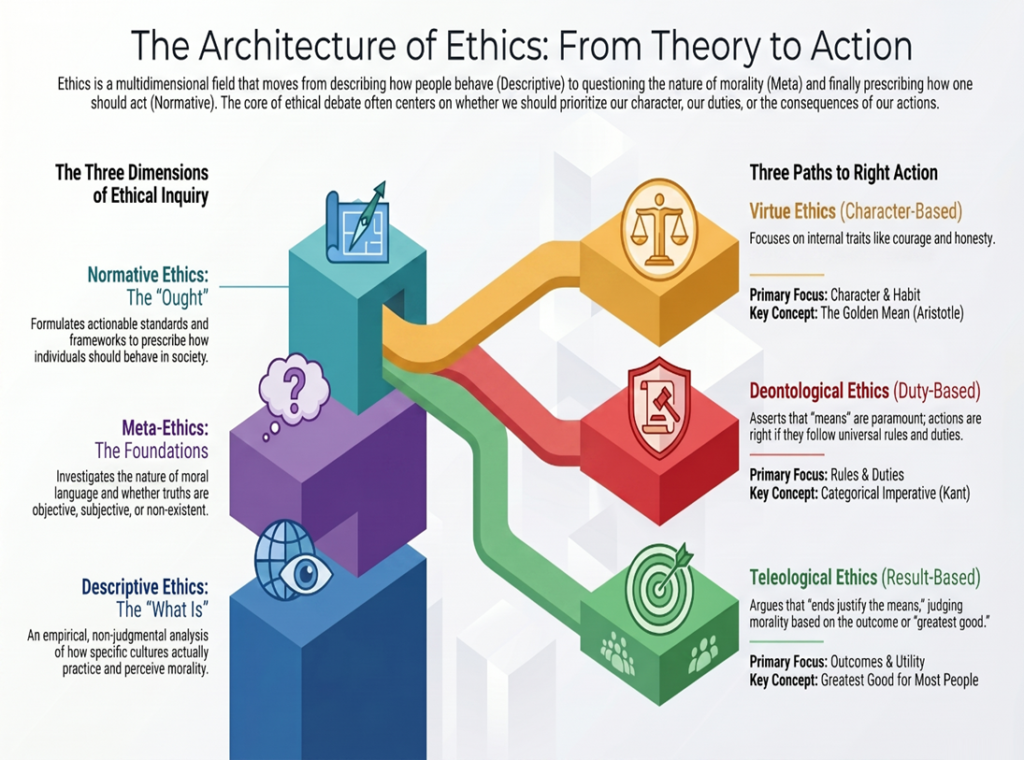
Descriptive ethics focuses on describing and analyzing existing moral beliefs, practices, and behaviors within specific cultures or societies. Unlike prescriptive ethics, which dictates how people should behave, descriptive ethics aims to provide an objective, empirical understanding of how people actually behave.
● Study of Moral Beliefs: It involves studying societal values, determining which actions a community considers right or wrong, and identifying the observed virtuous traits of moral agents.
● Value-Free Approach: It operates as a non-judgmental discipline that does not pass moral verdicts on practices and beliefs, but simply describes the phenomena observed in different groups or cultures.
Example: Anthropological and sociological data mapping global variations in digital privacy expectations. For instance, documenting how citizens in collectivist societies view public data sharing compared to the strict individualistic privacy demands in Western societies without judging which cultural approach is morally superior.
Meta Ethics
Meta-ethics investigates the nature and foundations of ethics itself. It examines the meaning of moral language, the cognitive status of moral claims, and the metaphysical nature of moral truths.
● Moral Objectivism: Asserts that there are objective moral principles valid for all humans, holding that certain actions are intrinsically right or wrong regardless of context.
● Moral Subjectivism or Relativism: Asserts that morality depends entirely on individual or cultural perspectives, denying the existence of absolute moral values.
● Moral Nihilism: Rejects the notion of any inherent ethical values, asserting that nothing is intrinsically moral or immoral.
● Investigating Ethical Concepts: It delves deeply into the underlying semantic and psychological questions, such as clarifying what constitutes a “wrong action”.
● Philosophical Inquiries: It targets fundamental issues like the core justification for being ethical, the interplay between reason and emotion, and whether ethics is an absolute reality or a fluid social construct.
Normative Ethics
Normative ethics focuses on ethical theories that explicitly prescribe how people should act. It formulates and evaluates actionable standards for determining right and wrong behaviors and provides justifications for those standards.
● Examination of Ethical Theories: It constructs frameworks that prescribe how individuals ought to behave to maintain a just society.
● Standards of Actions: It focuses primarily on systemic paradigms—addressing “who ought one to be” or what general rules to follow—rather than diagnosing isolated practical dilemmas.



● Establishing Moral Standards: Its central quest is determining how basic moral benchmarks are structurally established and philosophically justified.
Comparison: The Classical Case of the Ethical Lie
● Descriptive Ethics: Focuses purely on documenting personal or cultural beliefs and empirical experiences regarding the act of lying.
● Normative Ethics: Evaluates the systematic morality of lying by applying established philosophical lenses like deontology or consequentialism.
● Meta-Ethics: Explores the linguistic meaning of truth-telling and questions the fundamental objectivity or subjectivity of moral truth.
Branches of Normative Ethics
Virtue Ethics
Virtue ethics emphasizes that ethical actions must align with ideal internal virtues like honesty, courage, and compassion, ultimately promoting human flourishing (Eudaimonia). It is a character-based approach rather than a rule-based one.
● Plato: Suggested that primary virtues, particularly justice, represent a perfect, rational harmony within the soul.
● Aristotle: Defined virtue as the Golden Mean—the rational balance between two behavioral extremes (e.g., generosity lying between the vices of stinginess and extravagance).
● Practice and Habit: Virtues are not innate traits but are consciously acquired through continuous moral practice and habituation.
● Living a Good Life: Focuses on cultivating personal character traits necessary to lead a meaningful, self-actualized life.
Deontological Ethics
Deontological ethics asserts that actions are intrinsically right or wrong based on their adherence to rules, duties, and rights, independent of their outcomes. It argues that humans possess inherent dignity derived from their free will, meaning individuals must always be treated as ends in themselves, and never merely as a means to an end. Consequently, the means of actions are considered paramount.
● Immanuel Kant’s Categorical Imperative: Governed by two main formulations:
1. Universality: A moral law must apply to all rational agents without contradiction (e.g., basic human rights like life and liberty must be universally upheld).
2. Reciprocity: Acting only on principles you would want others to apply back to you.
● Moral Absolutism: The belief that there are absolute, unyielding moral benchmarks against which actions are judged, regardless of context or situational consequences.
● Divine Command Theory: Posits that an action is morally mandatory simply because it is decreed by a higher divine authority, emphasizing duty-bound obedience.
● Contractarianism: Holds that moral rules are those that rational, unbiased individuals would collectively agree upon to govern society (e.g., John Rawls’ Veil of Ignorance, where principles of justice are designed without knowing one’s ultimate socio-economic placement).
● Natural Rights Theory: Asserts that humans possess inalienable, fundamental rights simply by virtue of their humanity, a theory structurally advanced by thinkers like Thomas Aquinas.
Teleological Ethics
Teleological ethics, or consequentialism, judges the ultimate morality of an action entirely by its eventual outcomes or consequences, operating on the principle that the ends justify the means.
● Utilitarianism: Formulated by Jeremy Bentham and John Stuart Mill, it posits that the morally superior action is the one that maximizes utility, happiness, or pleasure for the greatest number of people.
● Egoism: Asserts that an action is right if it maximizes the long-term good and interest for oneself.
● Hedonism: A subset focusing entirely on maximizing immediate sensory pleasure and minimizing physical or emotional pain.
● Intellectualism: Evaluates the value of an action based on how effectively it promotes knowledge, cognitive depth, and rational growth.
● Consequentialist Libertarianism: Argues that the moral worth of an action or policy is measured by how effectively it maximizes individual liberty, choice, and freedom from external coercion.
● Welfarism: Evaluates actions based on their capacity to increase overall aggregate economic well-being and social welfare.
● Situation Ethics: Proposes that the ideal action is highly contextual and must be chosen to produce the most loving, compassionate outcome.
● Asceticism: Holds that moral purity and spiritual goals are achieved through self-discipline, abstinence, and the renunciation of material pleasures.
● Altruism: Demands that moral actions prioritizing the well-being and survival of others be executed completely selflessly, even at a steep personal cost.
Egalitarianism Approach
Egalitarianism is a cornerstone of distributive justice that emphasizes fairness, justice, and equality. It advocates for the equal treatment of all individuals and an equitable distribution of society’s benefits and burdens based on the premise that all human beings possess equal inherent worth.
Example: Global Climate Justice & Green Subsidies: The implementation of Common But Differentiated Responsibilities (CBDR) in international climate frameworks. This represents an egalitarian and teleological framework where developed nations bear a higher financial burden for global carbon mitigation, ensuring developing nations receive equitable access to technology and green funding.
Previous Year Questions
Q. With regard to morality of actions, one view is that means are of paramount importance and the other view is that the ends justify the means. Which view do you think is more appropriate? Justify your answer.
Q. “The good of an individual is contained in the good of all.” What do you understand by this statement? How can this principle be implemented in public life?
Q. “Human beings should always be treated as ‘ends’ in themselves and never as merely ‘means’.” Explain the meaning and significance of this statement, giving its implications in the modern techno–economic society.
Practice Questions
Question 1 Normative ethics involves determining what is morally right or wrong. Compare and contrast deontological and consequentialist approaches in the context of environmental policy-making. Which approach do you believe is more effective in addressing climate change, and why? (10 marks, 150 words)
Question 2 “The deployment of automated black-box algorithms in public welfare delivery represents a shift from deontological human dignity to purely teleological efficiency.” Critically analyze this statement in the context of administrative ethics. (10 marks, 150 words)



 Ravi Raaz
 Hassan Khan
 Shadab Ali