
Ethics in Public Relationships
Public relationships exist by virtue of profession or the position one holds in professional life. Ethics in public relationships guide behavior, action, and decision-making processes, which are vital for maintaining the integrity of the profession.
Ethical Principles
● Rule of Law: It is a constitutional directive for civil servants, ensuring consistency and predictability in their conduct.
Example:
Adherence to Judicial Due Process: Civil servants and police administrators strictly upholding the guidelines of the Supreme Court against punitive “bulldozer justice” or demolition actions without proper statutory notice. Honoring due process ensures that administrative actions remain within constitutional limits, preventing arbitrary executive actions and extrajudicial overreach.
● Fairness and Justice: This constitutional mandate directs politicians and civil servants to frame policies that accommodate all sections of society based on the principle of equity. For instance, Reservations for weaker sections of society.
● Transparency and Accountability: Essential for ensuring fairness in public dealings and increasing public confidence.
Example:
Real-time Digital Governance Frameworks: The integration of the Centralized Public Grievance Redress and Monitoring System (CPGRAMS) alongside the automated Public Financial Management System (PFMS). This ensures real-time tracking of public fund usage, institutional subventions, and direct benefit transfers (DBT), drastically cutting down systemic leakages.
● Probity: It requires civil servants to exhibit the highest standards of moral behavior. For example, the role of whistleblowers in the Vyapam scam in Madhya Pradesh demonstrates the importance of integrity and probity in public service.
● Impartiality and Non-Partisanship: It requires civil servants to avoid personal biases and nepotism. Public hearings like the Janta Darbar organized by various Chief Ministers ensure grievances are heard without preferential treatment.
● Courtesy: Civil servants must engage with the public courteously. For example, Prashanth Nair (IAS) earned the title ‘Collector bro’ due to his engaging and accessible style with the public.
● Spirit of Service: Civil servants are expected to serve the public interest beyond the call of duty. For instance, K.K. Shailaja, former Health Minister of Kerala, received international acclaim for her effective management of the pandemic in the state.
Principles of Public Life: Nolan Committee
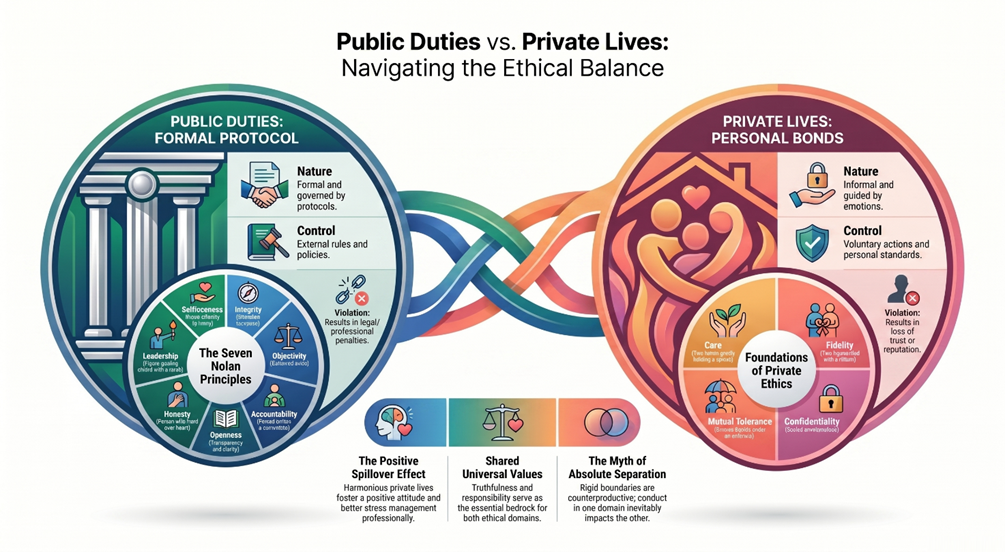
● Selflessness: Holders of public office should take decisions solely in terms of the public interest. They should not do so in order to gain financial or other material benefits.
● Integrity: Holders of public office should not place themselves under any financial or other obligation to outside individuals or organizations that might influence them in the performance of their official duties.
● Objectivity: In carrying out public business, including making public appointments, awarding contracts, or recommending individuals for rewards and benefits, holders of public office should make choices on merit.
● Accountability: Holders of public office are accountable for their decisions and actions to the public and must submit themselves to whatever scrutiny is appropriate to their office.
● Openness: Holders of public office should be as open as possible about all the decisions and actions they take.
● Honesty: Holders of public office have a duty to declare any private interests relating to their public duties and to take steps to resolve any conflicts arising in a way that protects the public interest.
● Leadership: Holders of public office should promote and support these principles by leadership.
Ethics in Private Relationships
Private relationships, often given or inherited, are relatively permanent with more tolerance for imperfections. Ethics in private relationships refer to the principles and values governing interactions with family members, life partners, and friends based on emotional bonds rather than formal procedures.
Ethical Principles in Private Relationships



● Care and Affection: Emotional bonds go beyond limitations, driven by human emotions rather than legal rules. In the Mahabharata, King Dhritrashtra’s unconditional affection for his sons despite their misdeeds highlights this principle.
● Fidelity: It refers to loyalty to one’s life partner and avoiding adultery. For example, the Tiger Woods scandal brought significant attention to the importance of fidelity in personal relationships.
● Confidentiality: Maintaining secrecy and privacy to uphold the sanctity of private relationships. For instance, respecting a friend’s confidentiality by not sharing their secrets.
● Truthfulness: Essential for mutual trust and strengthening emotional bonds. Always being truthful helps avoid unnecessary conflicts in private relationships.
● Responsibility & Accountability: Fulfilling responsibilities towards family members and being accountable in case of non-fulfillment. For example, parental duty towards children.
● Tolerance and Acceptance: Accommodating others’ imperfections to maintain peace and harmony. For instance, tolerating a spouse’s introverted nature for a peaceful marital life.
Sources of Ethics in Private Relationships
● Divine Command and Religion: Religious commands often guide ethical behavior in private life. For example, the Ten Commandments guide Christians in their interactions with family and society.
● Individual Experiences: Emotions like love and care are naturally inclined towards family, guiding ethical behavior without social conditioning.
● Social Conditioning: Values learned from family, peers, and society influence ethical behavior. For example, children learn to respect elders from their parents.
● Constitution: Some ethical principles are governed by legislation and constitutional values. For example, laws against domestic violence and child abuse guide ethical behavior in private relationships.
Comparison Between Public and Private Relationships
| Aspect | Public Relationships | Private Relationships |
| Scope | Concerns community, society, and professional environments. | Concerns immediate family, close friends, and personal relationships. |
| Nature | Formal and governed by official protocols. | Informal and guided by personal connections and emotions. |
| Sources of Ethics | Derived from societal norms, laws, and organizational standards. | Rooted in personal values, moral beliefs, and family traditions. |
| Role of Regulations vs. Emotions | Strong emphasis on adherence to rules and regulations. | Greater emphasis on feelings, emotions, and personal discretion. |
| Control Mechanism | Regulated by external rules, policies, and professional codes of conduct. | Governed by voluntary actions and personal ethical standards. |
| Codification | Often codified in formal documents and policies. | Generally not codified; based on unwritten personal principles. |
| Implications of Violations | Violations can lead to legal, social, and professional repercussions. | Violations typically result in personal and social consequences, such as loss of trust or reputation. |
Separation of Public and Private Relationships
The distinction between ethics in private and public relationships is often blurred as common ethical values govern both. A person unethical in public life is unlikely to be ethical in private life and vice versa.
Need for Separation
● Domain of Influence: The influence domains of private and public relationships are different. For instance, a civil servant’s conduct should not be affected by personal issues and vice versa.
● Conflicting Roles: Public and private relationships can conflict. For instance, King Dhritrashtra’s conduct in the Mahabharata showed how mixing public and private roles can lead to conflict.
● Potential Conflict of Interest: Avoiding conflicts of interest requires strict separation of professional and personal life. For example, civil servants must avoid nepotism and favoritism.
● Divergence of Values: Public relationships demand openness, whereas private relationships are governed by confidentiality.
Limitations of Separation
● Areas of Convergence: In some cases, conduct in private life affects public life. For example, Barack Obama’s positive personal relationship enhanced his public image, while Bill Clinton’s controversy had adverse effects.
● Rigid Separation: Strict separation can be counterproductive. For example, values of care learned in private life can be highly beneficial in public dealings.
Interplay Between Private and Public Relationships
Effect of Private Relationships on Public Relationships
● Positive Impact (Positive Attitude): Harmonious private relationships foster a positive attitude in public servants, helping them effectively engage in public life. Supportive family environments contribute to better stress management and job performance.
● Positive Impact (Emotional Bond): Emotional bonds in private life can be leveraged to give a humane touch in public engagements. For example, compassionate actions of public officials during crises stem from deep personal values.
● Negative Impact (Troubled Relationships): Troubled personal relationships can adversely affect public behavior. The stress and conflict from personal issues can spill over into professional conduct, reducing effectiveness and increasing errors.
● Negative Impact (Bias): Biases in private relationships can reflect in public engagements. For example, civil servants from patriarchal families may carry stereotypes about female colleagues, which can lead to discriminatory practices in the workplace.
Effect of Public Relationships on Private Relationships
● Positive Impact (Motivation): Public service values motivate civil servants to apply desirable elements in private relationships, such as democratic parenting inspired by public service values.
● Positive Impact (Induction and Training): Civil servants are trained to oppose social evils. For example, ethical training can positively influence personal conduct like opposing child marriage or dowry practices within one’s own family.
● Negative Impact (Spillover Effect): Misconduct in public relationships can reflect in personal relationships. For instance, public servants lacking integrity are often found to be unfaithful or untrustworthy in private life.
● Negative Impact (Work-Life Balance): Excessive involvement in public life can harm private relationships. Many civil servants face structural marital and familial strain due to shifting work priorities and high public demands.
Shared Ethical Elements
● Truthfulness: Essential in both relationships to maintain integrity. Being truthful to a life partner and maintaining truthfulness in professional life are key to successful relationships across both domains.
● Altruism: Expressed as compassion in public engagements and patience in private relationships. Altruistic actions reflect deep personal values and enhance societal good.
● Dedication: Avoids inner conflict and ensures fidelity in marital relationships alongside complete honesty in public service. Dedicated individuals exhibit consistency in their ethical behavior across domains.
● Accountability and Responsibility: Boosts trust in both relationships, such as being explicitly accountable for actions at home and work.
● Interpersonal Relationships: Improves quality and productivity at personal and public levels, helping maintain work-life balance. Effective communication and understanding in personal relationships translate into better professional interactions and vice versa.
Conclusion
Relationships are inescapable necessities in life. People often view personal and public relationships as diverging and requiring completely different standards, but separating them entirely is structurally problematic. Mahatma Gandhi believed that a public servant’s conduct should be open to scrutiny, except for intimate relationships. Excessive public scrutiny is also infeasible. Thus, balancing public and private relationships, rather than viewing them as mutually exclusive, is essential to enrich interactions at both levels.
Previous Year Questions
Q. All human beings aspire for happiness. Do you agree? What does happiness mean to you? Explain with examples. (10 marks, 150 words)
Q. What are the basic principles of public life? Illustrate any three of these with suitable examples. (10 marks, 150 words)
Practice Questions
| Question 1 Analyze the impact of personal ethics on the professional conduct of public servants in India. To what extent should there be a separation between public and private life for public officials? (10 marks, 150 words) |
| Question 2 Analyze the challenges faced by public servants in maintaining a balance between personal ethics and professional duties. Provide examples of how these challenges can be addressed. (10 marks, 150 words) |
| Question 3 “The modern information ecosystem has corporate whistleblowers and civil servants operating in a domain where personal conscience directly clashes with official non-disclosure codes.” Discuss the ethical dilemmas that arise when private morality overrides public organizational protocols. (10 marks, 150 words) |



 Ravi Raaz
 Hassan Khan
 Shadab Ali