
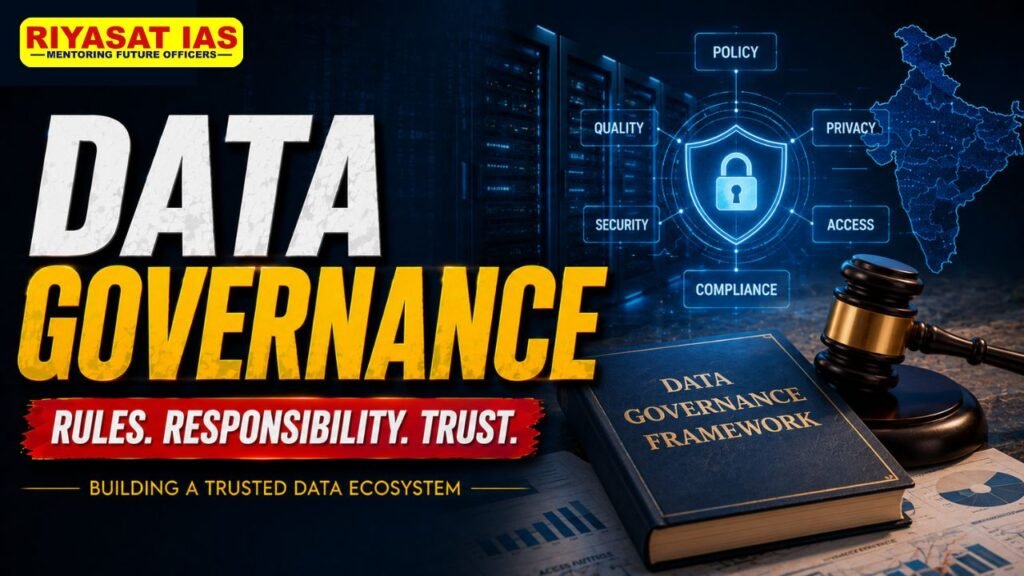
What is Data Governance?
· Data governance refers to the institutional framework of rules, standards, processes and accountability mechanisms through which data is collected, stored, shared, protected and used responsibly for public and private purposes.
· In governance, it aims to make data accurate, accessible, interoperable, secure and useful for evidence-based policymaking, while protecting privacy and individual rights.
Why is Data Governance Important?
- Evidence-Based Policy: Reliable data helps governments identify problems, target beneficiaries and evaluate policies.
- Better Service Delivery: Integrated data can reduce duplication and improve last-mile delivery of welfare schemes.
- Transparency & Accountability: Publicly accessible datasets enable citizens and researchers to scrutinise government performance.
- Economic Value: Data can support innovation, AI, research, startups and the digital economy.
- Efficient Resource Allocation: Governments can identify areas of deprivation and allocate resources according to actual needs.
- Trust in Digital Governance: Strong privacy and security safeguards are essential for citizens to trust digital public services.
NITI Aayog: Data preparedness enables governments to design targeted policies, undertake mid-course corrections and evaluate outcomes; however, data often remains fragmented across non-interoperable silos.
Key Principles of Data Governance
- Data Quality: Data should be accurate, reliable, timely and complete.
- Privacy: Personal data should be collected and processed with appropriate safeguards.
- Security: Data must be protected against breaches, cyberattacks and unauthorised access.
- Interoperability: Different government databases should be capable of communicating through common standards.
- Transparency: Citizens should know how their personal data is collected and used.
- Accountability: Clear responsibility should exist for misuse, breaches and poor-quality data.
- Purpose Limitation: Data should be collected and used for legitimate and specified purposes.
- Data Minimisation: Only data necessary for a legitimate purpose should be collected.
- Inclusiveness: Data systems should not exclude people because of the digital divide or algorithmic bias.
Relevant Constitutional and Legal Framework
- Article 21: The Supreme Court recognised privacy as a fundamental right in K.S. Puttaswamy v. Union of India (2017).
- Article 14: Data-driven decisions must not result in arbitrary or discriminatory treatment.
- Article 19: Data governance can intersect with freedom of speech and expression, particularly in the context of access to information and digital platforms.
- Digital Personal Data Protection Act, 2023: Provides the principal statutory framework for digital personal data protection.
- IT Act, 2000: Provides the broader legal framework for electronic records, cyber offences and digital transactions.
Data Governance in India
Digital Personal Data Protection Act, 2023
Aim: To regulate the processing of digital personal data while recognising individuals’ right to protect their personal data and the need to process such data for lawful purposes.
Key Provisions
· Introduces the concept of Data Principal for the individual to whom personal data relates.
· Places obligations on Data Fiduciaries that determine the purpose and means of processing personal data.
· Provides rights such as access to information, correction and erasure of personal data and grievance redressal, subject to the Act.
· Provides for a Consent Manager framework.



· Establishes the Data Protection Board of India for enforcement and adjudication.
· Provides penalties for certain breaches and non-compliance.
Recent Development: The Digital Personal Data Protection Rules, 2025 were notified on 14 November 2025, providing the detailed implementation framework for the 2023 Act. The Rules have a phased commencement, with several substantive provisions taking effect later according to the notified timeline.
National Data & Analytics Platform (NDAP)
NITI Aayog
Aim: To democratise access to government data by bringing datasets from different government sources into a standardised, interoperable and user-friendly platform.
· NDAP provides tools to discover, query, analyse and visualise government datasets, supporting policymakers, researchers, businesses and citizens.
· As of December 2025, NDAP hosted over 6,088 datasets across 31 sectors, sourced from 53 Ministries/Departments.
Data Governance Quality Index (DGQI)
Initiated: 2020 by NITI Aayog’s DMEO
Aim: To assess and improve the quality, availability, use and preparedness of government data systems.
Implementation
· The first DGQI exercise in 2020 covered 65 Ministries/Departments and around 250 Central Schemes/Central Sector Schemes.
· DGQI 2.0 was launched in 2021 with wider coverage.
· It assesses areas such as data generation, data quality, technology and data use for outcomes.
Importance: It seeks to move government from “data collection” to “data-driven decision-making.”
State Data Ecosystems
· NITI Aayog has promoted the development of State and District-level data ecosystems to improve evidence-based planning.
· Example: State Data and Analytics Platforms are being developed on the NDAP model; Karnataka (KADAP) and Meghalaya (MegDAP) have already developed such platforms, while work is underway in other States.
Aadhaar
Aim: To provide a unique digital identity that can facilitate authentication and targeted delivery of government services.
Governance Significance
Helps reduce duplication in certain welfare databases.
Facilitates DBT and digital authentication.
Supports portability of certain services.
Concern: Its extensive use creates concerns regarding privacy, surveillance, exclusion and data security, making strong data-governance safeguards essential.
Open Government Data (OGD) Platform
· Aim: To make non-sensitive government datasets publicly available and promote transparency, innovation, research and citizen participation.
· Principle: “Open by default, protected where necessary.”
· Sensitive personal information should not be made publicly available merely in the name of transparency.
Data Governance and Artificial Intelligence: The rise of Generative AI and data-intensive technologies has made data governance more important.
Opportunities
- Evidence-based policymaking.
- Predictive healthcare and disease surveillance.
- Better agricultural planning.
- Fraud and tax evasion detection.
- Personalised public services.
- Disaster prediction and management.
Risks
- Algorithmic Bias: Poor or unrepresentative data can produce discriminatory outcomes.
- Privacy Violations: Large datasets can expose sensitive personal information.
- Data Monopolisation: Concentration of high-quality data in a few firms can reduce competition.
- Misinformation: AI-generated synthetic content can undermine information integrity.
- Lack of Explainability: Citizens may not understand why an algorithm denied a service or benefit.
The Economic Survey 2025–26 highlights the need to balance openness with control and global integration with domestic economic interests, rather than treating data localisation as the sole solution.
Direct Benefit Transfer (DBT): To transfer welfare benefits directly to beneficiaries’ bank accounts and reduce leakages, duplication and intermediaries.
JAM trinity: Jan Dhan + Aadhaar + Mobile: Effective DBT requires accurate beneficiary databases, interoperability and strong safeguards against exclusion and misuse.
Challenges of Data Governance in India
Data Silos: Government data is often maintained in separate systems using different formats, reducing interoperability and cross-sectoral analysis.
Poor Data Quality: Incomplete, outdated or inconsistent datasets can result in wrong policy targeting and misleading conclusions.
Privacy Concerns: Large-scale collection and integration of personal data can create risks of profiling, surveillance and unauthorised use.
Cybersecurity Threats: Increasing digitisation makes government databases attractive targets for cyberattacks and data breaches.
Digital Divide: People without adequate devices, connectivity or digital literacy may be excluded from data-driven services.
Lack of Data Literacy: Government officials may possess large amounts of data but lack the skills required to interpret and convert it into policy insights.
Data Monopolies: Large technology companies may control valuable datasets, creating concerns regarding competition, innovation and public interest.
Way Forward
- Build Interoperable Data Architecture: Adopt common standards and APIs to break government data silos.
- Strengthen Privacy by Design: Privacy and security should be incorporated at the design stage, rather than added later.
- Improve Data Quality: Establish common standards for accuracy, metadata, updating and validation.
- Promote Responsible AI: Introduce mechanisms for algorithmic transparency, human oversight, bias testing and auditability.
- Strengthen Data Literacy: Train civil servants in data analytics, AI and evidence-based policymaking.
- Balance Open Data with Privacy: Follow a risk-based approach to data sharing rather than absolute openness or absolute localisation.
- Empower States and Districts: Develop local data ecosystems for place-based policymaking and decentralised planning.
· Adopt global best practices: India should adopt global best practices such as the EU–US Data Privacy Framework to ensure secure cross-border data flows, enhance interoperability and trust, and facilitate digital trade.
· The government should strengthen children’s data protection by prohibiting behavioural monitoring, profiling and targeted advertising without verified parental consent, similar to the U.S. COPPA framework, which protects children under 13.
Conclusion
Data is increasingly becoming a core infrastructure of governance; therefore, India needs a framework that combines data-driven innovation with privacy, security, interoperability, accountability and citizen rights.
FAQs
Q1. What is data governance?
Ans: Data governance is the framework of rules, standards and accountability mechanisms governing the collection, use, sharing, protection and management of data.
Q2. Which Act is India’s primary framework for digital personal data protection?
Ans: The Digital Personal Data Protection Act, 2023, supplemented by the DPDP Rules, 2025.
Q3. What is the objective of NDAP?
Ans: NDAP seeks to democratise access to high-quality government data and support evidence-based policymaking.
Q4. What is DGQI?
Ans: The Data Governance Quality Index assesses the preparedness and quality of government data systems to promote data-driven governance.
Q5. Which Supreme Court judgment recognised privacy as a fundamental right?
Ans: K.S. Puttaswamy v. Union of India (2017) recognised privacy as a fundamental right under Article 21.


 Ravi Raaz
 Hassan Khan
 Shadab Ali