
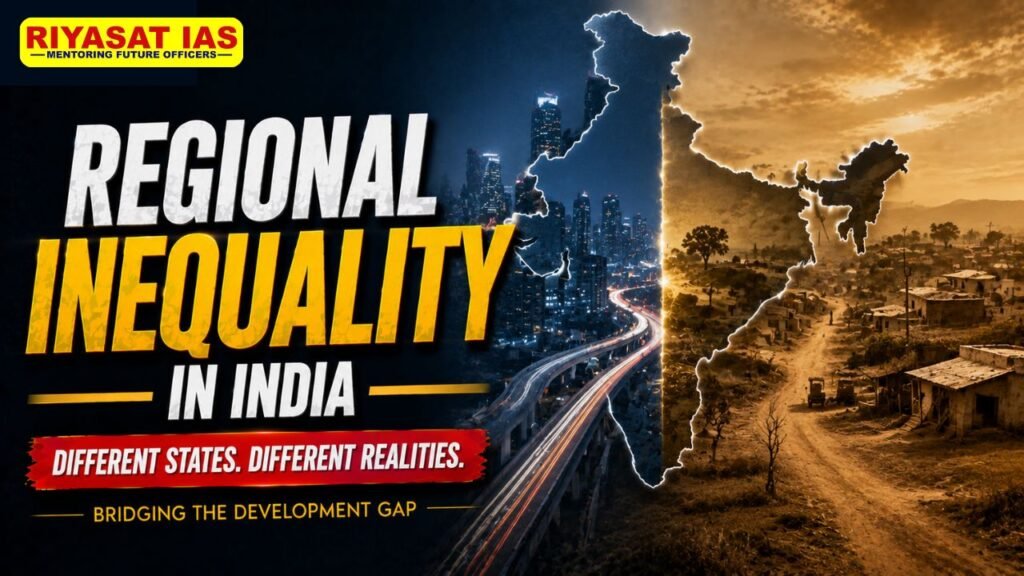
What is Regional Inequality?
· Regional inequality refers to the unequal distribution of income, employment, infrastructure, human capital, public services and development opportunities across different States, regions, districts and communities within India.
· It exists at both inter-State and intra-State levels, creating an uneven pattern of economic and social development.
Regional Inequality in India – Evidence
Regional disparities are visible in income, poverty, health, education, infrastructure and employment.
- Multidimensional Poverty: NITI Aayog estimates that multidimensional poverty declined from 24.8% in 2015–16 to 14.96% in 2019–21, and further to a projected 11.28% in 2022–23; however, the burden remains highly concentrated in certain States and regions.
- Inter-State Development Gap: NITI Aayog’s SDG India Index 2023–24 shows substantial differences in State-level performance, demonstrating that progress towards development goals is not uniform across India.
- North-Eastern Region: The North Eastern Region District SDG Index 2023–24 found that 85% of the 121 assessed districts were in the Front Runner category, but considerable intra-regional disparities continue to exist.
- District-Level Inequality: NITI Aayog’s Aspirational Districts Programme itself identifies 112 relatively under-developed districts, demonstrating that national and State-level averages can conceal substantial district-level deprivation.
Why is Regional Development Necessary?
- Inclusive Growth: National growth cannot be sustainable if large regions remain trapped in poverty and low productivity.
- Balanced Federalism: Regional development reduces economic disparities between States and strengthens cooperative federalism.
- Human Capital: Equal access to education, healthcare and nutrition improves India’s overall productivity.
- Migration Management: Development of backward regions can reduce distress migration towards already congested metropolitan areas.
- Social Justice: Regional inequality often overlaps with caste, tribal, gender and rural–urban inequalities, requiring targeted intervention.
- National Integration: Balanced development reduces perceptions of regional neglect and exclusion.
- Utilisation of Untapped Potential: Backward regions often possess substantial potential in agriculture, tourism, minerals, renewable energy, forests and human resources.
Causes of Regional Inequality
· Historical Factors
o Colonial economic policies concentrated ports, railways, industries and commercial activities in selected regions, creating initial differences in infrastructure and industrialisation.
o Example: The development of port-based commercial centres such as Mumbai, Kolkata and Chennai created early regional economic advantages.
· Geographical Factors
o Mountainous terrain, deserts, forests, difficult connectivity and climatic constraints increase the cost of infrastructure and service delivery.
o Example: Himalayan and North-Eastern regions face higher infrastructure and connectivity costs because of difficult terrain.
· Unequal Industrialisation
o Industrial investment tends to concentrate where there is better infrastructure, skilled labour, markets, logistics and access to finance, creating cumulative advantages.
o Example: Maharashtra, Gujarat, Karnataka and Tamil Nadu have developed strong industrial and services clusters.
· Green Revolution – Regional Concentration



o The Green Revolution initially benefited regions with assured irrigation, fertile soils, electricity, procurement and agricultural infrastructure, particularly Punjab, Haryana and western Uttar Pradesh.
o This increased agricultural productivity but also widened regional disparities in agricultural development.
· Unequal Infrastructure: Differences in roads, railways, ports, electricity, irrigation, digital connectivity and urban infrastructure influence the ability of regions to attract investment.
· Human Capital Differences: States and regions with better education, healthcare and skilled labour attract greater private investment, creating a self-reinforcing cycle of development.
· Natural Resource Paradox: Resource-rich States such as Jharkhand, Chhattisgarh and Odisha possess substantial mineral wealth but have historically experienced significant poverty and human-development challenges.
· Urbanisation and Agglomeration
o Investment, skilled labour and services tend to cluster around major cities, creating agglomeration economies.
o Example: Bengaluru’s technology ecosystem attracts firms, talent and investment, reinforcing Karnataka’s growth advantages.
Intra-State Regional Inequality
Regional inequality does not exist only between States; developed and backward regions can coexist within the same State.
- Maharashtra: Mumbai–Pune–Nashik region is significantly more industrialised and urbanised than several Vidarbha and Marathwada regions.
- Karnataka: Bengaluru and parts of southern Karnataka have stronger services and industrial ecosystems than several northern districts.
- Uttar Pradesh: Western UP has relatively stronger agricultural and industrial development compared with several eastern and Bundelkhand regions.
- Rajasthan: Jaipur and parts of eastern Rajasthan have stronger economic infrastructure than the desert and tribal-dominated regions of western and southern Rajasthan.
- Odisha: Coastal districts have historically benefited more from urbanisation and industrialisation than several tribal-dominated interior districts.
Government Initiatives
Aspirational Districts Programme
Aim: To rapidly transform 112 relatively under-developed districts through targeted improvements in health, education, agriculture, infrastructure, financial inclusion and skills.
Implementation
The programme follows the 3Cs:
· Convergence: Convergence of Central and State schemes.
· Collaboration: Centre–State–district administration collaboration.
· Competition: Monthly delta rankings based on incremental performance.
It uses 49 Key Performance Indicators across five themes.
Result: NITI Aayog describes the programme as a data-driven model reaching around 250 million people, with all 112 districts showing improvement across socio-economic indicators since inception.
For example: Chandauli, Uttar Pradesh used agricultural diversification to promote organic black rice and develop export-oriented value chains.
Aspirational Blocks Programme
Aim: To extend the Aspirational District approach to the block level, focusing on the most under-developed blocks.
· Covers 500 blocks across 27 States and 4 UTs.
· Focuses on health, education, agriculture, infrastructure and social development.
· Emphasises localised, outcome-based governance.
Pradhan Mantri Gram Sadak Yojana (PMGSY)
Aim: To provide all-weather rural road connectivity to eligible habitations.
Regional impact: Better connectivity reduces isolation and improves access to markets, schools, hospitals and employment opportunities.
Aspirational Districts + SDG Localisation: NITI Aayog uses the SDG India Index, National MPI and North-Eastern Region District SDG Index to identify spatial development gaps and encourage States and districts to improve their performance.
Special Area-Based Development
North Eastern Region: Initiatives under the Ministry of Development of North Eastern Region (DoNER) focus on connectivity, infrastructure, tourism and economic development.
Tribal Areas: Targeted interventions under the Ministry of Tribal Affairs, including tribal development programmes and infrastructure support, aim to address the specific development deficits of tribal regions.
PM Gati Shakti
Aim: To integrate infrastructure planning across ministries and improve multimodal connectivity and logistics efficiency.
Regional impact: Better connectivity can integrate backward regions into national markets and value chains.
Industrial Corridors and Connectivity Projects: Industrial corridors, dedicated freight connectivity, ports, highways and logistics infrastructure aim to deconcentrate economic activity and create new growth centres.
What Action Should We Take?
· Move from State-Level to District-Level Planning: Development policies should adopt a place-based approach, addressing district-specific needs and deprivation rather than relying solely on State-level averages.
· Strengthen Infrastructure in Lagging Regions: Prioritise roads, railways, electricity, irrigation, broadband, logistics and urban infrastructure in economically backward regions.
· Build Human Capital: Increase investment in quality schools, higher education, healthcare, nutrition and skill development, particularly in aspirational and tribal districts.
· Promote Local Economic Clusters: Instead of merely attracting large industries, develop district-specific economic strengths.
o Examples: Food processing, handicrafts, tourism, textiles, renewable energy, forest-based products and agro-processing.
· Empower Local Governments: Provide 3Fs — Functions, Funds and Functionaries to Panchayats and Urban Local Bodies so that development planning reflects local needs.
· Promote Cooperative + Competitive Federalism: States should compete on investment, human development and governance outcomes, while the Centre supports lagging regions through targeted interventions.
· Focus on Outcomes, Not Just Expenditure
o Monitoring should shift from money spent and assets created to service delivery and measurable development outcomes, as reflected in the delta-based monitoring approach of the Aspirational Districts Programme.
o A Balanced Regional Development Model combining infrastructure, human capital, local industries, connectivity, fiscal equalisation, decentralisation and good governance can transform backward regions into productive growth centres.
Conclusion
Regional inequality is not merely an economic issue but a challenge to inclusive growth, social justice and cooperative federalism; India therefore needs place-based, data-driven and decentralised development.
FAQs
Q1. What is regional inequality?
Ans: Regional inequality refers to disparities in income, infrastructure, employment, human capital and public services across different regions.
Q2. Which programme targets backward districts through outcome-based governance?
Ans: The Aspirational Districts Programme (2018) targets 112 under-developed districts using data-driven and outcome-based monitoring.
Q3. How did the Green Revolution contribute to regional inequality?
Ans: Its initial benefits were concentrated in regions with irrigation, fertile soil, electricity and procurement, particularly Punjab, Haryana and western Uttar Pradesh.
Q4. What is the key approach to reducing regional inequality?
Ans: India should adopt place-based development, addressing district-specific needs rather than relying solely on State-level averages.
Q5. How can fiscal federalism reduce regional disparities?
Ans: Finance Commission transfers and fiscal equalisation help States with lower revenue capacity meet their developmental and expenditure needs.


 Ravi Raaz
 Hassan Khan
 Shadab Ali