
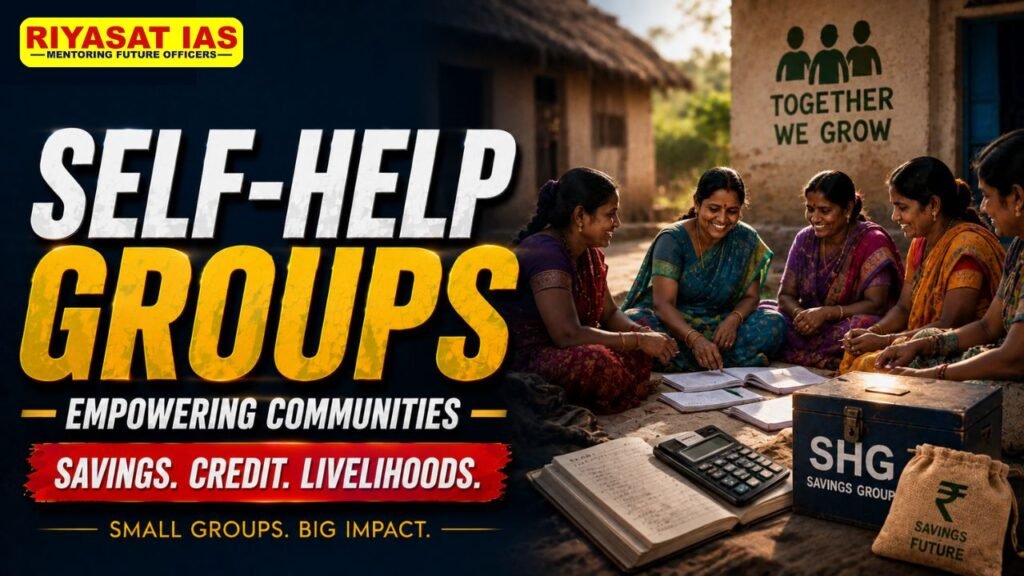
What is a Self-Help Group?
A Self-Help Group (SHG) is a voluntary, usually informal association of 10–20 people from similar socio-economic backgrounds who come together to save regularly, create a common fund, access credit, develop livelihoods and collectively address social and economic issues.
In India, SHGs have become an important instrument of financial inclusion, poverty reduction, women’s empowerment and grassroots development, particularly through the DAY-NRLM framework.
Objectives of SHGs
- Financial Inclusion: To connect poor and vulnerable households with formal banking and financial services.
- Access to Credit: To provide affordable credit through internal savings and bank linkages, reducing dependence on informal moneylenders.
- Livelihood Promotion: To support micro-enterprises, agriculture, livestock, handicrafts and other income-generating activities.
- Social Capital: To promote mutual trust, collective responsibility and community-level cooperation.
- Poverty Reduction: To improve household income and build resilience against economic shocks.
- Social Transformation: To enable collective action against issues such as child marriage, gender-based violence, malnutrition and social exclusion.
Key Features of SHGs
· Small and Homogeneous Group: An SHG generally consists of 10–20 members with broadly similar socio-economic backgrounds, enabling trust and collective decision-making.
· Regular Savings: Members contribute a fixed amount at regular intervals, creating a common savings pool.
· Internal Lending: The pooled savings are lent to members according to collectively decided rules, often providing faster access to small loans.
· Democratic Decision-Making: Members collectively decide matters relating to savings, lending, repayment and group activities.
· Bank Linkage: After developing a track record, SHGs can obtain loans from formal financial institutions through the SHG-Bank Linkage Programme.
· Collective Responsibility: Members often provide peer support and social pressure for repayment, reducing credit risk.
· Beyond Credit: Modern SHGs increasingly function as platforms for livelihood promotion, skill development, social awareness and participation in local governance.
Evolution of SHGs in India
Phase I – Informal Community Groups
Traditional systems of mutual aid, rotating savings and community cooperation existed in India long before formal SHG programmes. Such as Textile Labour Association (TLA), SEWA organisation.
Phase II – NABARD’s SHG-Bank Linkage Programme, 1992
· The National Bank for Agriculture and Rural Development (NABARD) launched the SHG-Bank Linkage Programme (SHG-BLP) in 1992.
· Objective
o To connect informal SHGs with formal banking institutions, allowing poor households to access institutional credit.
o This became a major turning point in the development of the SHG movement in India.
Phase III – SGSY, 1999
The Swarnjayanti Gram Swarozgar Yojana (SGSY) sought to organise rural poor households into SHGs and promote self-employment and sustainable livelihoods.
Phase IV – National Rural Livelihoods Mission, 2011
· The National Rural Livelihoods Mission (NRLM) was launched in 2011 and later renamed Deendayal Antyodaya Yojana–National Rural Livelihoods Mission (DAY-NRLM).
· It shifted the approach from individual beneficiaries towards community institutions and women’s SHGs.
Phase V – SHG-led Development
· SHGs facilitate a gradual transition from savings and credit to skill development, entrepreneurship, market linkages, social action and ultimately greater political participation. This represents the shift from microfinance to community-led development.
Role of SHGs
Financial Inclusion
· SHGs provide poor households, particularly women, with access to savings, credit, banking and financial literacy.
· Example: SHG-bank linkage allows members to access formal institutional credit without depending entirely on moneylenders.



Women’s Economic Empowerment
· SHGs enable women to earn income through livestock, food processing, handicrafts, agriculture, tailoring and micro-enterprises.
· Economic contribution can increase women’s role in household decision-making.
Social Empowerment
SHGs have become platforms for collective action on:
- Nutrition
- Sanitation
- Child marriage
- Gender-based violence
- School attendance
- Maternal health
Example: Women SHGs have been used as community-level platforms for spreading awareness about Poshan, sanitation and health services.
Political Participation
· SHG members increasingly participate in Gram Sabhas, Panchayati Raj Institutions and local development planning.
Local Entrepreneurship
· SHGs promote community-based enterprises and local value chains, particularly in agriculture, food processing, handicrafts and rural services.
· Example: SHGs can collectively process and market products such as millets, spices, pickles, handicrafts and forest produce.
Last-Mile Delivery
· SHGs can act as community-level partners in implementing government programmes because they have strong local networks and knowledge.
Advantages of SHGs
· Low-Cost Credit: Members can access small loans through internal lending and bank linkage, reducing dependence on informal lenders.
· Social Capital: Regular interaction builds trust, solidarity and collective responsibility.
· Women’s Empowerment: SHGs increase women’s access to income, financial resources and decision-making.
· Financial Literacy: Members learn about banking, savings, credit, insurance and digital payments.
· Entrepreneurship: SHGs create opportunities for micro-enterprises and collective businesses.
· Crisis Resilience: Savings and diversified livelihoods provide households with greater resilience during health emergencies, crop failures or income shocks.
· Community Development: SHGs can mobilise communities around health, sanitation, education and social issues.
Challenges of SHGs
· Limited Access to Markets: Many SHG products remain confined to local markets because of inadequate branding, packaging, quality certification and marketing channels.
· Credit Constraints: Despite bank linkage, some SHGs continue to face difficulties in obtaining adequate and timely institutional credit.
· Low Financial and Digital Literacy: Limited knowledge of accounting, digital payments, e-commerce and financial management can constrain growth.
· Small Scale of Enterprises: Many SHG enterprises remain micro-scale and have difficulty achieving economies of scale.
· Skill Gaps: Members may have production skills but lack expertise in business planning, quality control, branding and market analysis.
· Male Dominance and Social Norms: Patriarchal attitudes can restrict women’s control over income and decision-making despite their membership in SHGs.
· Overdependence on Government Support: Excessive dependence on subsidies can discourage the development of commercially sustainable enterprises.
Major Government Initiatives
DAY-NRLM
Launched: 2011; implemented as DAY-NRLM under the Ministry of Rural Development.
Aim: To reduce rural poverty by organising poor rural women into SHGs and higher-level community institutions and enabling them to access finance, skills, livelihoods and markets.
Key Features
- Formation and strengthening of women’s SHGs.
- Revolving Fund and Community Investment Fund.
- Bank linkage and financial inclusion.
- Skill development and livelihood promotion.
- Producer groups and enterprises.
- Digital financial literacy.
- Market linkages.
Latest Scale: By July 2026, approximately 92 lakh SHGs had been formed under DAY-NRLM, covering around 10.05 crore rural women.
Lakhpati Didi Initiative
Aim: To enable SHG women to earn a sustainable annual household income of at least ₹1 lakh.
· SHGs can enable women to progress from skill development and access to credit to entrepreneurship, market integration and ultimately higher and sustainable incomes.
· The government achieved the milestone of 3 crore Lakhpati Didis by December 2025 and has set a target of 6 crore Lakhpati Didis.
Namo Drone Didi
Aim: To empower women SHGs by providing drones for agricultural services such as spraying fertilisers and pesticides, creating technology-enabled livelihood opportunities.
Key Feature
· Women SHGs receive 80% financial assistance up to ₹8 lakh for the drone package.
· The scheme has an outlay of ₹1,261 crore for 2023–24 to 2025–26.
· Significance: SHGs are moving from traditional micro-enterprises to technology-enabled rural enterprises.
SHG-Bank Linkage Programme
· It is Implemented by NABARD.
· Aim: To connect SHGs with formal financial institutions and expand access to institutional credit. It transformed SHGs from informal savings groups into an important component of India’s financial inclusion architecture.
SVEP – Start-up Village Entrepreneurship Programme
· Aim: To support rural SHG members and their families in establishing small non-farm enterprises through training, mentoring, business support and access to finance.
· Significance: Helps SHGs diversify from wage employment and agriculture into rural entrepreneurship.
Deendayal Antyodaya Yojana – NULM
· The urban counterpart of the rural livelihood approach, DAY-NULM, promotes urban SHGs, skill development, self-employment and access to credit among the urban poor.
Mahila Kisan Sashaktikaran Pariyojana (MKSP)
· Aim: To strengthen the position of women in agriculture by improving their access to skills, sustainable agricultural practices, technology and productive resources.
· Significance: Recognises women not merely as agricultural labourers but as farmers and economic agents.
Way Forward
· SHG-to-Enterprise Transition: Move SHGs beyond small-scale credit towards sustainable enterprises, producer organisations and formal businesses.
· Strengthen Market Linkages: Connect SHG products with ONDC, e-commerce platforms, government procurement, GeM and organised retail markets.
· Improve Access to Institutional Credit: Ensure timely, adequate and affordable credit and reduce procedural barriers to bank finance.
· Invest in Skills and Technology: Provide training in digital marketing, accounting, packaging, branding, quality certification and AI-enabled business tools.
· Reduce Women’s Time Poverty: Expand childcare, crèches, clean energy and basic infrastructure so that unpaid care work does not limit women’s participation.
· Strengthen Digital Inclusion: Ensure SHG members have access to smartphones, digital payments, banking and e-commerce platforms.
· Promote SHG–Panchayat Convergence: Integrate SHGs with Gram Panchayats, Gram Sabhas and local development planning to strengthen participatory governance.
· Shift from Subsidy to Sustainability: Government support should gradually focus on capacity building, market access and institutional finance rather than permanent subsidy dependence.
Conclusion
SHGs have evolved from savings-and-credit groups into institutions of economic and social empowerment; strengthening their transition towards sustainable enterprises can make them powerful instruments of inclusive and women-led development.
FAQs
Q1. What is an SHG?
Ans: An SHG is a small voluntary group that promotes regular savings, internal lending, collective action and livelihood development among members.
Q2. Which institution launched the SHG-Bank Linkage Programme?
Ans: NABARD launched the SHG-Bank Linkage Programme in 1992.
Q3. Which is India’s major government programme for rural SHGs?
Ans: DAY-NRLM is the flagship programme for organising rural women into SHGs and promoting livelihoods and financial inclusion.
Q4. What is the objective of the Lakhpati Didi initiative?
Ans: It aims to enable SHG women to achieve sustainable annual household income of at least ₹1 lakh.
Q5. How do SHGs contribute to women empowerment?
Ans: SHGs provide women with savings, credit, livelihoods, financial independence, social capital and greater participation in household and community decision-making.


 Ravi Raaz
 Hassan Khan
 Shadab Ali