
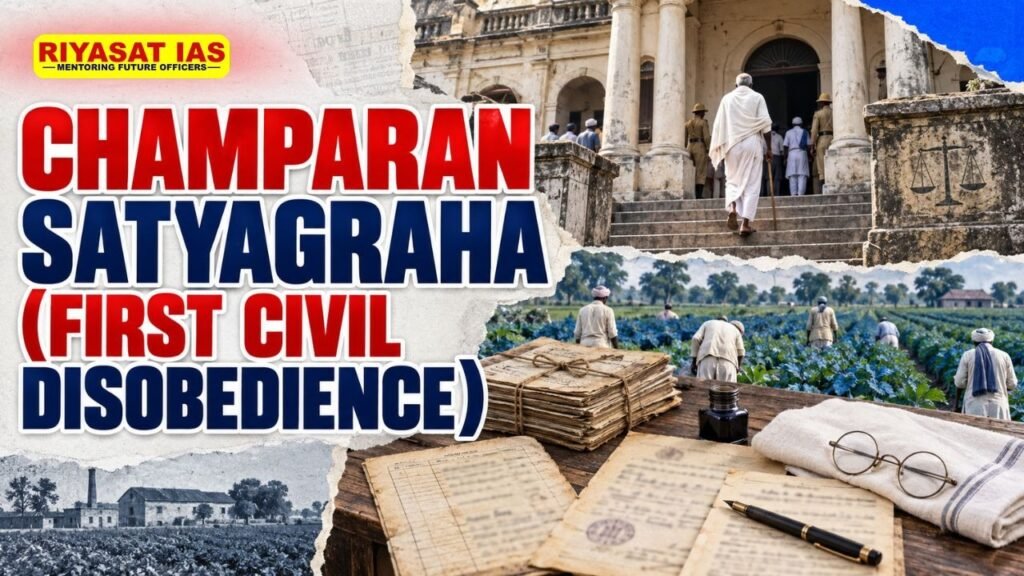
Champaran Satyagraha was Gandhi’s first major Satyagraha in India after he returned from South Africa. In 1917, he went to Champaran in Bihar to support the indigo cultivators who were facing exploitation by European planters. The struggle became an early example of how Gandhi used non-violence, civil disobedience, investigation of people’s grievances and negotiation to fight against injustice.
Background
· This was an important indigo-growing region in north Bihar. European planters had established plantations and exercised considerable influence over the local peasants.
· Indigo cultivation had become increasingly burdensome for the peasants because plantation arrangements restricted their freedom to use their land and often involved various illegal cesses, forced cultivation and coercive practices.
· A major grievance centred on the Tinkathia system, under which peasants were compelled to cultivate indigo on a fixed portion of their holdings. Growing resentment among the cultivators eventually brought the issue to Gandhi’s attention.
· Raj Kumar Shukla, a Champaran peasant associated with the local agitation, repeatedly requested Gandhi to visit the area. Gandhi finally agreed and reached Champaran in April 1917. On 10 April 1917, he arrived with Shukla and began investigating the condition of indigo cultivators.
What was the Tinkathia System?
· In the Tinkathia system, peasants were required to cultivate indigo on 3 kathas out of every 20 kathas of land, or roughly 3/20th of their holding. The arrangement became oppressive because cultivators were compelled to grow indigo rather than crops of their own choice. Indigo also reduced the productive value of the soil and affected the peasants’ ability to grow food crops. Later, when the demand for natural indigo declined because of the increasing use of synthetic indigo, European planters wanted to get rid of the compulsory indigo arrangement. Instead of simply releasing the peasants, they often demanded compensation or enhanced payments from them. These exactions added to rural resentment. The eventual inquiry accepted the need to abolish the Tinkathia system, and the Champaran Committee agreed to its abolition in August 1917.
Factors Behind the Champaran Satyagraha
· Forced indigo cultivation was the immediate agrarian problem. Peasants had little freedom over what they could cultivate because of the Tinkathia arrangement.



· Illegal dues and coercive practices imposed by planters further increased the burden on cultivators. Payments and exactions such as abwab became important issues during the later inquiry.
· Decline of natural indigo created another problem. With synthetic indigo becoming increasingly available, planters wanted to abandon compulsory indigo cultivation but sought compensation from peasants for releasing them from their contractual obligations.
· Enhanced rents and compensation payments, particularly the issue of sharahbeshi, became another source of resentment. Gandhi raised this matter before the Champaran Inquiry Committee.
Role of Gandhi
· Gandhi did not begin by immediately launching a large-scale confrontation. His first step was to investigate the actual condition of the peasants. After reaching Champaran, he travelled through the affected areas, met cultivators and collected evidence regarding their grievances. This fact-finding exercise gave the movement a strong documentary basis. Turning point came out when the local administration ordered Gandhi to leave Champaran. Gandhi refused to comply, explaining that his duty towards the suffering peasants required him to remain there.
· He appeared before the Motihari court on 17 April 1917 and pleaded guilty to disobeying the official order. At the same time, he made it clear that his disobedience was not based on disrespect for law but on what he considered a higher moral duty. The authorities eventually withdrew the case and allowed Gandhi to continue his inquiry with the assistance of government officials. Gandhi regarded this episode as an important early lesson in civil disobedience.
· Finally, the government appointed the Champaran Agrarian Committee, on which Gandhi himself served as a member representing the interests of the tenants. He participated in the inquiry and negotiations with the planters. The Committee eventually agreed to abolish the Tinkathia system.
· Gandhi also connected the struggle with constructive work. Volunteers worked among the villagers on issues such as education, sanitation and social awareness, showing that his idea of Satyagraha was not limited to protest alone.
Other Important Leaders
· Raj Kumar Shukla played the key role in persuading Gandhi to visit Champaran, while Rajendra Prasad and Brajkishore Prasad Mazhar-ul-Haq, and J. B. Kripalani provided organisational and legal assistance.
British Response
· The government initially attempted to restrict Gandhi’s activities. His order to leave Champaran and the subsequent court case demonstrated the administration’s concern about his presence among the peasants.
· Gandhi’s refusal to leave and his willingness to accept the legal consequences changed the situation. Rather than allowing the confrontation to develop further, the authorities withdrew the case and permitted him to conduct his inquiry.
· Government officials later became directly involved in investigating the agrarian grievances. In June 1917, discussions were held between Gandhi and the Lieutenant-Governor regarding the proposed inquiry, and Gandhi accepted nomination to the Champaran Inquiry Committee.
· The Committee conducted its investigation and finally accepted the abolition of the Tinkathia system. Gandhi also raised issues relating to abwab and sharahbeshi during the proceedings.
· The Government of Bihar and Orissa subsequently accepted the Committee’s report in October 1917 and acknowledged Gandhi’s moderation in representing the tenants.
Outcome and Significance
· Eventually, a compromise was reached under which the planters agreed to refund 25% of the illegally collected amount to the peasants and finally abolished the Tinkathia system, removing the compulsory indigo cultivation arrangement that had caused major hardship to the peasants.
· The movement brought peasants into the emerging Gandhian style of politics. It showed that nationalist politics could be connected with everyday economic problems rather than remaining confined to constitutional demands and urban political organisations.
· Another important feature was the combination of Satyagraha with constructive work. Education, sanitation and social awareness among villagers became part of Gandhi’s work in Champaran.
Conclusion
· Champaran was not only a struggle against the indigo system. It showed how Gandhi could take up the everyday problems of peasants and turn them into an organised, non-violent struggle. By investigating their grievances, standing with them and negotiating with the authorities, Gandhi gained the confidence of the peasants and laid the foundation for his future movements in India.
FAQs
1. What was the Champaran Satyagraha?
this was Gandhi’s first major Satyagraha in India which launched in 1917 in Bihar against the oppressive indigo plantation system and the grievances of Champaran peasants.
2. What was the Tinkathia system?
in this system, peasants were compelled to cultivate indigo on 3/20th of their land, which restricted their freedom of cultivation and became a major source of exploitation.
3. Who brought Gandhi to Champaran?
Raj Kumar Shukla continuously requested Gandhi to visit the Champaran and investigate the condition of the cultivators.
4. How did the British government respond to Gandhi?
Initially, Gandhi was ordered to leave Champaran and faced a court case for disobeying the order. The case was eventually withdrawn, and he was allowed to conduct an inquiry into the peasants’ grievances.
5. What was the main outcome of the Champaran Satyagraha?
Tinkathia system was abolished, and the agrarian grievances of the peasants were formally investigated through the Champaran Inquiry Committee. The movement also established Gandhi’s Satyagraha as an effective method of political struggle in India.



 Ravi Raaz
 Hassan Khan
 Shadab Ali