
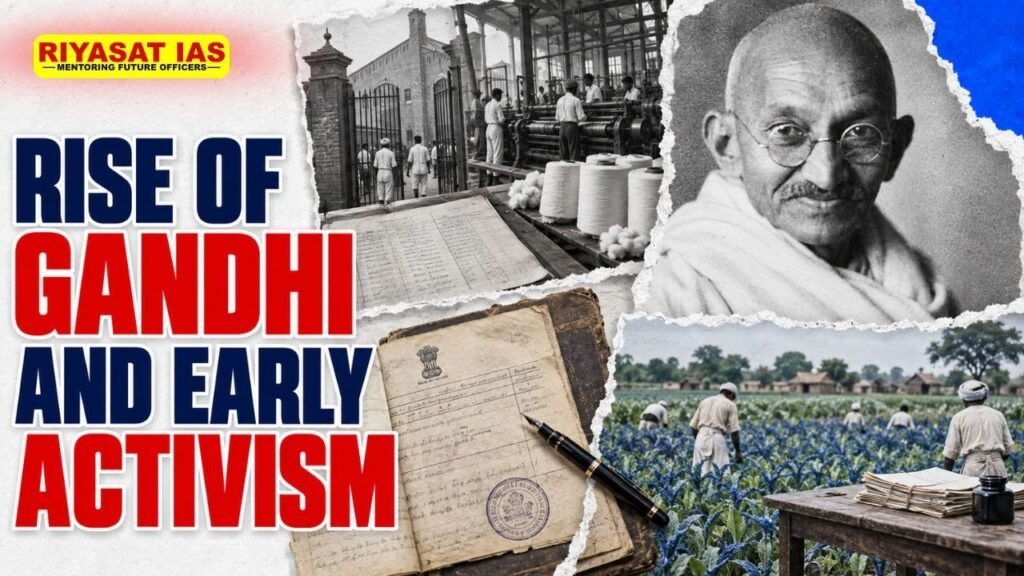
Gandhi’s political career took a decisive turn during his 21 years in South Africa (1893–1914). He went there as a young lawyer but gradually became the organiser of the Indian community and developed the method of Satyagraha. His South African experience later became the foundation of his political work in India.
Gandhi in South Africa
· Gandhi went to South Africa in 1893 to represent Dada Abdulla & Co., a prominent Indian trading firm, in a legal dispute. He reached Durban on 25 May 1893.
· After his arrival, Gandhi experienced racial discrimination personally. On 31 May 1893, while travelling from Durban to Pretoria, he was thrown out of a first-class railway compartment at Pietermaritzburg despite possessing a valid ticket. He also faced discrimination in court when he was asked to remove his turban.
· These experiences brought him face-to-face with the racial discrimination faced by Indians in South Africa. Instead of returning to India after completing the legal assignment, Gandhi decided to stay and work for the rights of the Indian community.
Gandhi’s Activism in South Africa
· Gandhi’s political work developed in two broad stages. During the initial period, he relied mainly on petitions, negotiations, public meetings and constitutional methods. After 1906, repeated discrimination and the failure of constitutional appeals pushed him towards Satyagraha and organised civil resistance.
· His work covered political organisation, journalism, community mobilisation, legal campaigns and experiments in collective living.
Moderate Phase of Gandhi’s Activism (1894–1906)
· The early phase was essentially constitutional. Gandhi tried to convince the colonial authorities that discriminatory laws violated the rights of British Indian subjects.
· Natal Indian Congress, 1894: On 22 August 1894, Gandhi founded the Natal Indian Congress (NIC). It became an important organisation for mobilising Indians in Natal and presenting their grievances before the government.
· Campaign against discriminatory legislation: Gandhi organised petitions, meetings and representations against restrictions imposed on Indians, particularly those affecting their political and civil rights.
· Green Pamphlet, 1896: Gandhi prepared the Green Pamphlet to explain the condition of Indians in South Africa and bring their grievances to public attention in India and Britain. He began writing it in July 1896.
· Indian Opinion, 1903: Gandhi started the weekly Indian Opinion in June 1903. It became an important instrument for educating the Indian community, publicising discriminatory policies and developing political awareness.
· Phoenix Settlement, 1904: Gandhi established the Phoenix Settlement near Durban in 1904. The settlement was connected with the operation of Indian Opinion and became an experiment in simple living, collective work and self-reliance.
· The early constitutional approach gradually proved insufficient because discriminatory measures continued despite petitions and negotiations. A major change came with the Transvaal legislation of 1906.



Passive Resistance and Satyagraha Phase (1906–1915)
· Protest against the Transvaal Asiatic Registration Act: In 1906, the Transvaal Government introduced legislation requiring Indians to register and carry certificates containing their identifying details. Indians regarded the measure as discriminatory and humiliating. At a mass meeting at the Empire Theatre, Johannesburg, on 11 September 1906, Indians took a solemn pledge to resist the legislation. Gandhi initially described the method as passive resistance, but later developed the more precise concept of Satyagraha.
· Satyagraha against Registration Certificates: When the Asiatic Registration Act was passed in 1907, Gandhi and his followers refused to comply with compulsory registration. Participants deliberately violated the law, refused registration and accepted imprisonment rather than submit to the discriminatory measure. Gandhi himself was imprisoned in January 1908 for refusing to obtain the registration certificate.
· Compromise with General Smuts, 1908: A temporary compromise was reached between Gandhi and General Jan Smuts in January 1908. Gandhi agreed to encourage Indians to register voluntarily, while Smuts indicated that the compulsory registration provisions would be withdrawn. Gandhi therefore asked Indians to cooperate with voluntary registration. The arrangement soon broke down because the government did not fulfil the understanding in the manner Gandhi expected. This led to renewed resistance, including the burning of registration certificates at Johannesburg in August 1908.
· Campaign against Immigration Restrictions: Gandhi also opposed restrictions placed on the movement and entry of Indians into the Transvaal. The struggle was therefore not limited to registration certificates; it increasingly covered the wider system of discriminatory immigration and residence regulations.
· Campaign against the £3 Poll Tax and Marriage Issue: Indian indentured labourers faced a £3 annual tax after the termination of their indenture if they remained in South Africa. Gandhi later made removal of this burden an important part of the struggle. Another major issue arose from the legal status of Indian marriages. The discriminatory interpretation of marriage laws particularly affected Indian women, and the issue became important during the renewed Satyagraha of 1913.
· Tolstoy Farm, 1910: Gandhi established Tolstoy Farm near Johannesburg in 1910 with the help of Hermann Kallenbach. It served as a residential centre for Satyagrahis and their families and became an experiment in self-reliance, simple living, communal work, education and co-operation. Men, women and children from different religious and regional backgrounds lived together there. Gandhi used the settlement to develop the discipline and community spirit required for prolonged Satyagraha.
· 1913 Satyagraha and Mass Participation: A renewed phase began in 1913 when several grievances came together, including the £3 tax, restrictions on Indian movement and the discriminatory treatment of Indian marriages.
· Women such as Kasturba Gandhi also participated and faced imprisonment. Indian workers joined strikes and marches, turning the struggle into a much broader movement than the earlier campaigns. This phase demonstrated that Satyagraha could bring together workers, women, traders and other sections of the Indian community.
· Final Settlement: Indian Relief Act, 1914: Sustained resistance and negotiations finally produced the Indian Relief Act of 1914. The legislation provided relief on several major issues that had formed the basis of the Indian struggle. Gandhi regarded the South African campaign as a significant practical demonstration of Satyagraha. He left South Africa in 1914 and returned to India in January 1915.
Gandhi’s Techniques of Satyagraha
- Non-violence: Resistance was to remain free from physical violence and hatred towards the opponent.
- Deliberate violation of unjust laws: Satyagrahis openly disobeyed laws considered unjust rather than secretly breaking them.
- Voluntary suffering: Participants accepted arrest, imprisonment and other hardships instead of using violence against the authorities.
- Non-cooperation: Withdrawal of cooperation from an unjust system became a means of putting moral and political pressure on the government.
- Mass mobilisation: Meetings, pledges, strikes, marches and community organisation brought ordinary people into political action.
- Negotiation and compromise: Gandhi did not consider confrontation to be the only objective. He was willing to negotiate when the opponent showed willingness to address genuine grievances, as seen in his agreement with General Smuts in 1908.
- Self-discipline and constructive community life: Settlements such as Phoenix and Tolstoy Farm helped develop self-reliance, discipline, simple living and collective responsibility among participants.
Gandhi’s Experiences in South Africa
· South Africa transformed Gandhi from a lawyer concerned with a particular legal case into a political organiser capable of leading a community-wide struggle.
· He learnt that political mobilisation required organisation, communication and disciplined participation. The Natal Indian Congress provided organisational experience, while Indian Opinion showed him the importance of the press in creating political awareness.
· Phoenix Settlement and Tolstoy Farm gave him practical experience in community living, self-reliance, education and collective discipline. The repeated campaigns taught him how to combine protest with negotiation.
· Most importantly, the South African struggles gave concrete form to Satyagraha. Gandhi tested the method against discriminatory laws, imprisonment, government repression and negotiations before bringing it to India.
Significance of Gandhi’s South African Activism
· Gandhi’s South African experience provided the foundation for his later political career in India. He returned in 1915 not merely as a political activist but as a leader who had already spent years organising people, negotiating with authorities and conducting sustained campaigns.
· Experience also broadened the meaning of political struggle. Satyagraha combined truth, non-violence, civil disobedience, voluntary suffering, mass mobilisation and negotiation into a single method of resistance.
· His South African experiments became particularly important after his return to India, when the same principles were adapted to Indian conditions in Champaran (1917), Ahmedabad (1918) and Kheda (1918).
FAQs
1. Why did Gandhi go to South Africa in 1893?
Gandhi went to South Africa to represent Dada Abdulla & Co. in a legal dispute. His personal experiences of racial discrimination later drew him into the struggle for Indian rights.
2. What was the significance of the Natal Indian Congress?
Founded in 1894, it organised the Indian community in Natal and provided a platform for presenting their grievances through petitions, meetings and constitutional methods.
3. How did Gandhi’s political methods change after 1906?
Repeated discrimination and the failure of constitutional appeals led Gandhi towards Satyagraha, based on non-violence, civil disobedience, voluntary suffering and disciplined mass resistance.
4. What was the difference between Gandhi’s early activism and Satyagraha?
Before 1906, Gandhi mainly relied on petitions, negotiations and constitutional pressure. After 1906, he increasingly used deliberate violation of unjust laws, non-cooperation, imprisonment and mass mobilisation.
5. Why was South Africa important in Gandhi’s political development?
South Africa became Gandhi’s political laboratory, where he developed and tested Satyagraha, learnt mass organisation and negotiation, and experimented with institutions such as Phoenix Settlement and Tolstoy Farm before applying these methods in India.




 Ravi Raaz
 Hassan Khan
 Shadab Ali