
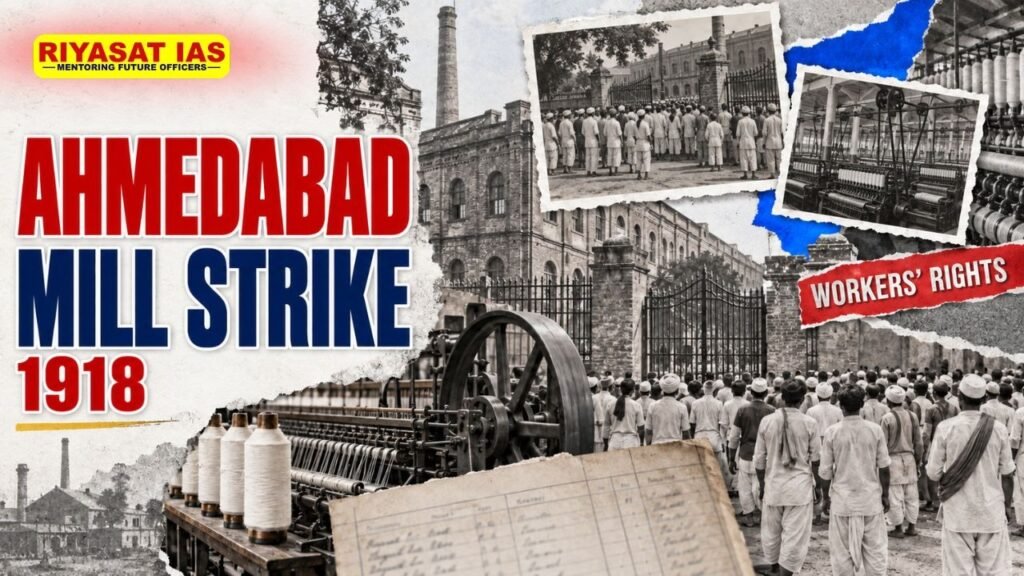
The Ahmedabad Mill Strike of 1918 was one of Gandhi’s early experiments with Satyagraha in India. Unlike Champaran, where the issue concerned peasants, Ahmedabad brought Gandhi into a labour dispute between textile mill workers and mill owners. It is especially remembered because Gandhi used fast as a means of moral pressure for the first time in India.
Background
· Ahmedabad had developed into an important centre of the cotton textile industry. During the plague epidemic, mill owners had been paying workers an additional “plague bonus” to persuade them to remain in the city and continue working.
· Once the epidemic began to subside, the mill owners decided to withdraw this bonus. At the same time, the cost of living had risen considerably during and after the First World War, so the workers wanted higher wages to compensate for the rising prices. A dispute therefore developed between the workers and the mill owners over the question of wages.
Reasons for the Strike
· The immediate issue was the withdrawal of the plague bonus. Workers opposed its withdrawal because prices had risen sharply and their existing wages were no longer sufficient.
· Gandhi studied the situation and concluded that the workers were justified in demanding a 35% increase in wages. The mill owners, however, were prepared to offer only around 20%.
· Another important issue was the breakdown of an earlier attempt to settle the dispute through arbitration. Gandhi had encouraged both sides to negotiate through a tribunal, but the mill owners later withdrew from the arrangement and declared that they would give only a 20% increase.
Gandhi’s Role
· Gandhi became involved in the dispute at the request of the workers and local leaders. Anasuya Sarabhai, who was closely associated with the workers, was an important figure in bringing the workers’ grievances to Gandhi. Her brother Ambalal Sarabhai was himself one of the prominent mill owners and had close relations with Gandhi.
· Rather than immediately encouraging a strike, Gandhi first tried to bring the workers and owners to an agreement. He supported arbitration and asked both sides to settle the dispute peacefully.



· When negotiations failed, Gandhi advised the workers to go on strike but insisted that they should remain peaceful and united. He also asked them to take a pledge that they would not return to work until their demand was considered.
· As the strike continued, Gandhi noticed that the workers were gradually losing confidence because of financial hardship. At this stage, he decided to take an unusual step.
Gandhi’s First Hunger Strike
· On 15 March 1918, Gandhi announced that he would undertake a fast until a settlement was reached and the workers’ demand for a 35% wage increase was accepted.
· This was significant because Gandhi used his own suffering as a form of moral pressure, rather than threatening the mill owners or encouraging violence.
· The fast strengthened the determination of the workers and attracted considerable public attention. Gandhi continued the fast until an agreement was reached. On 18 March 1918, a settlement was announced and Gandhi ended his fast.
Result
· A settlement was reached in favour of the workers. The dispute was resolved through an arrangement that provided for the 35% wage increase sought by the workers.
· The strike ended peacefully, and the workers returned to work. The episode also demonstrated Gandhi’s preference for negotiation and arbitration before resorting to prolonged confrontation.
Significance
· The Ahmedabad Mill Strike was important because it showed that Gandhi’s Satyagraha could also be applied to industrial and labour disputes, not merely to agrarian problems.
· For the workers, Gandhi’s leadership provided a disciplined way of putting pressure on the mill owners without violence. The episode also brought together people from different sides of the social divide, as Gandhi maintained close relations with both Anasuya Sarabhai and Ambalal Sarabhai.
· The use of fast as a method of Satyagraha became an important part of Gandhi’s political technique. He demonstrated that personal suffering could be used to strengthen the resolve of the movement and appeal to the conscience of the opposing side.
· Along with Champaran (1917) and Kheda (1918), Ahmedabad helped establish Gandhi’s early reputation as a leader who could connect Satyagraha with the everyday economic problems of ordinary people. NIOS also places Ahmedabad among Gandhi’s first three successful movements in India.
· Most importantly, the Ahmedabad experience gave Gandhi practical experience in dealing with workers, industrialists, negotiations, strikes and collective discipline. It became another step in the development of the methods that he would later use on a much larger scale in the national movement.
Conclusion
Ahmedabad Mill Strike was a small but important episode in the early Gandhian phase. Gandhi showed that a labour dispute could be handled through non-violence, negotiation, discipline and personal sacrifice. His fast strengthened the workers’ resolve and added a new method to his growing repertoire of Satyagraha.
FAQs
1. Why did the Ahmedabad Mill Strike begin in 1918?
The dispute arose after mill owners withdrew the plague bonus, while the workers demanded higher wages because of the rising cost of living.
2. What wage increase did the workers demand?
Gandhi supported the workers’ demand for a 35% increase in wages, while the mill owners were initially willing to offer only about 20%.
3. Who were the important leaders associated with the strike?
Gandhi and Anasuya Sarabhai supported the workers, while Ambalal Sarabhai was one of the prominent mill owners involved in the dispute.
4. Why did Gandhi undertake a fast during the strike?
Gandhi began a fast on 15 March 1918 when the workers were losing confidence and the dispute remained unresolved. He used personal suffering as a means of strengthening the workers’ resolve and putting moral pressure on the mill owners.
5. Why is the Ahmedabad Mill Strike important in Gandhi’s career?
It was Gandhi’s first hunger strike in India and showed that his methods of Satyagraha could be applied to labour disputes as well as agrarian problems.



 Ravi Raaz
 Hassan Khan
 Shadab Ali