
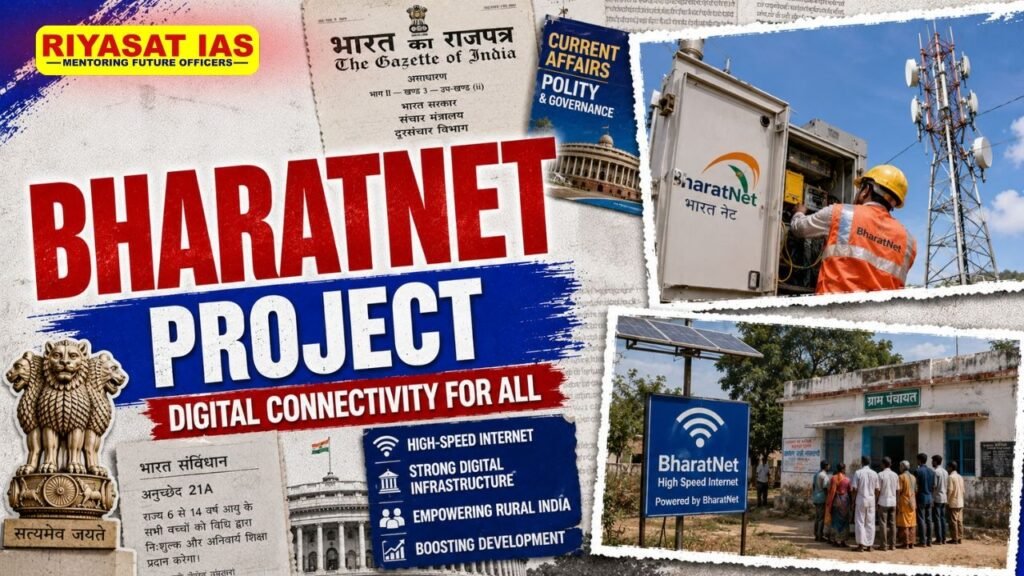
About
BharatNet is the Government of India’s flagship rural broadband programme aimed at providing high-speed broadband connectivity to Gram Panchayats and extending connectivity to villages beyond Gram Panchayats on demand. It is funded through the Digital Bharat Nidhi (DBN) under the Department of Telecommunications (DoT), Ministry of Communications, and seeks to bridge India’s rural–urban digital divide.
Phases of Implementation
- Phase I: Focused on laying optical fibre cables to connect 1 lakh Gram Panchayats by utilising existing infrastructure. This phase was completed in December 2017
- Phase II(ongoing): Expanded coverage to an additional 1.5 lakh Gram Panchayats using optical fibre, radio, and satellite technologies. This phase incorporated collaborative efforts with state governments and private entities.
· Phase III / Amended BharatNet Programme (ABP)
o The Amended BharatNet Programme (ABP) was approved on 4 August 2023 with an estimated outlay of ₹1,39,579 crore. It aims to provide high-speed broadband connectivity to around 2.65 lakh Gram Panchayats and extend connectivity to about 3.8 lakh non-GP villages on demand.
o Under ABP, the network is being upgraded to a ring architecture to improve reliability, along with Remote Fibre Monitoring Systems, 5G Technology, dedicated Network Operation Centres, power backup and long-term O&M under Service Level Agreements.



Satellite connectivity: Under the BharatNet project, satellite connectivity using GSAT-11 and GSAT-19 is being used to provide broadband connectivity to around 6,700 Gram Panchayats and other areas that cannot be reached through conventional connectivity methods.
Funding & Implementation
· Funding: BharatNet is fully funded through the Universal Service Obligation Fund (USOF), now renamed Digital Bharat Nidhi (DBN) under the Department of Telecommunications. The total financial requirement for BharatNet, including Phases I and II, is around ₹1.88 lakh crore, while the Amended BharatNet Programme has an estimated outlay of ₹1,39,579 crore.
· Implementation: The project was initially executed through Bharat Broadband Network Limited (BBNL). Under the Amended BharatNet Programme, BSNL has been appointed as the Project Management Agency (PMA) for the network’s operation and maintenance. Professional Project Implementing Agencies (PIAs) are selected through open bidding under the Design, Build, Operate and Maintain (DBOM) model.
· Current Status: Around 2,14,912 GPs had been connected under BharatNet Phase-I and Phase-II and as of June 2026, 13,494 GPs have been upgraded under ABP for providing high speed internet services.
Conclusion
· BharatNet is a crucial component of India’s Digital India and rural digital-inclusion strategy, connecting rural communities with opportunities in e-governance, education, healthcare, banking, e-commerce and digital employment. Its evolution from basic fibre connectivity to the Amended BharatNet Programme’s reliable, ring-based and professionally maintained network reflects a shift from “connecting villages” to “delivering reliable digital services.”
FAQs
1. What is BharatNet?
Ans: BharatNet is a flagship Government programme aimed at providing high-speed broadband connectivity to Gram Panchayats and rural areas, thereby reducing the rural–urban digital divide.
2. What are the major phases of BharatNet?
Ans: Phase I focused on connecting 1 lakh GPs, Phase II expanded connectivity to another 1.5 lakh GPs, while the Amended BharatNet Programme aims to provide reliable broadband connectivity to about 2.65 lakh GPs and extend it to villages beyond GPs on demand.
3. How is BharatNet funded?
Ans: BharatNet is funded through the Digital Bharat Nidhi (DBN), formerly known as the Universal Service Obligation Fund (USOF), under the Department of Telecommunications.
4. Who implements BharatNet?
Ans: Under the Amended BharatNet Programme, BSNL acts as the Project Management Agency, while Project Implementing Agencies are selected through open bidding under the Design, Build, Operate and Maintain (DBOM) model.
5. Why is BharatNet important for India?
Ans: BharatNet can enable rural communities to access e-governance, online education, telemedicine, digital banking, e-commerce and digital employment, thereby promoting digital inclusion and inclusive development.




 Ravi Raaz
 Hassan Khan
 Shadab Ali