About
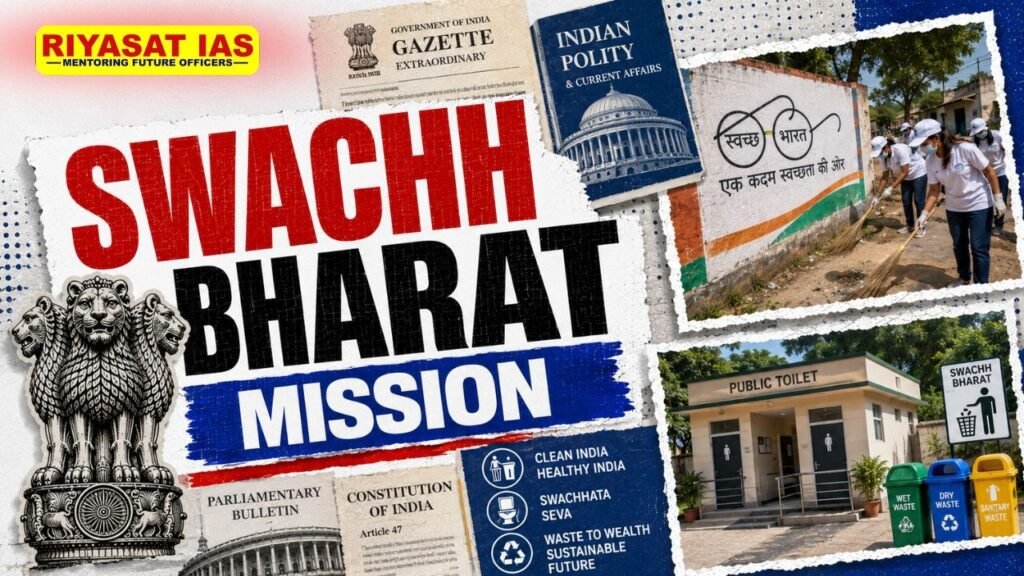
The Swachh Bharat Mission (SBM) was launched on 2 October 2014 to fulfil the vision of a cleaner India by 2 October 2019, as a tribute to Mahatma Gandhi on his 150th birth anniversary.
The campaign is one of the biggest-ever drives to accelerate efforts towards achieving universal sanitation coverage, improving cleanliness and eliminating open defecation in India. The Mission comprises components such as the construction of individual household toilets, community and public toilets, and solid and liquid waste management, etc.
SBM-Grameen (Rural)
Phase I – SBM-G 1.0 (2014–2019)
SBM-G Phase I primarily focused on eliminating open defecation by providing access to household toilets and promoting their regular use.
Key Points
- The programme aimed to increase rural sanitation coverage and achieve ODF status by 2 October 2019.
- Rural sanitation coverage increased from 39% in 2014 to 100% in 2019.
- More than 10 crore Individual Household Latrines (IHHLs) were constructed under Phase I.
- By 2 October 2019, all villages had been declared ODF according to government-reported data.
- The programme relied heavily on behaviour-change communication, Jan Bhagidari and community mobilisation, rather than treating sanitation merely as an infrastructure programme.
Major Achievement: SBM-G 1.0 shifted rural sanitation from low toilet coverage towards nationwide ODF declaration.
SBM-Grameen Phase II (2020–26)
After achieving the ODF target, SBM-G Phase II was launched from 1 April 2020 with the objective of sustaining ODF behaviour and achieving ODF Plus villages through comprehensive solid and liquid waste management.
Key Points
- Phase II focuses on ODF sustainability rather than merely toilet construction.
- It promotes Solid Waste Management (SWM) and Liquid Waste Management (LWM) at the village level.
- It aims to transform villages into ODF Plus Model villages.
- It promotes visual cleanliness, waste segregation, composting, greywater management and faecal-sludge management.
- The programme encourages community participation and convergence with MGNREGS and other schemes.
- The current ODF Plus framework has three progressive categories: Aspiring, Rising and Model.
ODF Plus Categories
| Category | Meaning |
| ODF Plus Aspiring | The village sustains ODF status and has arrangements for SWM or LWM. |
| ODF Plus Rising | The village sustains ODF status and has arrangements for both SWM and LWM. |
| ODF Plus Model | The village sustains ODF status, has SWM and LWM arrangements, and maintains visual cleanliness. |
Current Rural Status
According to the SBM-G official dashboard, the latest available data show:
- 5,69,500+ villages have been declared ODF Plus.
- More than 5.36 lakh villages have arrangements for Solid Waste Management.
- More than 5.63 lakh villages have arrangements for Liquid Waste Management.
- More than 5.18 lakh villages have been declared ODF Plus Model.
- The programme has created more than 12 lakh community compost pits, nearly 5 lakh waste-collection and segregation sheds, and over 6.9 lakh waste-collection/transport vehicles.
The Ministry’s 2025 Year-End Review also reported that more than 83% of villages had been declared ODF Plus Model, with over 5.27 lakh villages having SWM arrangements and 5.41 lakh having LWM arrangements.
Swachh Bharat Mission-Urban
SBM-U 1.0 (2014–2021)
SBM-U 1.0 focused on improving sanitation and solid-waste management in urban areas, with major emphasis on eliminating open defecation and increasing access to toilets.
Key Points
- The Mission promoted construction of Individual Household Toilets (IHHTs) for urban households without toilets.
- It promoted Community and Public Toilets in areas where individual toilets were difficult to construct.
- It aimed to eliminate open defecation in urban areas.
- It promoted door-to-door collection of municipal solid waste.
- It encouraged source segregation, scientific waste processing and disposal.
- It also promoted citizen participation and behavioural change.
By March 2018, NITI Aayog reported that 47.04 lakh household toilets and 3.18 lakh community/public toilet seats had been constructed, while 2,648 cities had declared themselves ODF.
SBM-U 2.0 (2021–26)
SBM-U 2.0 was launched in 2021 with a broader objective of creating “Garbage Free Cities” and sustaining sanitation outcomes.

Key Points
- It focuses on sustaining ODF outcomes and improving the entire urban sanitation value chain.
- It aims at 100% scientific processing of municipal solid waste.
- It focuses on source segregation, door-to-door collection and scientific processing of waste.
- It promotes remediation of legacy dumpsites and reclamation of land.
- It strengthens faecal sludge and septage management.
- It promotes mechanised cleaning of sewers and septic tanks to improve sanitation-worker safety.
- It encourages circular-economy approaches, including composting, biomethanation, waste-to-energy and material recovery.
- The mission promotes citizen participation and institutional capacity-building.
Major Certification Framework
SBM-U 2.0 uses sanitation certifications such as: ODF to ODF+ ODF++ to Water+
- ODF+ focuses on functionality and maintenance of community/public toilets.
- ODF++ focuses on the safe management of faecal sludge and septage.
- Water+ focuses on the treatment and reuse of wastewater and prevention of untreated discharge.
Current Urban Status
The latest Ministry of Housing and Urban Affairs review reported that by 2026:
- 97% of urban wards were covered by door-to-door waste collection.
- Municipal solid-waste processing increased from 16% in 2014 to 81% in 2026.
- About 65% of the 26 crore metric tonnes of waste identified across 2,482 legacy dumpsites had been remediated.
- Nearly 9,000 acres of land had been reclaimed through legacy-waste remediation.
A Ministry report also indicated that nearly 98% of urban areas practised door-to-door collection, around 91% of collected waste was source-segregated, and about 80% was processed in the reporting period.
Major Components / Initiatives under SBM
· Individual Household Toilets (IHHLs): The programme provides support for construction and use of household toilets, particularly for households without access to sanitation facilities.
· Community and Public Toilets: Community and public toilets are promoted in densely populated areas, slums, markets and locations where individual toilets are difficult to construct.
· GOBARdhan: GOBARdhan (Galvanizing Organic Bio-Agro Resources Dhan) was launched under SBM-G in 2018 to convert cattle dung, kitchen waste, crop residue and other biodegradable waste into biogas and bio-slurry.
o It promotes waste-to-wealth, renewable energy, organic manure, employment and additional income opportunities for rural communities.
o As of January 2026, the SBM-G dashboard reported 1,697 registered and 1,230 functional biogas plants, along with 1,189 registered and 157 functional CBG plants.
Swachh Vidyalaya Abhiyan
· The Swachh Vidyalaya initiative was launched in 2014 to provide separate functional toilets for boys and girls in government schools.
· Within one year, 4,17,796 toilets were constructed or made functional in 2,61,400 government elementary and secondary schools, achieving the target of providing access to separate toilets in government schools.
Rashtriya Swachhata Kosh
The Rashtriya Swachhata Kosh, also known as the Swachh Bharat Kosh, was created to mobilise additional resources for sanitation and cleanliness activities.
Funds could support activities such as:
- Construction and repair of toilets.
- Sanitation infrastructure.
- School sanitation.
- Water connections for toilets.
- Training and capacity-building.
- Other cleanliness-related interventions.
NITI Aayog identified the Kosh as one of the financing sources for SBM along with budgetary allocations, CSR contributions, external assistance and Finance Commission grants.
Swachhata Hi Seva
· Swachhata Hi Seva (SHS) is a mass mobilisation campaign that promotes Jan Bhagidari, cleanliness drives and behavioural change.
· In 2025, the campaign involved participation from more than 18 crore people, including over 13 crore participants from rural India.
Legacy Waste Remediation: Under SBM-U 2.0, old dumpsites are being scientifically remediated to remove legacy waste, reclaim land, reduce environmental pollution and promote scientific waste management, making legacy-waste remediation a major priority of the mission.
SafaiMitra / Sanitation-Worker Safety
This represents a shift from merely “cleaning cities” to ensuring “safe cleaning.” SBM-U increasingly focuses on eliminating hazardous manual entry into sewers and septic tanks through:
- Mechanised cleaning.
- Protective equipment.
- Training.
- Safety protocols.
- Rehabilitation and dignity of sanitation workers.
Major Achievements
Rural
- Rural sanitation coverage increased from 39% in 2014 to 100% in 2019, according to government-reported data.
- More than 10 crore rural household toilets were constructed during SBM-G Phase I.
- More than 5.69 lakh villages are currently reported as ODF Plus.
- The focus has shifted from toilet construction to ODF sustainability and village-level waste management.
Urban
- More than 63 lakh household toilets and around 6 lakh community toilets were reported as constructed between 2014 and 2026.
- Door-to-door waste collection has reached around 97–98% of urban areas/wards, according to recent Ministry reports.
- Waste processing has increased dramatically, reaching around 80–81% in recent government reporting.
- Legacy-waste remediation has reclaimed thousands of acres of urban land.
Health & Human Development: NITI Aayog research highlights the broader health significance of sanitation: access to improved sanitation is associated with lower levels of stunting and underweight among children, while open defecation is associated with poorer child-health outcomes.
Major Challenges / Implementation Issues
· ODF Sustainability: Declaring a village or city ODF does not automatically guarantee continued toilet use. Behavioural change and regular maintenance remain essential.
· Toilet Functionality: The next challenge is to ensure that toilets have water availability, cleanliness, repairs and regular maintenance, rather than merely counting their construction.
· Solid-Waste Segregation: NITI Aayog has identified non-segregation of waste and inadequate infrastructure for collection, transportation and processing as important implementation challenges.
· Urban Waste Processing: Increasing waste generation in rapidly urbanising India creates pressure on processing capacity, land availability and municipal finances.
· Weak ULB Capacity: Many Urban Local Bodies face shortages of technical expertise, manpower, financial resources and institutional capacity.
· Water–Sanitation Link: Toilet usage and hygiene depend heavily on reliable water supply, particularly in water-stressed rural and urban areas.
· Sanitation Workers: Mechanisation and safety protocols need to be strengthened further to eliminate hazardous manual sewer/septic-tank cleaning and ensure dignity and social security for sanitation workers.
· Data vs Ground Reality: Official declarations and dashboard indicators need regular third-party verification, social audits and field-level monitoring to ensure that reported outcomes correspond to actual sanitation conditions.
Way Forward
· Move from Infrastructure to Outcomes: The focus should shift from “toilet constructed” to “toilet safely used and maintained” and from “waste collected” to “waste scientifically processed.”
· Strengthen Behavioural Change: Continuous IEC, school-based sanitation education, community mobilisation and local leadership are necessary to sustain sanitation behaviour.
· Strengthen Local Governments: ULBs and Gram Panchayats need greater technical capacity, predictable finances, trained manpower and institutional autonomy.
· Scale GOBARdhan: Biogas and CBG projects should be linked with farmers, SHGs, FPOs, Panchayats and local enterprises to create a viable rural waste-to-wealth ecosystem.
· Strengthen Sanitation-Worker Safety: India should move towards 100% mechanised sewer and septic-tank cleaning, supported by protective equipment, training, insurance and rehabilitation.
· Climate-Resilient Sanitation: Sanitation infrastructure should be designed to withstand floods, extreme rainfall, droughts and water scarcity.
· Independent Verification: ODF Plus and urban sanitation certifications should be supported by third-party verification, social audits and citizen feedback.
Conclusion
The Swachh Bharat Mission has evolved from a mass toilet-construction and ODF campaign into a broader sanitation and waste-management mission. SBM-G 1.0 focused on eliminating open defecation, while SBM-G 2.0 focuses on ODF sustainability and ODF Plus villages. Similarly, SBM-U 1.0 focused on urban sanitation, while SBM-U 2.0 aims to create Garbage Free Cities through scientific waste management and legacy-waste remediation.
FAQs
1. When was Swachh Bharat Mission launched?
Ans: SBM was launched on 2 October 2014 with the objective of achieving universal sanitation coverage and eliminating open defecation.
2. What is the difference between SBM-G 1.0 and SBM-G 2.0?
Ans: SBM-G 1.0 focused mainly on toilet access and ODF status, whereas SBM-G 2.0 focuses on ODF sustainability, solid and liquid waste management and ODF Plus villages.
3. What is an ODF Plus village?
Ans: An ODF Plus village sustains its ODF status and also undertakes solid and/or liquid waste management, with the Model category additionally requiring visual cleanliness.
4. What is GOBARdhan?
Ans: GOBARdhan is an SBM-G initiative that converts biodegradable waste such as cattle dung, crop residue and kitchen waste into biogas and bio-slurry, thereby promoting waste-to-wealth and rural livelihoods.
5. What was the objective of Swachh Vidyalaya?
Ans: Swachh Vidyalaya aimed to provide separate functional toilets for boys and girls in government schools. It resulted in 4.17 lakh toilets being constructed or made functional in 2.61 lakh government schools within one year.
6. What is the significance of ODF++ in urban sanitation?
Ans: ODF++ goes beyond toilet access and maintenance by focusing on the safe collection, transportation and treatment of faecal sludge and septage and preventing untreated discharge.

 Ravi Raaz
 Hassan Khan
 Shadab Ali