
About
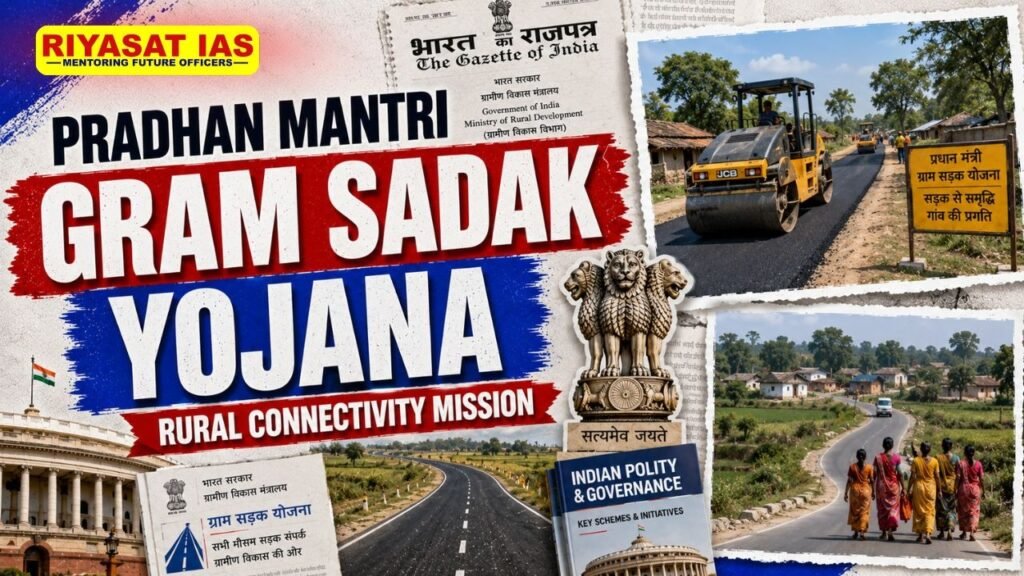
The Pradhan Mantri Gram Sadak Yojana (PMGSY) was launched in December 2000 by the Government of India to provide all-weather road connectivity to eligible unconnected rural habitations. Over time, the programme has evolved from basic rural connectivity to upgradation, consolidation, economic connectivity, green technologies and last-mile connectivity for vulnerable communities.
o The scheme is implemented by the Ministry of Rural Development, with the National Rural Infrastructure Development Agency (NRIDA) providing technical and institutional support.
Evolution of PMGSY
| Phase/Intervention | Year | Main Focus |
| PMGSY-I | 2000 | Providing all-weather connectivity to eligible unconnected habitations. |
| PMGSY-II | 2013 | Upgrading 50,000 km of existing rural roads. |
| PMGSY-III | 2019 | Consolidating 1,25,000 km of Through Routes and Major Rural Links connecting villages to markets, schools and hospitals. |
| RCPLWEA | — | Improving road connectivity in Left Wing Extremism-affected areas. |
| PM-JANMAN | 2023 | Providing road connectivity to Particularly Vulnerable Tribal Group (PVTG) habitations. |
| PMGSY-IV | 2024 | Providing all-weather connectivity to 25,000 previously unconnected habitations through 62,500 km of roads. |
PMGSY-IV
Pradhan Mantri Gram Sadak Yojana-IV (PMGSY-IV) was approved all weather road connectivity to previously unconnected 25,000 habitations by constructing 62,500 km of all-weather roads with necessary cross drainage and culvert with a total financial outlay of ₹70,125 crore (Central share: ₹49,087.50 crore; State share: ₹21,037.50 crore). To ensure objective selection, Census 2011 remains the standard benchmark for population data, though significant relaxations are provided for specific geographies:
(i) General Areas: Habitations with a population of 500 or more.
(ii) Special Category Areas: A threshold of 250 or more applies to Hill States, North-Eastern Regions, Desert Areas, and Tribal (Schedule V) Areas.
(iii) Aspirational Districts/Blocks: These regions also benefit from the relaxed 250 or more population criteria.
(iv) LWE-Affected Districts: Connectivity is extended to habitations with a population of 100 or more as identified by the Ministry of Home Affairs.
The scheme further prioritises social inclusion through convergence with Dharti Aaba Janjatiya Gram Utkarsh Abhiyan (DA-JGUA) for ST-dominated habitations and PM-Anusuchit Jaati Abhyuday Yojana (PM-AJAY) for SC-concentrated areas.
Funding Pattern



PMGSY follows a Centre-State cost-sharing mechanism.
- The Centre and States generally share the cost in a 60:40 ratio.
- For the 8 North-Eastern States, 2 Himalayan States and Jammu & Kashmir, the sharing ratio is 90:10.
- Union Territories without a legislature receive 100% Central funding.
- For 2025–26, PMGSY received a budget allocation of approximately ₹19,000 crore, reflecting continued government emphasis on rural connectivity.
Three-Tier Quality Monitoring:
To ensure the quality and durability of rural roads constructed, a three-tier Quality Monitoring System is in place.
Tier 1: Field-level quality checks by the executing agency.
Tier 2: Inspections by independent State Quality Monitors (SQMs).
Tier 3: Surprise inspections by National Quality Monitors (NQMs) deputed by Ministry. Progress and quality inspections are tracked in real-time through the Online Management, Monitoring and Accounting System (OMMAS).
Economic & Social Significance
· Agricultural Development: Better roads provide farmers with improved access to agricultural markets, storage facilities, inputs and transport, thereby reducing transaction and transportation costs.
· Access to Social Services: Rural roads improve access to schools, hospitals, markets, banks and government services, particularly in remote areas.
· Employment & Livelihoods: Improved connectivity facilitates non-farm employment, rural enterprises, tourism and local markets, while reducing isolation of rural communities.
· Poverty Reduction: PMGSY contributes to poverty reduction by connecting rural populations with economic opportunities and essential services.
· Women’s Mobility: Better road connectivity can improve women’s access to education, healthcare, markets and employment opportunities.
· Inclusive Development: Special interventions under PM-JANMAN, RCPLWEA and PMGSY-IV extend connectivity to tribal, PVTG, LWE-affected and other underserved habitations.
Challenges
· Difficult Terrain: Constructing and maintaining roads in hilly, tribal, forested and flood-prone areas increases costs and technical complexity.
· Maintenance: Creating roads is only the first step; ensuring long-term maintenance and all-weather usability remains a major challenge.
· Climate Vulnerability: Floods, landslides, extreme rainfall and other climate-related events can damage rural roads and bridges.
· Quality Variation: Although the three-tier quality-control system provides safeguards, maintaining uniform quality across thousands of projects remains challenging.
· Land and Environmental Issues: Land acquisition, forest clearances and environmental concerns can delay road projects.
· Last-Mile Gaps: Despite substantial progress, some remote and sparsely populated habitations remain difficult and costly to connect.
· Sustainability: Greater use of green technologies is required to reduce the carbon footprint, resource consumption and maintenance burden of rural road construction.
Way Forward
- Rural roads should increasingly be designed according to climate-resilient and disaster-resilient standards.
- Greater emphasis should be placed on preventive maintenance, rather than waiting for roads to deteriorate.
- Green technologies such as FDR, waste plastic, geotextiles and cold mix should be scaled up after rigorous performance assessment.
- GIS, drones, satellite imagery and real-time monitoring can strengthen project supervision and quality control.
- Road planning should be integrated with agricultural markets, schools, healthcare centres and rural economic clusters.
- Special attention should continue for tribal, PVTG, LWE-affected, aspirational and geographically difficult areas.
Conclusion
PMGSY has transformed rural connectivity from a basic infrastructure challenge into a broader instrument of economic and social development. Its evolution from PMGSY-I’s habitation connectivity to PMGSY-III’s economic linkages and PMGSY-IV’s inclusive last-mile connectivity, along with the adoption of green technologies, reflects a shift towards resilient, sustainable and inclusive rural infrastructure.
FAQs
1. What is the main objective of PMGSY?
Ans: PMGSY aims to provide all-weather road connectivity to eligible unconnected rural habitations.
2. What is the difference between PMGSY-I, II, III and IV?
Ans: PMGSY-I focused on habitation connectivity, PMGSY-II on road upgradation, PMGSY-III on economic and social connectivity, while PMGSY-IV focuses on connecting 25,000 previously unconnected habitations.
3. What is the funding pattern of PMGSY?
Ans: The Centre and States generally share costs in a 60:40 ratio, while the ratio is 90:10 for North-Eastern and Himalayan States and Jammu & Kashmir.
4. What is the three-tier quality-control mechanism under PMGSY?
Ans: It consists of Programme Implementation Units (PIUs), State Quality Monitors (SQMs) and National Quality Monitors (NQMs).
5. What are the major new technologies used under PMGSY?
Ans: PMGSY promotes Full Depth Reclamation (FDR), waste-plastic roads, cold-mix technology, geotextiles and other green technologies for sustainable and durable rural roads.


 Ravi Raaz
 Hassan Khan
 Shadab Ali