
About
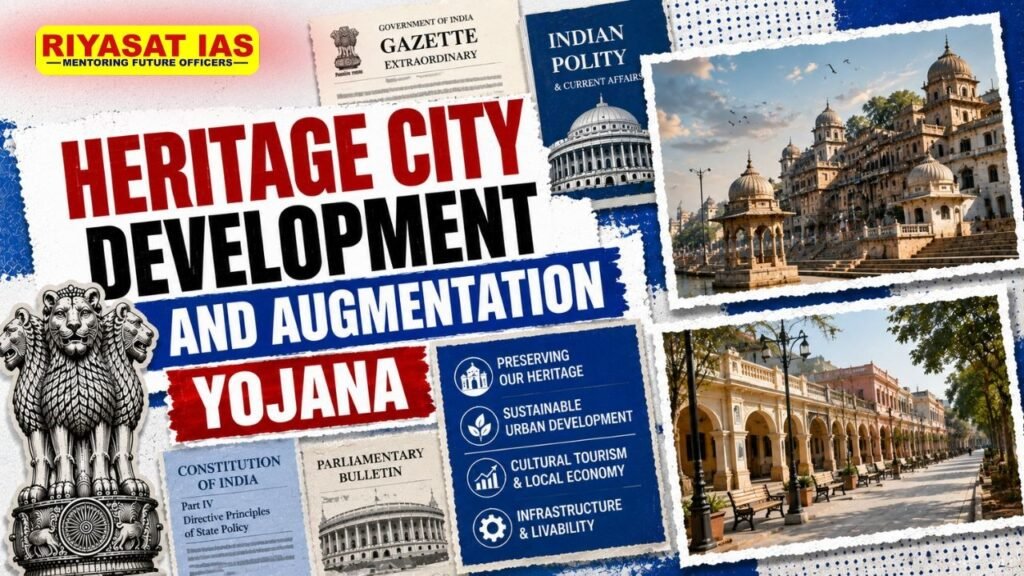
The Heritage City Development and Augmentation Yojana (HRIDAY) was launched on 21 January 2015 as a Central Sector Scheme with an outlay of ₹500 crore. It aimed to integrate heritage conservation with urban planning, infrastructure development and economic growth, while preserving the unique cultural character of selected heritage cities.
Objectives: The major objectives of HRIDAY were to:
- Promote heritage-sensitive urban planning and infrastructure development.
- Improve civic services and infrastructure in the core areas of historic cities.
- Preserve and revitalise the unique cultural character and heritage of cities.
- Develop a comprehensive inventory and mapping of natural, cultural, living and built heritage assets.
- Improve basic services such as sanitation, water supply, drainage, street lighting and tourist amenities.
- Promote tourism, livelihoods and inclusive heritage-based economic development.
Components
HRIDAY supported development of core heritage-linked civic infrastructure around heritage, religious, cultural and tourism assets. Major interventions included:
- Heritage documentation, mapping (using GIS System) and management plans.
- Water supply, sanitation and drainage infrastructure.
- Waste management and public conveniences.
- Approach roads, footpaths and street lighting.
- Tourist facilities and amenities.
- Landscaping and improvement of public spaces.
- Heritage walks and improved access to heritage sites.
- Capacity building and awareness activities for heritage-city management.
Selected Cities: These cities were selected primarily because of their rich cultural, historical and heritage significance. HRIDAY was implemented in 12 heritage cities:
| State | City |
| Rajasthan | Ajmer |
| Andhra Pradesh | Amaravati |
| Punjab | Amritsar |
| Karnataka | Badami |
| Gujarat | Dwarka |
| Bihar | Gaya |
| Tamil Nadu | Kanchipuram, Velankanni |
| Uttar Pradesh | Mathura, Varanasi |
| Odisha | Puri |
| Telangana | Warangal |



Benefits
· Heritage Conservation: HRIDAY helped integrate heritage conservation with urban infrastructure development, rather than treating monuments as isolated structures.
· Improved Civic Infrastructure: Projects improved water supply, sanitation, drainage, roads, footpaths, lighting and public spaces around heritage areas.
· Tourism Promotion: Improved accessibility, heritage walks and tourist amenities enhanced the visitor experience and tourism potential of heritage cities.
· Livelihood Generation: The Mission promoted opportunities for local businesses, artisans, tourism-related activities and heritage-based livelihoods.
· Inclusive Urban Development: HRIDAY sought to ensure that heritage conservation was connected with the needs of local communities, residents and businesses, rather than focusing only on monuments.
· Important Achievement: By 2018, 63 projects worth ₹421.47 crore had been approved, with ₹241.26 crore released. Several projects included heritage roads, public parks and heritage walks.
Conclusion
HRIDAY represented a shift from monument-centric conservation to integrated heritage-city development, combining heritage preservation, civic infrastructure, tourism and livelihoods. Although the mission ended on 31 March 2019, its approach provides a useful model for balancing urban development with cultural heritage conservation.
FAQs
1. What is HRIDAY?
Ans: HRIDAY is a Central Sector Scheme launched in 2015 to integrate heritage conservation with urban infrastructure development in selected heritage cities.
2. What was the main objective of HRIDAY?
Ans: It aimed to preserve the cultural and historical character of heritage cities while improving civic infrastructure and promoting tourism and local livelihoods.
3. How many cities were selected under HRIDAY?
Ans: HRIDAY was implemented in 12 heritage cities, including Varanasi, Mathura, Ajmer, Amritsar, Puri, Gaya and Warangal.
4. What type of projects were supported under HRIDAY?
Ans: The scheme supported heritage mapping, sanitation, water supply, drainage, roads, footpaths, street lighting, heritage walks, public spaces and tourist amenities.
5. When did the HRIDAY Scheme end?
Ans: HRIDAY was implemented for a four-year period and concluded on 31 March 2019.


 Ravi Raaz
 Hassan Khan
 Shadab Ali