
GS-III | Indian Economy | Science and Technology | Start-ups | Innovation
Why in News?
- The first three quarters of 2026 saw a decline of 37 percent for seed funding (to $698 million), while early-stage funding rose by 27 percent (to $4.2 billion), according to recently published data from Tracxn.
- This follows a 30 per cent decline in seed funding in 2025.
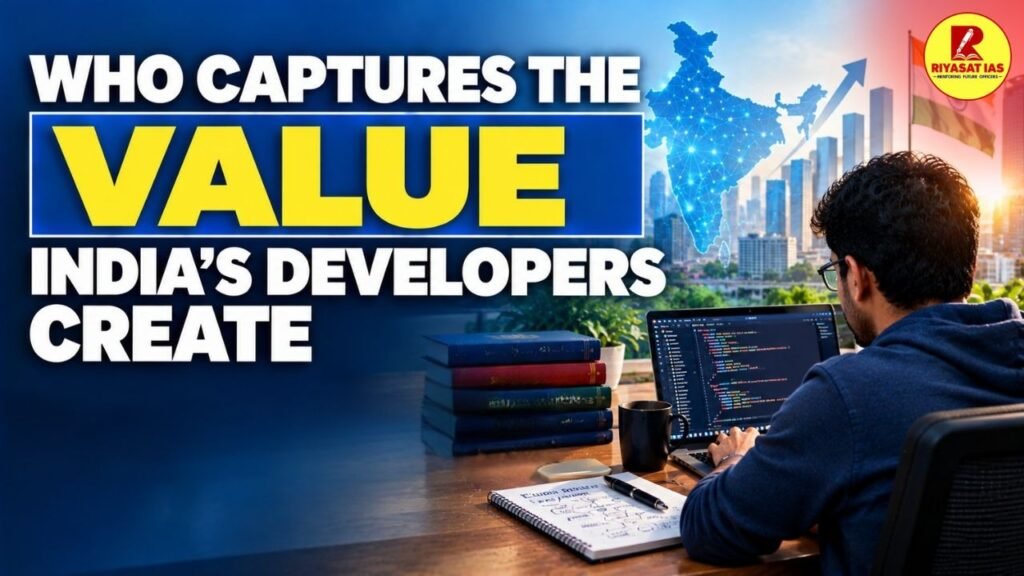
- In 2025, GitHub estimated there were 21.9 million developers in India. This was an increase from the 4.5 million developers in India in 2020.
- The country of India currently possesses the world’s most significant contributor group to open source and public repositories.
Key Issues and Developments
1. India’s Growing Technology Talent Base
- Growing talent base: India’s technology talent base has never been larger.
- Developer growth: It added more than 5 million developers in just one year.
- Expertise expanded: In addition to the conventional software services work done by our team, we have added capabilities in Artificial Intelligence (AI), Cyber Security, Engineering, Analytics and Product Development.
2. Four Layers of Economic Value
- Jobs and salaries: In addition to job opportunities, the technology sector is responsible for employing approximately 5.8 million individuals. Global Capability Centers (GCCs) currently employ roughly 2.36 million people, and the total value of exports generated by both Indian service providers and multinational corporations (MNCs) that include GCCs is almost equal.
- Profits and enterprise value: The Indian IT industry sells technology services worldwide and therefore gains the benefit of global margins, profits and enterprise value.
- High-value work and expertise: GCCs that once handled mainly support increasingly house product engineering, AI, architecture, R&D and end-to-end responsibility for global platforms. That brings better-paid roles, deeper expertise and stronger technology ecosystems into India.
- Products, IP and ownership: Who owns the product/platform being developed? What will be the owner of the recurring revenue and the long term enterprise value?
3. Limited Ownership of Technology Products
- Limited software product share: NASSCOM estimates that only $16.1 billion of India’s $282.6 billion total technology industry is generated by software products.
- Services-led growth: India is far more successful at providing technology-related services and global delivery than it is at creating and owning globally-scaled software products and platforms.
- Ownership gap: Although the shift from talent, to services, to higher-value capabilities has occurred on a large scale, ownership is still limited.

4. Declining Seed Funding and Its Implications
- Selectiveness of Capital: The drop in seed funding, along with an increase in funding for companies with proven traction, indicates that capital is growing more selective.
- Early-Stage Risk: Often, the product owner position is established prior to proof of concept (when the idea is unproven), high failure rates exist, and a person must invest in belief prior to establishing proof.
- An Innovation Challenge: Capital is necessary to take on early failures, even with an adequate infrastructure and technical capabilities.
- Impact on founders: It is more difficult for India to move from capability to ownership if access to capital is decreased at the exact time that founders are attempting to transition their ideas to products.
5. Start-ups versus Global Capability Centres (GCCs)
- Career Options: Architects and engineers who are highly skilled in their field of work in Bengaluru have many more career options than ever before in the country’s technology sector. These options include working for an Indian-based IT firm; working for a globally recognized product firm; working for a Global Capability Center (GCC) that focuses on complex tasks; or working for a startup trying to establish its presence.
- GCCs: Offers great salaries, international experience, and rapidly improving career options.
- Start-ups: Startups offer an opportunity to own a piece of the company, but also provide a lot more risk.
- Risk-reward equation: Those options offer vastly different risk-reward equations.
6. Innovation Infrastructure and Early-Stage Capital
- Existing Infrastructure: India has spent a significant amount on innovation infrastructure including, but not limited to, Research Centers, Incubator spaces, Public Funding Programs and R&D facilities.
- Capital gap: Technical capabilities and infrastructure do not replace capital that is willing to accept failure in the beginning.
- Disciplined funding: This is not a call for indiscriminate start-up funding. Many of the initial ideas that are funded will ultimately fail, therefore capital needs to continue to be used with discipline.
- Need for risk capital: In order to fund ideas prior to having a mountain of proof, India will need to develop large pools of risk capital.
Way Forward
- Enhance early stage financing: Create an adequate size pool of risk capital for funding of ideas while they remain unverified.
- Promoting product ownership: Enable additional technology-related professionals to develop products, intellectual property and businesses that are based in India.
- Support innovation: Support innovation by strengthening research centers, incubator organizations, publicly-funded programs and research and development (R&D) facilities.
- Encourage entrepreneurship: Tackle the financing barriers that entrepreneurs face when developing their ideas into tangible products.
- Keep Your Investments on Track: Support Innovative Ideas in Their Early Stages, But Keep in Mind That Most Early Ideas Don’t Succeed.
Conclusion
India now has the talent. It has established world-class service organizations. It is an integral part of the IT operations for some of the world’s largest companies. The second phase of this process is more difficult: moving from being a provider of technology to the rest of the world to owning more of what is developed.
With AI entering the picture, it’s unknown whether we need more developers or fewer. But the technology race now goes well beyond having the most developers. It is increasingly about who owns what those developers build.
UPSC Mains Practice Question
Q. India has built a large technology talent base and globally competitive IT services industry, yet its ownership of globally scaled technology products remains limited. Discuss the challenges and suggest measures to strengthen India’s innovation ecosystem and early-stage start-up funding.
Master UPSC Essay Writing with Expert Mentorship!
Learn to analyse contemporary topics like “Who Captures the Value India’s Developers Create?” with a multidimensional approach, logical arguments and relevant examples. Join our UPSC Essay Foundation Course to improve your essay structure, critical thinking and answer presentation for UPSC Mains 2027.
Build your ideas. Strengthen your arguments. Write essays that stand out!




 Ravi Raaz
 Hassan Khan
 Shadab Ali