
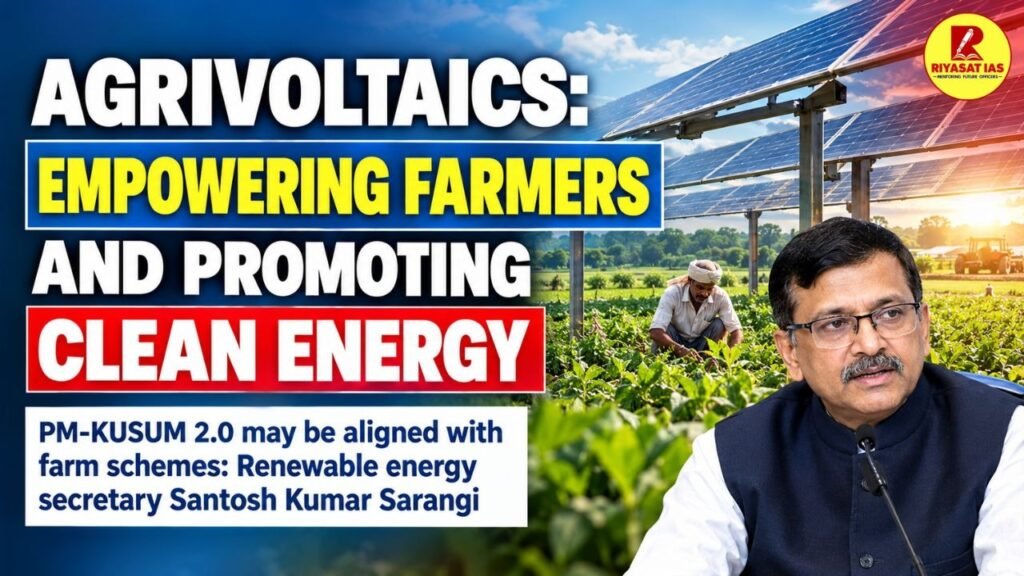
GS-III | Agriculture | Renewable Energy | Environment | Inclusive Growth
Why in News?
- India will be the host for the 7th AgriVoltaics World Conference from October 21st through 23rd in New Delhi, at Bharat Mandapam.
- Theme: ‘Powering the Global South’.
- The Indian Government is planning on establishing a distinct space for AgriPV as part of its second phase of PM-KUSUM to increase the rate at which it generates solar power.
Key Issues and Developments
1. Agrivoltaics (AgriPV)
- Meaning: Agrivoltaics refers to combining agriculture with the production of solar energy using structures and spacing designed for agricultural use.
- Additional income: Farmers can earn extra money by producing electricity.
- Cost reduction: The replacement of diesel fuel or purchased electricity by solar energy can lower your costs.
- Crop protection: Under AgriPV, the favorable microclimate provides further protection from heat stress, drought, too much sun exposure, and hail.
- Rural employment: Creates job opportunities in areas such as installation of equipment/systems, maintenance of equipment/systems and service to agriculture.
2. Significance for Indian Agriculture
- Farmer Success: Even if you have a great year with your crops, it may not translate into a high profit. With Agrivoltaics, farmers will be able to manage the risks associated with unpredictable weather patterns, rising input costs, and declining market prices.
- Small and marginal farmers: Small and marginal farmers make up a majority (approximately 86 percent) of India’s farmer population. Because of this, it is crucial that there are affordable and accessible agricultural photovoltaic (AgriPV) options available to them.
- Viksit Bharat: Agrivoltaics can provide clean energy opportunities in rural economies without displacing agriculture as the base.
- Energy transition: The transition to clean energy is built on three pillars: domestic manufacturing of clean energy technologies, transparent procurement processes that enable fair competition among suppliers, and significant investments in energy infrastructure. These three pillars will serve as a foundation for additional progress.
3. Crop Selection and Agronomic Management
- Crop selection: Optimal crop selection will be crucial to successful adoption. The selection of crops should focus on their ability to tolerate shade, exhibit morphological plasticity and maintain a productive output even with variable amounts of sunlight.
- Agronomic Management: To maintain high levels of production, it is necessary to use alley-based plantings with sufficient irrigation and nutritional supplies.
- Solar panel design: Generally speaking, solar panel designs will be able to allow for approximately 70% (or more) of the total amount of available natural sunlight to reach the level of the crop’s leaves.
- Adjustable Panels: These provide flexibility during the radiation-sensitive growth stage.
- Institutional coordination: The agriculture and energy departments should coordinate planning efforts with states, research organizations, and other local government entities.

4. Farmer Trust and Inclusive Participation
- Transparent agreements: Farmers need to know about the terms of their agreement with a company, what they can expect to earn from that relationship, and who has what obligations.
- Land ownership: Land ownership must remain protected.
- Inclusive benefits: Land tenant cultivators and women farmers have a say in how projects are designed and how benefits are shared.
5. Indian Initiatives and Research
- ICAR-Central Arid Zone Research Institute, Jodhpur: Has investigated growing crops under solar panels and collecting water from rain.
- BAIF’s Rural Innovation Centre, Pune: The Rural Innovation Center of BAIF (Pune) is experimenting with various combinations of crop production.
- Centre of Excellence on Agri-Photovoltaics: The Government of India has created a 100 kW capacity Centre of Excellence for Agri-Photovoltaics at ICAR–Indian Agricultural Research Institute, New Delhi in 2025.
- Institutional leadership: The center is jointly led by both the Indian Council of Agricultural Research (ICAR) and the National Institute of Solar Energy (NISE) under the leadership of the Ministry of New and Renewable Energy.
- Research outcomes: The results of this study are expected to result in recommendations regarding the suitability of crops for use in conjunction with solar panels, the boundaries that define how much space can be used for each purpose, and the most effective way to combine both uses within a single field.
6. International Cooperation
- The global south: This conference will allow for further development of India’s relationship with countries experiencing strain from land use, water supply issues, and declining rural income.
- International Solar Alliance (ISA): The International Solar Alliance (ISA), launched jointly by India and France, is a platform that allows countries to work together toward developing solar energy.
- Knowledge Sharing: Agrivoltaics provides a framework for collaborative field-based research, training, and exchange of on-farm practices.
- Affordable technology: The same amount of consideration given to advanced solar technologies should be paid to the affordability of structures and financial systems that fit small-scale farms.
Way Forward
- Affordable Solutions: Create affordable buildings and financing options for small and marginal farmers.
- Scientific Research: To increase the quality of field research regarding the suitability of different crops for various panels, the layout of those panels, and how they relate to the overall productivity of the land.
- Institutional coordination: Create a coordinated plan involving agricultural and energy departments, state governments, research organizations, and local government.
- Farmer-centric projects: Farmer-oriented projects should have clearly written agreements, provide safeguards for farmers’ land ownership rights, and guarantee equitable distribution of benefits to all farmers (including those who are tenant cultivators as well as female farmers).
- International cooperation: Collaborate on joint research, education, and knowledge transfer via the International Solar Alliance and other organizations.
Conclusion
Agrivoltaics can contribute to Viksit Bharat by combining agricultural productivity with clean energy generation and additional rural income. Its success will depend on affordable technology, scientific research, institutional coordination and farmer trust, keeping agriculture at its foundation and the annadata at its centre.
UPSC Mains Practice Question
Q. Discuss the potential of agrivoltaics in promoting farmers’ income, renewable energy generation and rural development in India. What measures are required to ensure its sustainable and inclusive adoption?
Prepare for UPSC 2027 with Expert Mentorship!
Master important current affairs topics like Agrivoltaics, Renewable Energy and Sustainable Agriculture with exam-oriented analysis for Prelims and Mains. Join our UPSC GS Foundation Course 2027 to strengthen your conceptual understanding, answer-writing skills and current affairs preparation.
Start your UPSC preparation today and move one step closer to your IAS dream!




 Ravi Raaz
 Hassan Khan
 Shadab Ali