
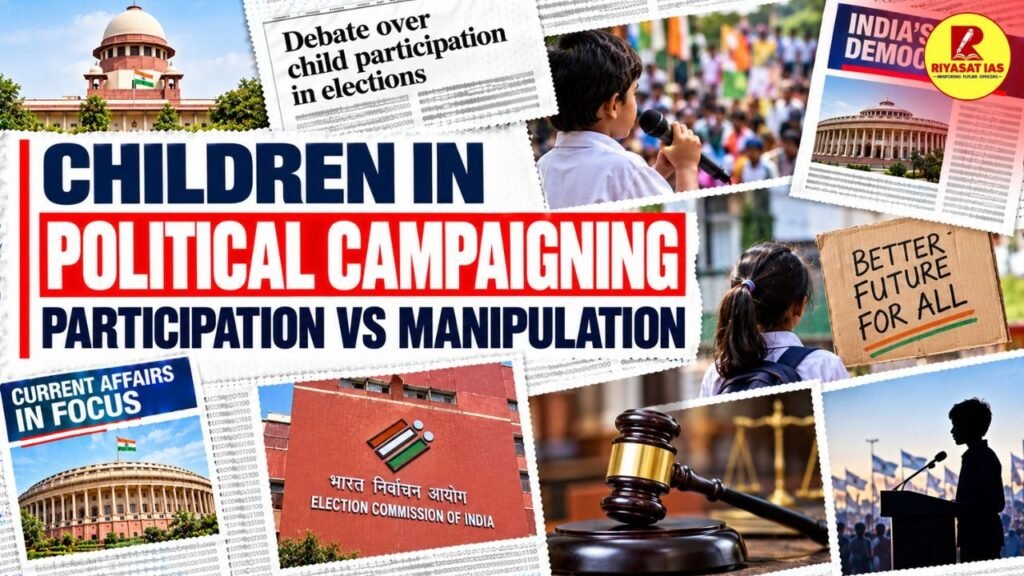
GS-II | Polity | Governance | Electoral Reforms | Child Rights
Introduction
- The success of Tamil Nadu’s TVK showed the importance of young people as a part of the campaign process. The Madras High Court has stated that using children for political campaigning is unacceptable and could be used to manipulate voters or allow parents to unduly influence their children’s voting behavior.
1. Children’s Political Participation
- Children’s right to take part: Children’s right to take part in political life is guaranteed by the UN Convention on the Rights of the Child.
- Genuine voice: Kids should state what they think, not be told what to say by grownups who have already decided what they want the kids to tell everyone.
- UNICEF framework: The UNICEF framework distinguishes what is true participation versus manipulation or tokenism.
2. Pester Power and Political Manipulation
- The Consumer to Electoral Marketing: Campaigns utilize children’s emotional ties to celebrities to affect family decision making.
- Pester effect: Children will continue to ask their parents to vote for a certain candidate, this may cause some influence on how the parent votes.
- Emotional Persuasion: Campaigns use a person whom the voter cares about to continue on with the campaign’s message of persuasion.
3. Agency and Informed Choices
- Adult Independence: Adults have the ability to assess candidates on an individual basis, as well as vote differently than other members of their household.
- Emotional appeals: Emotional appeals can create pressure for parents without being based upon the merits of a candidate.
- The value of democracy: Decisions made through democracy are based on knowledge, not emotion.
- Child Development: Creating scripts for children to deliver messages as part of a campaign is contrary to what we know about promoting children’s agency and goes against the best practices in child development.



4. Legal Framework
- Section 123, Representation of the People Act: Deals with undue influence.
- Legal limit: Excessive pressure can be placed on a person’s thinking process to influence their vote.
- Court’s decision: There was no proof that the election was manipulated, according to the High Court, however there were concerns regarding the use of young people to help carry out those types of activities.
- Legislative issue: It was suggested by the court that parliament may want to look into if these types of conduct can be used as a reason to void an election.
5. Digital Permanence
- Permanent digital footprint: A child’s digital footprint is permanent. Although children who appear in political videos may eventually come to regret their participation, once they have appeared on the Internet, the video will be available forever.
Way Forward
- Precise legislation: Consider a well-defined law on child campaigns that does not restrict children from taking part in politics.
- Avoid Manipulation: Separate actual political speech from choreographed political persuasion.
- Protect agencies: Don’t allow adult’s use of kids’ love to manipulate voters.
- Safely protect children’s online privacy: Think about the future impacts of posting your children’s campaign video online.
Conclusion
Children must be empowered to develop their own political voice, not used as instruments of electoral persuasion. Protecting their agency while preserving genuine participation is essential for ethical campaigning and informed democracy.
UPSC Mains Practice Question
Q. Discuss the ethical and legal concerns arising from the use of children in political campaigning. Suggest measures to protect children’s agency while preserving their right to political participation.
1. UPSC Mentorship Program 2027–2028: Start your preparation early with expert guidance, a structured study plan, and regular answer-writing practice. Join our UPSC Mentorship Program today!
Preparing for UPSC CSE 2027? Stay ahead with the UPSC Calendar 2027, track important exam dates, and prepare strategically with our personalised UPSC Mentorship Program.
Your UPSC 2027 Journey Starts Now! Plan your preparation around the UPSC Notification 2027 and exam schedule. Join our UPSC Mentorship Program for expert guidance, performance analysis, and a focused preparation strategy.



 Ravi Raaz
 Hassan Khan
 Shadab Ali