
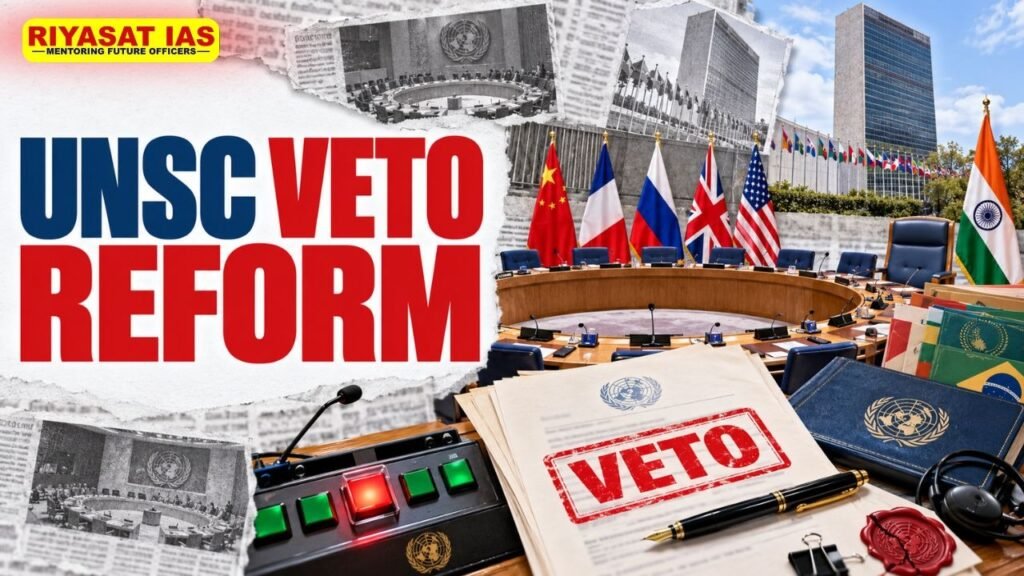
GS-II – International Relations | United Nations | UNSC Reforms | Global Governance
Why in News?
- French Proposal: France proposed to improve how the UN works, especially collective security and the use of veto.
- Veto Regulation: France has been advocating that the use of veto in the UN Security Council (UNSC) be “regulated” when it comes to dealing with humanitarian crises such as in Sudan, Lebanon or in cases of genocide.
- France’s Stand: France has accused the veto use as not a matter of “privilege” but “responsibility”.
- Prime Question: Is the permanence and veto powers of the members of UN Security Council needed to remain?
French-Mexican Initiative
- 2015 Initiative: The initiative with France and Mexico was launched in 2015.
- Voluntary Restraint: Permanent members of the SC would voluntarily commit to abstaining from using their veto power in cases of genocide, crimes against humanity and massive war crimes.
- Not Abolition: It does not seek to abolish the veto or reform the UN Charter.
- On Self-Restraint: It is, in effect, a P5 act of self-restraint (U.S., U.K., France, China and Russia).
- Legislative Momentum: France and Mexico reported that the declaration has passed 128 states — 21 of which have joined in the last four months.
- U.K. Support: The U.K., another P5 country, has now joined France in accepting the principle.
- Three Questions: The use of the veto, accountability for the use of the veto, and the larger question of reform of the Security Council are different issues.
- Humanitarian Crises: Even if the veto remains, there must be circumstances of exceptional human suffering in which a permanent member agrees not to exercise it.
- Approach: It seeks to change the political behaviour of the five permanent countries without undertaking the task of rewriting the Charter.
P5 and Veto
- France and U.K.: The U.K. and France are not the heavyweights among the P5.
- Regulation: France and the U.K. believe that the P5 (the five permanent members of the UN Security Council) should also be in a better position to regulate or at least manage elemental use.
- Ensuring: Ensuring that the UNSC remains capable of taking action, rather than go into paralysis.
- Syria: Chinese and Russian veto had rendered the UNSC ineffective in adopting any resolution condemning Syria, during the civil war in Syria.
- August 2013 Proposal: Following the chemical weapons attack in Ghouta, France’s then President Francois Hollande proposed a ‘code of good conduct’ for the UNSC.
- Non-Binding Voluntary Restraint: The argument was that the P5 could self-commit to refrain from using their right of veto in cases involving genocide, crimes against humanity or large scale war crimes.
- UN Charter: An effort was to amend the UN charter without amending it and make it horribly up to date.
- No Talk about Abolishing Veto: None of P5 speaking For Abolishment of Veto Power Exercised by Them.
- Sovereign Equality: As an ideal we have tried to convince ourselves that we live in a world of sovereign equality.
- Distribution of Power: Due to the distribution of power, really no international organisation can exist if they (in the case that any major powers fall) take a decision against any of them.
- Life and Death Veto: Veto is not a term used within the UN Charter; The concept of the veto was written into place through another mechanism.
- Major Powers: The principle is that no international organisation can form on a decision which is fundamentally opposed to the major interests of any major power.



Liechtenstein Initiative
- UNGA: The UNGA adopted the Liechtenstein initiative in 2022.
- Other Route: It did not stop a permanent member from exercising veto.
- UNGA Debate: Where a veto was exercised, the General Assembly must convene within ten working days of that decision to discuss the issue.
- Accountability: The relevant permanent member would have to justify its action in the UNGA hall.
- Objective: This would eliminate a veto allowing you to simply end the conversation.
ACT Code of Conduct
- Accountability, Coherence and Transparency Initiative: The ACT code of conduct goes beyond the P5.
- Scope: It calls upon all Security Council members, including non-permanent ones, not to cast a veto against credible action aimed at preventing or stopping genocide, crimes against humanity and war crimes.
- Nature: It is stronger morally and politically, but not legally.
Accountability for Use of Veto
- Liechtenstein Initiative: Existing UNGA-stayed debates without amending the UNSC; views of an amendment/extension of veto powers left untouchedist restructuring were ignored.
- Explanation: So, the victorious permanent member that exercised veto power would be forced to prove to all members in the UN as to why they exercisedat cross purposes and what were those reasons.
- Humanitarian Action: This could be particularly significant when it has vetoed a measure to prevent or end genocide or crimes against humanity.
- National Self-Interest: If real national self-interest is at stake, calling on a permanent member to explain and defend its action would not — but it would force the permanent member to justify and be answerable for its action.
Debate on French Proposal
- Different Interpretations: It is simply not the case that you can say all UN members — whether they are working in the Security Council or in the General Assembly — arrive at the world’s largest platform with their minds sharing a superordinate understanding on each conflict.
- International Law: Here, there exists a notable tension of letter and spirit – word versus the intent of the various regimes of international law or Charter obligations.
UPSC Mains Practice Question
Q. Discuss the different possible options for reform of the UN Security Council veto system with regard to (a) voluntary restraint (b) political accountability and (c) structural reform?




 Ravi Raaz
 Hassan Khan
 Shadab Ali