
GS-II – Polity and Governance | Judiciary | GS-III – Road Safety | Social Justice
Why in News?
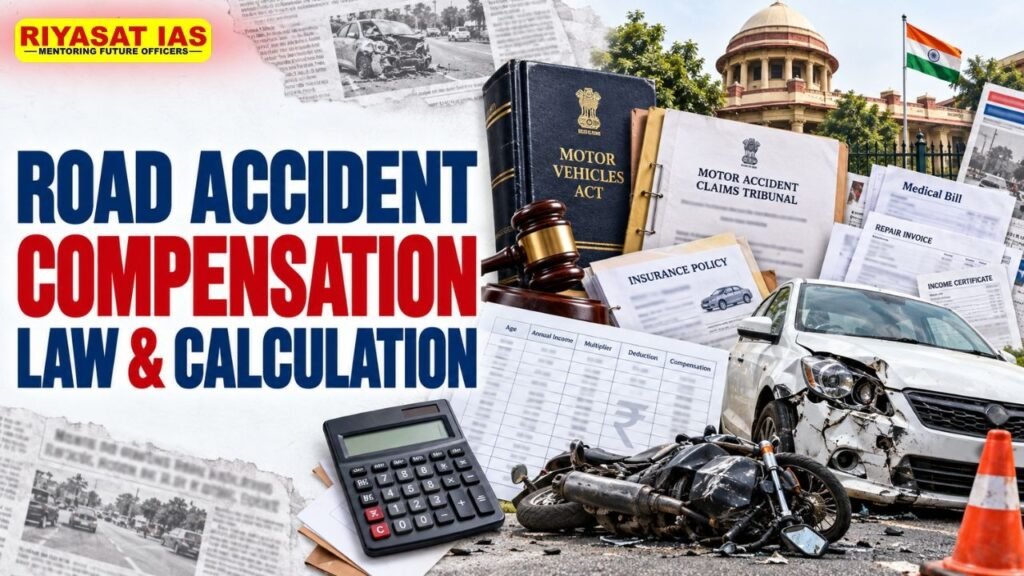
- Road Accidents in India 2024: In a report from the Ministry of Road Transport and Highways (MoRTH), there were almost 4,87,707 road accidents in 2024 that resulted in the deaths of 1,77,175 people and left another 4,71,441 injured.
- Economic Costs: Such accidents in various forms incur huge costs to the economy as well, which are assessed at approximately 3.14% of India’s GDP.
- Compensation Hurdles: The quantification and award as compensation by courts for the harm caused to countless claimants continues to pose challenges.
Legal Framework
- Motor Vehicles Act, 1988: The main motor-accident compensation law, which involves regulation, the road user’s and the vehicle driver’s duties and owner, insurance, liability investigation and compensation.
- Motor Accidents Claims Tribunals (MACTs): Section 165 gives power to State governments to establish MACTs for the determination of claims because of accidents involving motor vehicles.
- Section 166: Injured person and owner of damaged property or legal representatives of a deceased person can file the application.
- Appeals before the High Court – Section 173: Shall be filed within a period of 90 days with deposit as prescribed.
- Reena v. Managing Director, KSRTC (2026): An acquittal in a criminal proceeding does not bar MACT proceeding as the standard for proof is different between the two.
- Liability for Compensation
- Driver / Owner: Liability attaches first to the negligent driver and, by operation of law, the vehicle owner is vicariously liable for their non-discretionary negligence.
- Compulsory Insurance: Insurance is mandatory and third-party insurance has been made compulsory under Section 146.
- Making Insurance Companies Pay: Section 150 imposes liability on insurers to pay third-party judgments, but the defences are restricted and statutory.
- No-Fault Liability: Fixed compensation of ₹5 lakh for death; ₹2.5 lakh for grievous hurt, payable without proof of negligence.



How Compensation Is Calculated in Accidental Deaths
- Section 168: Requires an “appropriate” compensation award.
- Landmark Judgments: Sarla Verma (2009) and Pranay Sethi (2017) laid down standardised formulas and principles.
- Fundamentals: Age of the deceased, yearly income and dependants.
- Income Assessment:
- Income after tax paid.
- If income cannot be substantiated, minimum wages as specified by the State will apply.
- For salaried persons, the ITR of the immediate preceding assessment year should be taken into account.
- For self-employed individuals or business owners, the average income shown in ITRs of the last three years should be considered depending on the case-to-case basis.
- Jitender Kumar (2025): Even a married or earning son/daughter is entitled to get compensation from a parent, irrespective of whether the person is financially dependent upon his elder.
Four Heads of Compensation
- Loss of Income/Dependency: Annual income, adjusted for future prospects and personal-expense deductions, is multiplied by the appropriate multiplier.
- Future Prospects: Consider the business progression of the deceased that they would have been on track to receive.
- Personal-Expense Deduction: Reflects other accrued earnings and spends over deceased needed to live.
- Multiplier: Solely driven on the basis of age of deceased.
- Genus Captures: Estate impairment, internment losses and loss integrity.
- Consortium: Spousal, parental and filial consortium for qualifying relatives.
- Improvement: Traditional quantities are improved by ten percent every three years, as given in Pranay Sethi.
- Interest: Courts are able to award interest pursuant to Section 171, which is usually somewhere from 6%–9%, based on the facts.
Recognition of Unpaid Domestic Work
- Shishu Pal (2026): In which the Supreme Court made an award of at least ₹30,000 per month as notional income for a homemaker under the head “loss of domestic care.”
- Cumulative Enhancement: The amount carries a 10% cumulative enhancement every three years.
- Importance: Household work, such as cooking, cleaning and caregiving, enables the paid workforce.
UPSC Mains Practice Question
Q. Road accident compensation is an important instrument of social justice. Discuss the legal framework governing motor-accident compensation in India and explain how courts determine just compensation in accidental death cases.




 Ravi Raaz
 Hassan Khan
 Shadab Ali