
GS-II – Socio-Economic Development | Government Schemes for Vulnerable Sections | Women
GS-III – Agriculture | Farmers’ Welfare
Why in News?
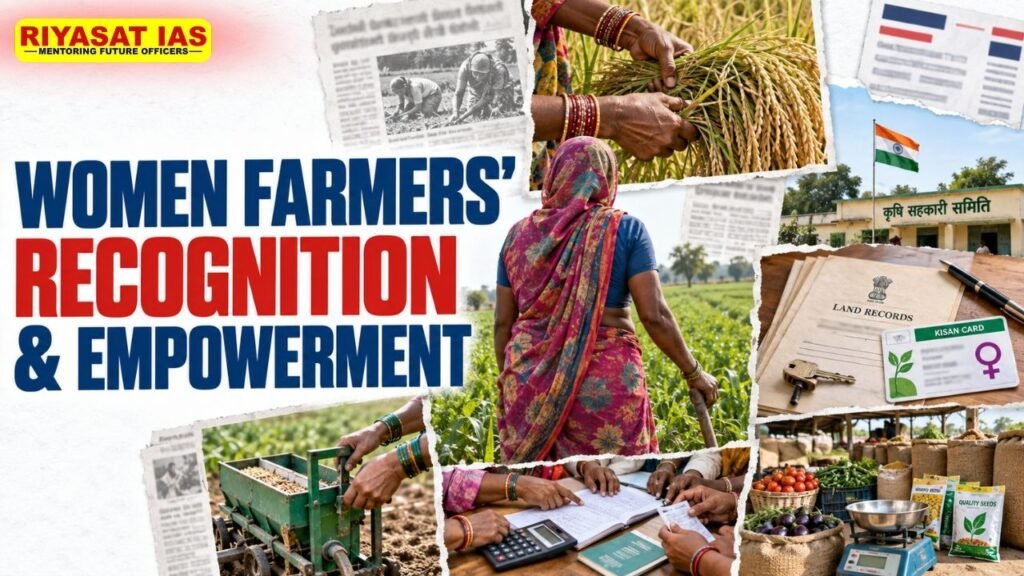
- Maharashtra Women Farmers’ Empowerment Bill, 2026: In July 2026, Maharashtra passed the Women Farmers’ Empowerment Bill at an unprecedented chapter in Indian agrarian policy, which recognizes women as farmers with independent status through a Woman Farmer Certificate beyond land ownership.
- First State Legislation: The first Indian State to publish a legally enforceable activity-based, land-de-linked definition of farmer, which the National Policy for Farmers proposed in 2007 but never gave effect.
- Three Decades of Movements: Truly, the Bill is the final event of civil society-supported women farmers’ movements which are protracted and staggered over the last 30-odd years.
- State-level efforts:
- Kudumbashree collectives in Kerala.
- KALIA scheme for women landless and sharecropper workers in Odisha.
- Recognition Gap: Land records had missed the women farmers’ registry de-linked from land records.
- The important shift: Maharashtra law legally recognizes the person who cultivates land, as opposed to the individual owning agricultural land, and its implications are undeniably impactful.
The Recognition Gap
- Agricultural Workforce: In 2025, approximately 110 million women and 127 million men (rural, PLFS, Census adjusted) were employed in agriculture, the most gender-equal sector.
- Women’s participation: Women’s participation in the agricultural labour force has more than doubled since 2017–18.
- Rural women workers: The share of rural women working in agriculture has remained far higher than males (three-quarters versus less than half).
- Unpaid Work by Gender: In 2025, over 41% of female agricultural workers were unpaid, compared to 20% of men.
- Own-Account Workers: 63% of men were own-account workers in comparison to 39% of women.
- Recognition Gap: While women are farming more, they are not always acknowledged as farmers.
The Worker-Owner Dichotomy
- Family Land: Most women work on family lands, with no title or name in the records.
- Male Registered Land Rights: Most land is owned by males.
- Women’s Land Holdings: 14% of all operational agricultural land holdings (based mainly on land records) are with women (Agricultural Census 2015–16).
- Database Access: The name in the records organises access to organised data within the database that benefits the bearer of that name.
- Scheme Access: Women agricultural workers are not able to avail the key Central-State agricultural schemes and incentives linked to land titles (land records).
- Structural Bias: The ownership structure of land revenue records is also a source of truth for administrative use, and each State thus carries forward its structural bias against women into scheme access and databases.
- Lost Opportunities: This all finally means women farmers are not able to reach out for credit, subsidies, technology, extension services and other related prospects.



PM-KISAN and Gender Gap
- PM-KISAN Beneficiaries: Only 23% of women benefited from the Pradhan Mantri Kisan Samman Nidhi (PM-KISAN), a direct cash transfer scheme for eligible landholding farmer families with income support of ₹6,000 per year as household beneficiaries to meet agricultural expenses and household needs.
- State-Level Disparity: In States where the women’s share in the agricultural workforce is more than 50%, the percentage of women beneficiaries is less than one-third in most states.
- Exceptions:
- Meghalaya, where 70% of beneficiaries are women.
- Kerala is a distant second at 44%.
- NSRI (1999) – Institutional Arrangements: These States have institutional or social arrangements for enhanced recognition/benefits to women in respect of land access and agricultural resources.
- Northeastern States: Customary tenure and matrilineal systems matter.
- Kerala: Collectivity through formations like Kudumbashree affords a different avenue to both participation and recognition.
- The Widest Gaps: More than two-thirds of the workforce in Jammu and Kashmir and Himachal Pradesh are women, but they are awarded a tiny fraction of the benefits.
- Land Is Not a Binding Constraint:
- Binding Constraint: The true binding constraint, therefore, is not land itself, but the identification system that is built upon it.
- Land Record as Gatekeeper: Women are more likely to get filtered out where the land record is the gatekeeper, and this effect increases substantially where an alternative mechanism exists.
Year of the Woman Farmer
- International Year of the Woman Farmer: Maharashtra has made possibly a game-changing first step and set an example for other States, with the United Nations declaring 2026 to be observed as International Year of the Woman Farmer.
- Wide Definitions: The Maharashtra Act goes beyond its definition of ‘agriculture’ and ‘farmer’ by acknowledging any woman resident who has been in agriculture for a minimum of one agricultural season a year, without respect to the nature of the land, through a Woman Farmer Certificate.
- Explicit Recognition of Categories: It specifically identifies:
- Landless cultivator.
- Landless livestock rearer.
- Agricultural labourer.
- Plantation labourer.
- Pastoralist.
- Independent Agricultural Identity: The independent agricultural identity helps women who do not possess land by allowing them to enrol and avail the benefits of State welfare schemes and credit.
Implementation
- Identification: Gram Sabha should identify women farmers, both those with no land as well as agricultural land titles in their name (or self-registration).
- Information Campaign: A strong information campaign will be required in both cases.
- New Database: This also creates a new data bank of female farmers.
- Database Integration: How this database can interface with current agriculture databases and not replicate or exclude existing data is another avenue that needs to be worked on.
- Inter-State Cooperation: This is an opportunity for States to cooperate.
- Standardised System: A standardised system across States, for providing common definitions to identify women farmers, issuance of certificates and fielding databases, would facilitate inter-linkages of women farmer identities across schemes and administrative platforms without the need for multiple registrations.
- Agri Stack: These certificates must be combined with the Agri Stack (digital layer developed by the Union Ministry of Agriculture & Farmers Welfare) to issue Farmer IDs to these women, integrating these deserving souls with the digital agricultural ecosystem.
- Local-Level Actions: Even if the recognition translates into some empowerment, its effectiveness will depend upon local-level initiatives to sensitise women farmers about the schemes and to make them accessible.
UPSC Mains Practice Question
Q. More women participate in agriculture, but they are still not recognized as farmers and do not have equal access to agricultural resources. Examine challenges faced by women involved in farming.


 Ravi Raaz
 Hassan Khan
 Shadab Ali