GS-II – International Relations | United Nations | Global Governance
Why in News?
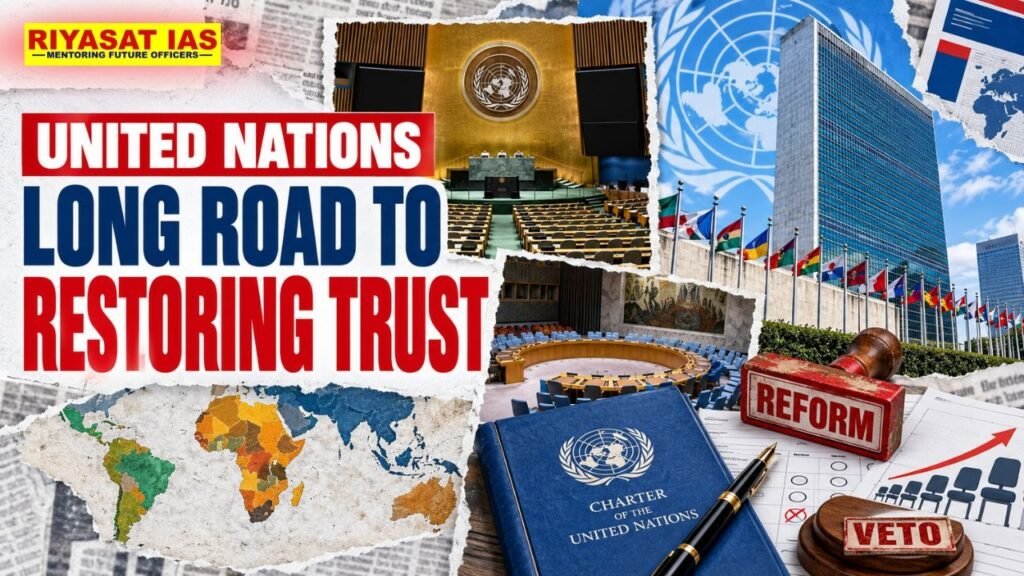
- 81st UN General Assembly: World leaders assembled in New York for the annual high-level week of the 81st United Nations General Assembly and discussed trust — a question that is becoming ever more acute.
- Theme: “Restoring Trust, Managing Transformation: a UN that delivers for all”.
- Requirement for Restoration: The term “Restoration” indicates that there is a gap of trust and the UN itself needs to rekindle its own dimensions.
UN and Trust-Building
- Low-Trust World: The world has always been a low-trust society characterized by conflict between nations driven by mistrust.
- Formation of UN: After the Second World War, UN was formed to make actions of nation-states more predictable.
- Dialogue and International Law: It laid out a platform for dialogue and provided an intricate structure of international law.
- Rules-Based System: The game of thrones would still be played but it would have some laws.
- UN’s Achievement: The UN is perhaps one of the greatest achievements humankind has reached, specifically since it exists to establish and put a path of trust between nations.
Declining Trust in the UN
- Falling Credibility: Increasingly the UN has had difficulty to gain trust — these days its role is questioned by many parties.
- Peacebuilding: UN staff used to design and seed “trust-building” approaches among conflicting parties in the peacebuilding space — today, the organisation needs to rebuild trust in its own approaches.
- Edelman Trust and Pew: Two surveys from last year found that both trust in the UN and favourability toward it had decreased across all countries surveyed.
- UN Foundation Poll: 52% believe the UN is failing to deliver and needs deep structural reform.
- International Law and Human Rights: About two-thirds agree that the UN has been ineffective in enforcing international law and protecting human rights.
- Dominance of Great Powers: Well over half think the UN is dominated by a few great powers.
- Rockefeller Foundation and Focaldata: Just 58% believe the UN can spearhead action to geopolitically tackle global challenges — possibly a record low for the body.



Reasons for Declining Trust
Persistent Deadlock in the UNSC
- UNSC Deadlock: The continued deadlock in the UN Security Council has caused a loss of faith that the General Assembly has in the UNSC.
- Resolution A/76/262: Through a resolution, the Assembly mandated the permanent members of UNSC to justify every use of veto on a case-by-case basis.
Internal Integrity and Accountability
- Internal Procedures: Within the UN itself, there remain questions of corrupt and fully accountable procedures whether in recruitment or procurement or allocation of resources.
- Procurement Scandal: Allegations of procurement irregularities in Afghanistan (2013).
- Sexual Exploitation and Abuse: Cases involving peacekeepers in 2017.
- Projects Existed Only on Paper: Contract for non-existent housing projects in Ghana and India in 2021.
- Systemic Accountability: Where some were held accountable personally but not for the system.
- Challenges: Not much repercussion for individual malfeasance.
Financial Muscle and Influence
- Financial Power: Financial power will come to dominate the UN system in the few countries that have been unwilling or interested in reforming.
- Influence: They exert influence either by lobbying for their citizens to join the system, supplementary non-budgetary grants in support of selective UN programmes or a blend of both.
- ACABQ Report 2024: Eight of nine technical experts for recruitment in one UN agency were sponsored by one government.
- Neutrality: They bring into question whether the policies that the entity encourages a beneficiary country to adopt are truly neutral.
- Limited Transparency: Transparency on programme spending is increasingly available to donor governments, but not necessarily so much for the public of recipient countries.
- Risk-Averse Bureaucracy: The UN bureaucracy has become increasingly risk-averse and unforthcoming as a result of fears that office-holders might offend powerful countries, damaging the prospects of financial contributions and individual careers.
Limited Global South Representation
- Global South: Most of the UN programme implementation is in the Global South, and trust in the UN is higher in the Global South.
- Authority: The Global South holds little decision-making power.
- Population and Leadership: 84% of the world resides in developing nations, yet these countries own only 44% of UN civil service leadership.
- African Representation: Only a third of positions are occupied by Africans in UN leadership across African countries.
- UN Cities: Less than two in five of the cities that host UN entities are located in the Global South.
- Relocation of Posts: In 2025, cities in the Global South again missed out on their cost advantages when thousands of posts were moved from New York and Geneva through a cost-cutting measure by the UN machinery.
UN’s Humanitarian Role and Challenges
- Humanitarian Assistance: The UN delivered global humanitarian assistance and protection in 2025-26 to 98 million people, or just over 1.1% of the world population.
- Challenges: These include the issues of aid effectiveness and the amount of funds that flow to local actors.
- Wars: Tactical interventions in wars like Ukraine, Gaza and Iran.
- Black Sea: It supported the flow of exports of grain through the Black Sea.
- Red Sea: It helped to prevent an oil spill in the Red Sea.
- Restrained Peacemaking: The UN could not capitalize on the goodwill thus earned to establish structures for peace negotiations between the belligerents.
- Centralisation: The responsibility to initiate peacemaking has to a degree become untenably centralised at the top of its bureaucratic hierarchy.
Way Forward
- More Transparency: The UN needs to increase its transparency.
- Rebuild Bridges: It will have to remake its bridges with the peoples of the world, not only governments.
- Hold People Accountable: Make systems accountable instead of just individuals.
- UNSC Deadlock: A persistent deadlock in the UNSC requires redress action.
- Address Financial Clout of Some Countries: Need to check the influence of certain countries due to their financial contributions.
- Make Global South Voices the Standard: Enhance representation of decision makers hailing from the Global South.
- Strengthen Local Actors: The share of funds that is transferred to local actors has to grow.
- Facilitate Peacemaking: The task to facilitate peacemaking should no longer be confined among the apex of the organisation’s bureaucracy.
Conclusion
- Rebuilding Confidence: The UN is one of the greatest accomplishments of humanity because it reaches into, and codifies trust between nations.
- World: The UN needs to improve its transparency and rebuild its relationship with the world’s peoples, as well as their governments.
- Humanity’s Hopes: The United Nations is not merely an inter-governmental organisation. It is a testament to all that humanity’s highest hopes for itself.
- Transformation: The “transformation” that the 81st General Assembly seeks would certainly have to begin with a restoration of trust.
UPSC Mains Practice Question
Q. “The change the 81st General Assembly seeks would necessarily begin by rebuilding trust.” Analyse the decline in trust with the UN and prescribe a way forward.



 Ravi Raaz
 Hassan Khan
 Shadab Ali