
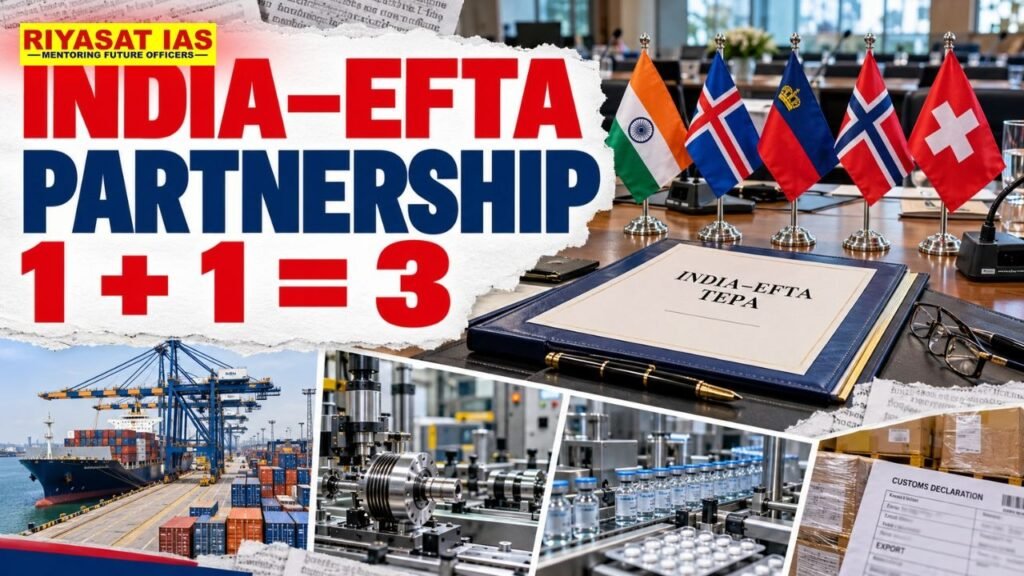
GS-II – International Relations | India-EFTA Bilateral Relations | Trade Agreements | Technology & Investment
Why in News?
- TEPA Entry into Force: On 1 October 2025, the Trade and Economic Partnership Agreement (TEPA) between India and the four members of European Free Trade Association (EFTA), Iceland, Liechtenstein, Norway and Switzerland entered into force.
- One Year of TEPA: One year later, perhaps the more productive question is not how many tariff lines are down, but what sort of partnership that agreement enables.
TEPA: Tariff Concessions
- EFTA concessions: There has been EFTA offers on 92.2% of the tariff lines, covering 99.6% of the value of India exports to EFTA.
- India: India is offering concessions on 82.7% of its tariff lines, accounting for 95.3% of EFTA’s exports value.
- An Ambitious Market Opening: This was one of the more ambitious market-opening exercises attempted between India and a bloc of developed economies.
Investment and Job Creation
- Dedicated Chapter: TEPA was the first trade pact signed by India with a dedicated chapter on investment and employment generation.
- Investment: EFTA economies to increase investment in India by USD 100 billion over 15 years.
- Jobs: The pact is supposed to lead to one million direct jobs.
- Long Term Partnership: The agreement is aimed at creating a long term industrial and technology partnership.
The Collection of Iceland-India Partnering Areas
Geothermal Energy
- Iceland’s Experiences: Iceland has particular experience in the direct use of low to medium enthalpy geothermal heat.
- Utilization in Iceland: Nearly every home has its heat and hot water thanks to geothermal energy; so do fish drying, greenhouses and whole communities from the polar circle can run on community services without using fossil fuels.
- Indian Potential: The following section provides an overview of the Indian geothermal potential and direct-use experience, specifically addressing the potential resources in, and relevance to, northern India’s Himalayan region.



Carbon Capture Utilisation and Storage (CCUS)
- The NITI Aayog Study: According to the study, India could potentially sequester about 750 million tonnes of CO2 annually by 2050.
- R&D Road Map: The Department of Science and Technology has been the guiding force in India’s CCUS research and published India’s first dedicated R&D road map for CCUS in support of 2070 net-zero goal in December 2025.
- Union budget: The Union budget announced an outlay of ₹20,000 crore over the next five years to promote these technologies for scaling up in power, steel, cement, refining and chemicals.
- The public sector companies: ONGC, NTPC and Indian Oil Corporation Limited are pushing the work to ground through feasibility studies, pilot projects and subsurface assessments.
Ocean Economy and Fisheries
- Iceland Experience: North Atlantic fisheries formed around the sustainable management of Iceland’s economy.
- Expertise: This led to a deep expertise in:
- Seafood quality
- Cold-chain logistics
- Value-added processing
- Indian Shores: Icelanders in the throes of spinning North Atlantic catch into local jobs and transferring technology via TEPA concessions.
- Fish Utilisation: Where most fishing nations use only 40% to 60% portions of each fish, Iceland now uses about 90%.
- Value addition: You turn skin, guts and bones into:
- Medical products
- Oils
- Feed
- The Opportunity for India: Create New Values, Jobs and Exports without Catching More Fish. It has to have a different look at what its fleets are already landing.
Climate & Energy: India-Iceland Cooperation
- Climate and energy policy: Climate and energy policy represents a long-term pragmatic partnership among nations.
- Arctic Engagement: Iceland and India both advance their interests in the Arctic with similar ethos.
- Iceland: Iceland is a founding member of the Arctic Council.
- India: Observer since 2013.
- India’s Arctic Policy: India had released its Arctic policy in the year 2022.
- Himadri: Himadri is Indian Research station located at Svalbard.
- Bilateral Channel: As one of the eight Arctic States itself Iceland provides India with a direct, trusted bilateral channel into Arctic governance and research relevant to its multilateral engagement.
- Common Agenda: Energy, Trade and Arctic stewardship are all in the same conversation for Iceland and India.
TEPA and EU-India FTA
- Rules–Based Partnership: As evidenced already, TEPA can deliver an ambitious rules-based partnership between Europe and India on:
- Investment
- Technology
- Jobs
- Energy
- Fisheries
- The changing Arctic requires thinktanks sharing management responsibilities.
- Complementarity: TEPA does not aim to take on, but rather complement the EU-India Free Trade Agreement (FTA).
- Working Model: TEPA is already an operative model of how the next phase of EU-India trade can be.
- Icelandic Math: TEPA and The EU – India FTA is a classic case of “One + One = 3” — not competition, but aggregate.
Conclusion
- Tariffs: TEPA is about much more than tariff reduction — it’s about investment, technology, jobs, energy, fisheries and Arctic stewardship.
- Long-Term Partnership: The agreement lays the groundwork for long-term industrial and technological partnerships.
- An India-EFTA partnership: Shows how trade agreements go beyond traditional approaches to become platforms for cooperation in new and emerging areas.
UPSC Mains Practice Question
Q. Examine the features of TEPA area and how it can be an instrument for promoting investment, technology, jobs, energy cooperation and sustainable development between India and EFTA states.




 Ravi Raaz
 Hassan Khan
 Shadab Ali