
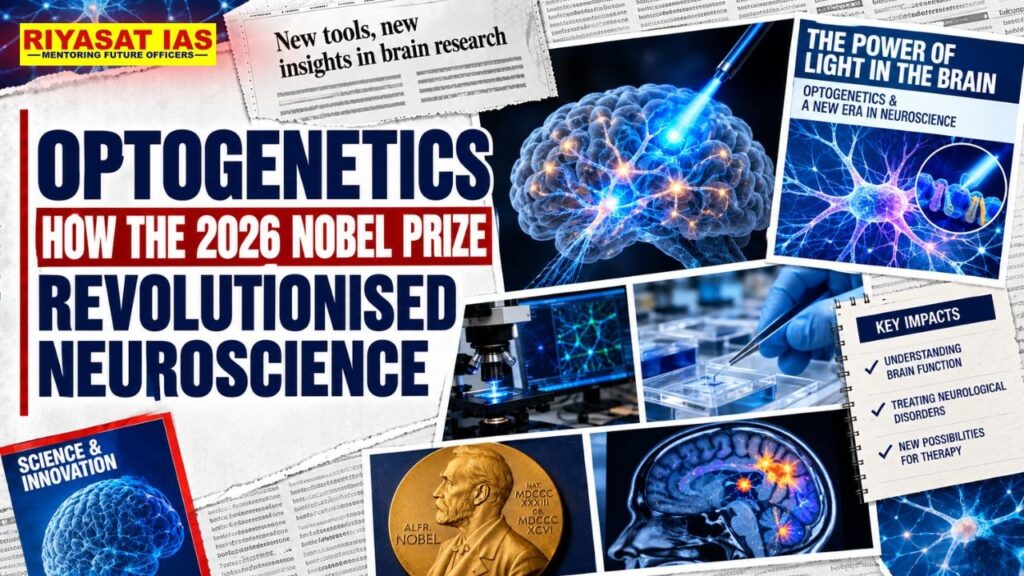
- What is it? This method, called optogenetics—which fuses genetics + light—allows researchers to manipulate the activity of particular cells (especially neurons).
- Fundamental principle: Cells genetically engineered to express opsins, light-sensitive proteins.
- Activation with light: Opsins open or close ion channels when exposed to particular wavelengths of light, stimulating or repressing neuronal activity.
- Common opsins:
- Channelrhodopsin: A tool for primarily blue light activation of neurons.
- Halorhodopsin: Inhibits neuronal activity with yellow light.
- Delivery: Most of the time, light is delivered through optical fibres or an optic-delivery system.
- Use in major: It enables research to relate specific neural circuit properties (morphological and electrophysiological) to behaviours.
- Applications: Research of Memory, Movement, Emotions & Diseases and Brain functions in general.
- Key feature: Its key feature is that, unlike conventional electrical stimulation, optogenetics has both high spatial and temporal precision because only genetically-targeted cells responds to the light.
- Optogenetics: Optogenetics is not just something to do with light and looking at neurons, it involves genetically inserting light sensitive proteins in order to control cellular activity.



UPSC Prelims Question
Q. Optogenetics are statements:
- It is a combination of both genetic modification and light to control a specific cell.
- It uses light-sensitive proteins called opsins.
- It can be a tool for studying the role of specific circuits in neural behaviour.
- It is solely based on electric stimulation of the neurons.
How many of the statements given above are correct?
(a) 1 and 2 only
(b) 1, 2 and 3 only
(c) 2 and 4 only
(d) 1, 3 and 4 only
Answer: (b) 1, 2 and 3 only
Explanation
- Statement 1 — True: Optogenetics fuses genetic engineering with light control of cells.
- Statement 2 — True: It uses light-sensitive proteins called opsins.
- Statement 3 — True: This is particularly useful for exploring selective neural circuits relevant to behaviour.
- Statement 4 — False: Optogenetics is light (not solely electrical stimulation!).
→ UPSC GS Course 2028: Start your UPSC CSE 2028 preparation with the Riyasat IAS GS Foundation Mentorship Program, covering Prelims and Mains fundamentals, NCERTs, GS preparation, answer writing, current affairs, Essay and CSAT with structured mentor support. Explore the UPSC GS Foundation Course 2028





 Ravi Raaz
 Hassan Khan
 Shadab Ali