
GS-II: Federalism | Centre–State Relations | Constitutional Governance
GS-III: Mineral Resources | Mining | Environment | Inclusive Growth
Context
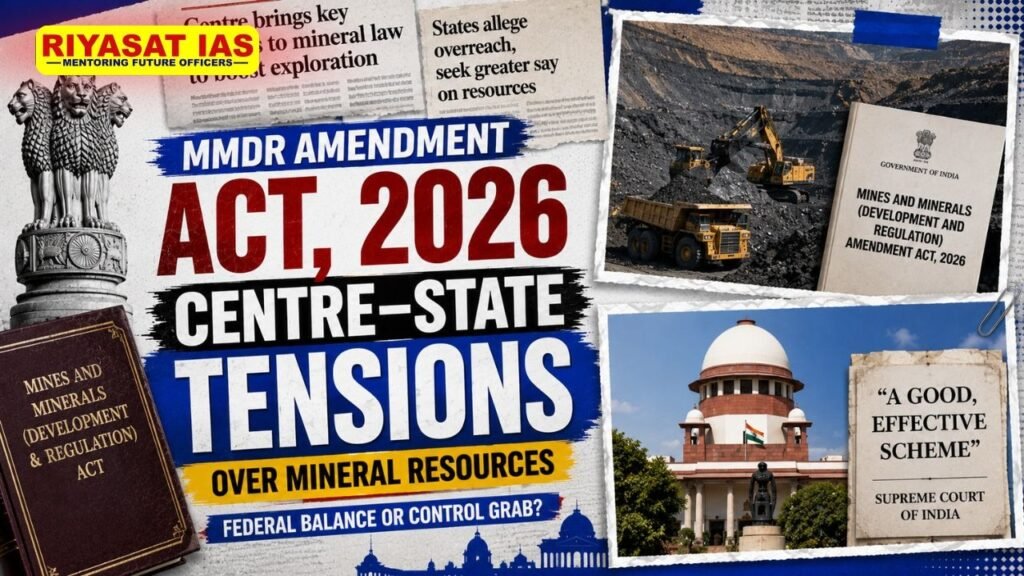
- MMDR Amendment Act, 2026: The Mines and Minerals (Development and Regulation) Amendment Bill, 2026 was passed by both Houses of Parliament on August 13, 2026, and became an Act after receiving the assent of President Droupadi Murmu.
- Mineral Concentration: According to the Ministry of Mines’ 2024–25 Annual Report, around 97.70% of the value of mineral production (excluding atomic, fuel and minor minerals) is concentrated in just eight States.
- Odisha’s Dominance: Odisha contributes the largest share at 43.49%, followed by Rajasthan (16.26%), Chhattisgarh (13.69%) and Karnataka (12.42%).
- Core Debate: The amendment has triggered concerns over greater Union control, State fiscal autonomy, federalism and accountability towards mining-affected communities.
- Human Dimension: Mineral-rich tribal regions often bear the environmental, health and displacement costs of mining while receiving limited benefits from mineral wealth.
What Does the MMDR Amendment, 2026 Change?
- Expansion of Union Control: Section 2 has been amended so that the expression “regulation of mines” is followed by “and mineral-bearing land”.
- Broader Regulatory Domain: The insertion of “mineral-bearing land” potentially expands the Union government’s regulatory control over areas associated with mineral resources.
- Section 9D: The amendment introduces provisions concerning taxes, cesses and other levies on mineral rights/mineral-bearing lands.
- Government’s Position: The Centre argues that the amendment does not take away States’ rights over land and minerals or taxes already collected by States.
- Minor Minerals: The Centre has also clarified that the amendment does not affect minor minerals.
- Underlying Objective: The amendment seeks to prevent heavy and non-uniform taxation from distorting mineral production, supply chains and market efficiency.
Centre’s Rationale
- Avoid Excessive Taxation: Heavy and non-uniform taxes are viewed as increasing the cost of mineral production.
- Supply-Chain Efficiency: Excessive local levies may encourage industries to bypass local supply chains.
- Reduce Transportation Costs: Rationalisation of levies can reduce unnecessary transportation and associated costs.
- Lower Pollution Load: Shorter and more efficient supply chains could reduce transportation-related emissions.
- National Interest: Mineral extraction and management are expected to be guided by long-term national goals rather than fragmented approaches.



Why Odisha Is Concerned
- Mineral Powerhouse: Odisha produced minerals worth around ₹67,955.89 crore in 2024–25, the highest among States.
- Fiscal Dependence: Mining accounted for around 37.59% of Odisha’s projected State revenue for 2026–27.
- Potential Revenue Loss: State stakeholders fear that restrictions on taxation and cess could significantly reduce future fiscal resources.
- Retrospective Dues: Concerns have also been raised regarding the State’s ability to recover certain mining-related dues and penalties.
- Local Development: Mining-related revenues have historically been used for infrastructure, education, employment and development in mining-affected areas.
Federalism Dimension
- Constitutional Concern: Land falls primarily within the State domain, while regulation of mines and mineral development involves significant Union legislative and regulatory powers.
- Division of Powers: Mining therefore represents an area where Union and State jurisdictions overlap.
- Fiscal Federalism: Restrictions on State levies raise questions regarding the financial autonomy of mineral-rich States.
- Accountability: If regulatory powers shift towards the Centre while environmental and social consequences remain local, democratic accountability may become blurred.
- Cooperative Federalism: Mineral governance requires coordination rather than excessive centralisation, particularly where resource extraction directly affects State communities.
Environmental and Social Costs
- Mining-Affected Communities: Tribal and rural communities frequently live close to mineral-bearing regions and bear the consequences of extraction.
- Displacement: Mining projects can result in land acquisition, displacement and livelihood disruption.
- Pollution: Mining can contaminate water, soil and air, particularly where environmental safeguards are weak.
- Health Burden: The Sukinda Valley, rich in chromite resources, illustrates concerns regarding pollution associated with mining.
- Intergenerational Impact: Environmental damage can continue even after individual mines are closed.
- Tribal Communities: Many mineral-rich areas are inhabited by ST communities, raising concerns regarding livelihood security, rehabilitation and benefit-sharing.
Case Study: Odisha’s ORISED Act
- Objective: The Odisha government enacted the Odisha Rural Infrastructure and Socio Economic Development (ORISED) Act to raise resources for development in mining-affected areas.
- Legal Challenge: Mining companies challenged the legislation, leading to prolonged litigation.
- Development Focus: Revenues were intended for infrastructure, education and employment in affected regions.
- Federal Question: The episode highlights the continuing tension between State fiscal powers and the Union’s role in regulating mineral development.
Key Concerns
- Centralisation of Power: States fear that expanding Union control over mineral-bearing lands could weaken their regulatory authority.
- Fiscal Autonomy: Mineral-rich States may lose an important source of revenue.
- Local Accountability: Communities may find it difficult to identify which level of government is responsible for environmental and social consequences.
- Tribal Welfare: Reduced State fiscal capacity could constrain programmes targeted at mining-affected tribal communities.
- Environmental Justice: The communities bearing the costs of mining must have a greater role in decisions concerning resource extraction.
- Unequal Distribution: Mineral wealth is geographically concentrated, while environmental costs are often concentrated among vulnerable communities.
Way Forward
- Cooperative Federalism: Establish stronger institutional mechanisms for Centre–State consultation on mineral taxation and regulation.
- Protect Fiscal Space: Ensure that mineral-rich States retain adequate fiscal resources for local development and rehabilitation.
- Benefit Sharing: Strengthen mechanisms such as the District Mineral Foundation (DMF) to ensure mining revenues reach affected communities.
- Tribal Participation: Ensure meaningful participation of Gram Sabhas and tribal communities in decisions affecting their land and livelihoods.
- Environmental Safeguards: Strengthen monitoring of pollution, mine closure, ecological restoration and compliance with environmental clearances.
- Transparent Revenue Framework: Clearly define the respective powers of the Centre and States regarding taxes, cesses, royalties and other mineral-related revenues.
- Accountability Mechanism: The government exercising greater regulatory authority should also bear clear responsibility for environmental protection and social rehabilitation.
- Sustainable Mining: Shift from extraction-centric mining towards resource efficiency, ecological restoration and intergenerational equity.
Conclusion
The MMDR Amendment Act, 2026 seeks to create a more uniform and nationally coordinated framework for mineral development, but its implementation raises important questions of fiscal federalism, State autonomy and environmental justice.
For mineral-rich States such as Odisha, the issue is not merely about revenue. It concerns who controls natural resources, who benefits from them and who bears their social and environmental costs. India therefore needs a mineral governance framework based on cooperative federalism, transparent revenue sharing, tribal participation and sustainable extraction.
UPSC Mains Practice Question
Q. “India’s mineral governance requires a balance between national interests, State fiscal autonomy and the rights of mining-affected communities.” Discuss in the light of the MMDR Amendment Act, 2026.


 Ravi Raaz
 Hassan Khan
 Shadab Ali